BPC-157 can be shipped internationally for laboratory research only where the specific export, import, and carrier requirements permit the shipment. A research-use label does not establish permission: you need destination-specific confirmation and the required documentation before dispatch.
- Can BPC-157 be shipped internationally for research? Only when the destination, export rules, and carrier permit the shipment.
- A research-use label is not an import permit or a customs clearance guarantee.
- Southwestaminos lists BPC157; confirm the specific international route before arranging a laboratory purchase.
- Match the material identity, shipment documents, and receiving laboratory records before dispatch.
Can BPC-157 be shipped internationally for research use?
There is no universal international shipping permission for BPC-157. The answer depends on the origin, destination, exact material, intended laboratory work, and parties responsible for the shipment. For a 2026 purchase, verify the rules that apply when the parcel will actually cross the border.
Use these checks in order rather than treating checkout acceptance as clearance:
- Confirm destination requirements. Ask the relevant customs authority and, where applicable, the authority responsible for chemical or pharmaceutical imports how the material is classified.
- Confirm export requirements. Establish whether the origin country imposes restrictions or documentation requirements on the proposed transaction.
- Identify the importer. Name the party responsible for the import declaration and confirm that it can fulfill that role.
- Check carrier acceptance. Confirm that the carrier accepts the accurately described material on the proposed route.
- Approve the documentation. Have your laboratory’s procurement or compliance team review the shipment before release.
For institutional purchases, the peptide procurement and institutional compliance review guide provides a related workflow. Internal approval and border permission are separate checks; neither replaces the other.
Why this matters
International shipment involves different decisions: whether a seller accepts an order, whether a carrier accepts a parcel, and whether the destination permits entry. An affirmative answer at one stage does not settle the others.
For your 2026 laboratory procurement file, record the basis for each decision. A dated authority response tied to the exact material and destination is more useful than a general statement that a supplier ships internationally.
Research intent describes the purpose of the purchase; it does not determine the legal outcome. Keep the shipment description strictly laboratory-focused and accurate, without human-use claims or language suggesting treatment.
What evidence supports an international shipment?
Different documents answer different questions. A certificate of analysis addresses analytical information about a sample or batch; it does not authorize importation. Likewise, a tracking event records movement, not necessarily final customs release.
Use the following table to keep those boundaries clear when reviewing a proposed shipment.
| Evidence or record | Best for | What it does not establish |
|---|---|---|
| Written destination-authority guidance | Understanding the applicable import requirements | Permission for a different material, recipient, or destination |
| Applicable permit or authorization, if required | Documenting permission within its stated scope | Automatic acceptance outside its conditions |
| Carrier confirmation | Checking acceptance of the declared shipment and route | Customs permission or laboratory suitability |
| Commercial invoice | Describing the transaction for shipment processing | Analytical identity or import authorization by itself |
| Batch-linked certificate of analysis | Reviewing reported analytical results for the identified batch | Legal entry or suitability for every experiment |
| Laboratory receiving record | Documenting what arrived and how it was accepted | Proof that every earlier shipping decision was correct |
Ask what each record proves before relying on it. When a document answers a different question from the one holding up approval, obtain the correct evidence rather than adding unrelated paperwork.
Why international BPC-157 shipping requirements vary
The relevant questions follow the actual shipment, not just the name on a product page. These factors define the review:
- Destination jurisdiction. The receiving country’s classification and import requirements govern the entry decision.
- Origin jurisdiction. Export requirements must be checked independently of destination permission.
- Material identity and composition. Review the exact substance and formulation being shipped, not merely a shortened product name.
- Recipient and importer roles. Confirm who receives the material and who accepts responsibility for the import declaration.
- Declared laboratory purpose. Describe the actual research activity consistently across procurement and shipment records.
- Carrier and route. Confirm acceptance for the planned transport service, including any relevant transit arrangements.
A previous delivery is not a substitute for reviewing a new transaction. A different recipient, formulation, or route creates a different fact pattern, even when the product name stays the same.
Do not extrapolate a BPC-157 shipping decision to Retatrutide, Tirzepatide, or a peptide blend. Review each material separately and keep every assessment limited to laboratory research.
What should your laboratory verify before dispatch?
Build the review around the actual material and receiving organization. For a 2026 order, ask for current documents that identify the shipment clearly enough for procurement, the carrier, and the receiving laboratory to reconcile their records.
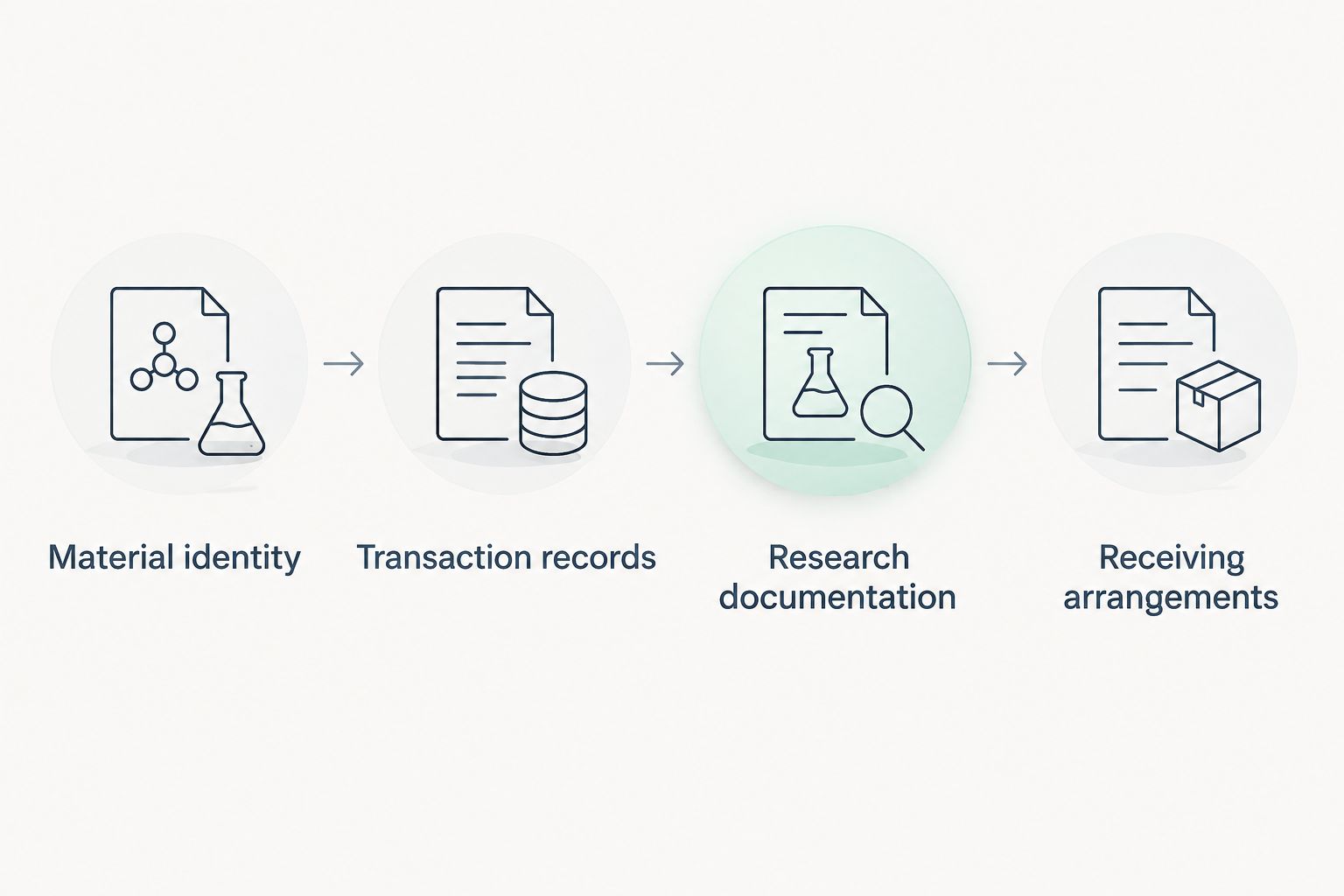
Material identity
Record the exact material name, composition information supplied for the order, and batch identifier when assigned. Preserve the supplier’s terminology while resolving any differences between the purchase order and supporting documents.
Do not assume that a familiar abbreviation supplies every detail needed for classification. Ask the relevant authority or customs professional which identifying information is necessary for the specific import review.
Transaction records
Check that the invoice identifies the seller, consignee, goods, quantity, and transaction information required for the shipment. The description must be accurate and consistent with the laboratory purpose.
Do not describe a peptide as an unrelated commodity to simplify processing. If a customs professional recommends a classification, retain the reasoning and supporting material in the procurement file.
Research documentation
Prepare a factual explanation of the receiving laboratory’s intended work when requested. Keep it specific to the research project and consistent with institutional approvals.
A statement of laboratory use supports the factual record; it does not override a restriction. Never substitute a purpose statement for an authorization that the relevant authority requires.
Receiving arrangements
Assign responsibility for customs questions, delivery acceptance, document review, and any receiving discrepancy. Ensure the recipient knows how to access the shipment records before the parcel leaves the origin.
Resolve unanswered permission questions before dispatch, not after a tracking alert. This keeps the decision with the people responsible for procurement rather than leaving it to whoever first receives a carrier message.
Does “research use only” mean customs will allow BPC-157?
“Research use only” does not establish customs permission. It describes the stated use of the material, but the relevant authorities still determine how the actual shipment is treated.
Treat laboratory-use wording as a factual declaration, not a workaround. It must agree with the purchase records, recipient details, and intended research activity.
If an authority requests an authorization or additional evidence, answer that request directly. Repeating the research-use statement does not resolve a separate documentation requirement.
Can a certificate of analysis clear a BPC-157 shipment?
A certificate of analysis is not an import authorization. It reports analytical information and can support a material review, but it does not replace an entry requirement.
Check whether the document identifies the batch associated with your order and states the methods behind its reported results. A headline purity result alone does not answer every question about identity, composition, or suitability for your laboratory protocol.
Keep analytical review and customs review separate in your records. Both matter, but approval in one category does not constitute approval in the other.
Does successful delivery prove BPC-157 is ready for research?
Successful delivery does not establish analytical suitability. Your laboratory still needs to reconcile the received material with the approved order and its acceptance criteria.
Inspect the shipment, record discrepancies, and follow the material-specific handling information supplied with it. Do not invent a storage temperature or transport tolerance from the peptide name alone.
Document any unresolved concern before releasing the material into laboratory inventory. Customs release, physical receipt, and research acceptance should remain distinguishable decisions.
What should you ask Southwestaminos before ordering?
Southwestaminos is a research peptide seller for buyers evaluating BPC157 for laboratory work. A seller’s product listing is not evidence that a particular international shipment is permitted.
Ask Southwestaminos whether the proposed destination and receiving organization can be assessed for the specific order. Request the material description and supporting documentation needed by your laboratory, customs professional, and carrier; do not assume which documents or shipping arrangements the seller provides.
Evaluate the response against the same approval checklist used for any research supplier. The useful question is not simply whether international shipping exists, but whether your exact transaction has a documented, acceptable route.
How should you record the shipping decision?
Keep a single shipment file that connects procurement approval to laboratory receipt. For a 2026 transaction, date the decision and retain the correspondence supporting it, including any conditions imposed by an authority or transport provider.
Your file should identify:
- The material and transaction under review.
- The origin, destination, consignee, and responsible importer.
- The source of each regulatory or carrier confirmation.
- Any required authorization and its applicable conditions.
- The approved shipment documents.
- The receiving decision and unresolved discrepancies.
Separate confirmed facts from open questions. If permission remains unresolved, hold the dispatch decision rather than interpreting silence, an accepted payment, or a generated shipping label as approval.
FAQ
Can BPC-157 be shipped internationally for research in 2026?
BPC-157 can be shipped internationally for laboratory research only where the applicable export, import, and carrier requirements permit the specific shipment. Confirm the destination, material, recipient, and documentation before dispatch.
Does a research-use-only label make BPC-157 legal to import?
A research-use-only label does not establish legal permission to import BPC-157. The relevant authority determines the requirements for the actual material, destination, and transaction.
Do I need an import permit for laboratory BPC-157?
The permit requirement depends on the destination’s treatment of the specific shipment. Ask the responsible authority whether authorization is required and obtain any required permission before dispatch.
Can I use a certificate of analysis instead of import paperwork?
A certificate of analysis does not replace required import paperwork. It supports analytical review, while import documentation addresses the shipment’s entry requirements.
Does Southwestaminos ship BPC-157 to my country?
Confirm the proposed destination directly with Southwestaminos before arranging a laboratory purchase. A product listing does not establish destination-specific shipping acceptance or customs permission.
Can I apply BPC-157 shipping guidance to Retatrutide or Tirzepatide?
Do not apply a BPC-157 shipping decision automatically to Retatrutide or Tirzepatide. Each material requires its own destination-specific assessment for laboratory research.
Does customs clearance mean my laboratory can accept the material?
Customs clearance does not establish laboratory acceptance. Your laboratory must still reconcile the shipment, review the relevant analytical records, and apply its own receiving criteria.
One last thing
The most useful pre-dispatch question is: Who can document permission for this exact shipment? A supplier, carrier, customs professional, and laboratory each answer different parts of that question.
For your next 2026 research purchase, assign an owner to every unresolved item before authorizing dispatch. A complete parcel-tracking history cannot repair an incomplete permission decision.