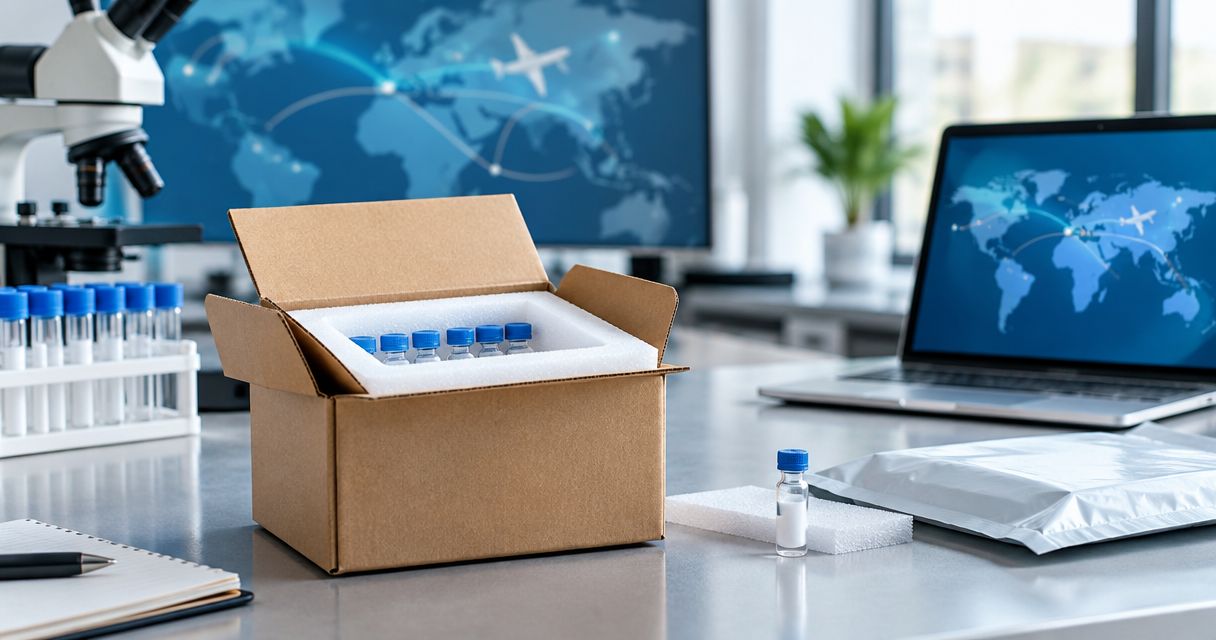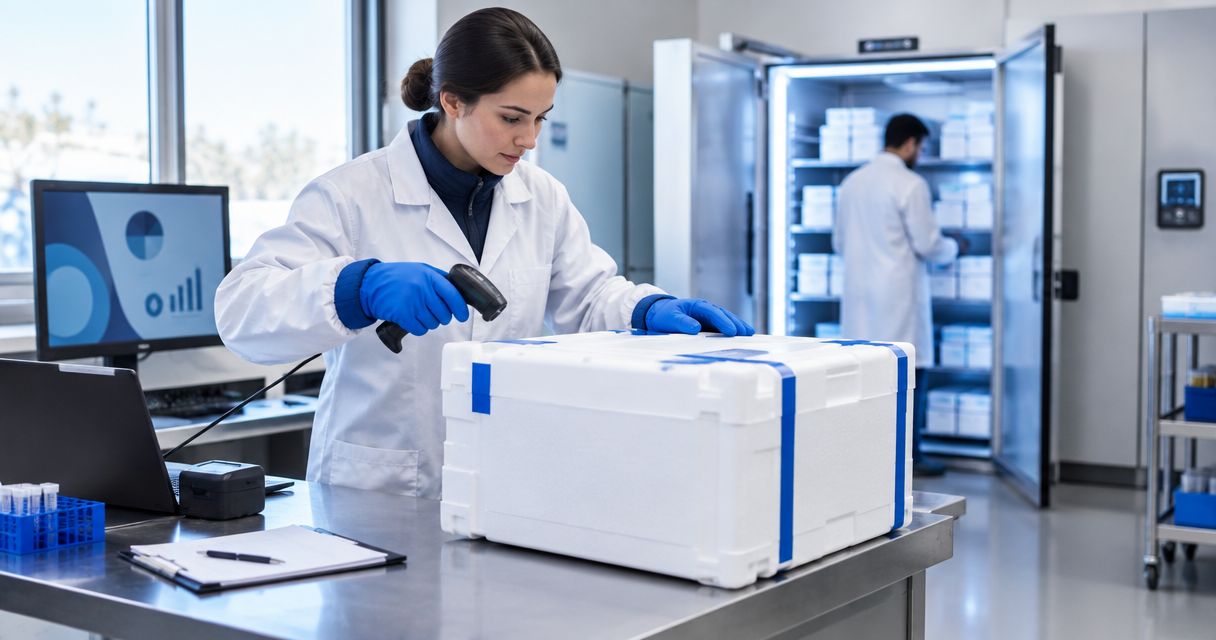
Instead of reconstructing shipment history after a package reaches the freezer, use a peptide cold chain receiving workflow that connects the order, arrival evidence, storage location, and release decision. This 2026 guide shows you how to build that laboratory receiving record without assuming that every peptide requires the same shipping or storage conditions.
- A peptide cold chain receiving workflow starts with documented material requirements, not a universal freezer setting.
- Southwestaminos research peptides belong in laboratory procurement workflows, not human-use workflows.
- Record arrival condition and temperature evidence separately; packaging appearance does not establish shipment temperature history.
- Separate storage placement from release so unresolved shipments cannot enter experiments.
Why this matters
Putting a shipment in a freezer does not establish that it arrived within its documented limits. Receiving must preserve the evidence needed to decide whether the material meets your laboratory's acceptance criteria.
Southwestaminos sells research peptides, including Retatrutide and Tirzepatide. That catalog description does not establish a shipment's packaging configuration, transit limits, or lot-specific storage requirements; obtain the applicable documentation before receipt.
A useful 2026 receiving record answers distinct questions: what arrived, what evidence accompanied it, where it went, and who authorized its laboratory use. Keeping those answers separate prevents an inventory entry from becoming an accidental release decision.
This guide covers laboratory receiving and traceability only. It does not provide preparation, dosing, administration, or human-use instructions.
Before you start
- Access and ownership: Assign a receiving owner and backup. Give them access to the purchase record, delivery notifications, shipment documents, and your laboratory's approved receiving procedure.
- Materials and storage: Prepare an inventory record, identification labels, an approved storage location, and any equipment required by your laboratory's safety procedures. Confirm material-specific storage instructions before assigning that location.
- The gotcha: A temperature requirement is not an excursion allowance. If transit acceptance limits, monitoring requirements, or permitted excursions are undefined, arrange a documented hold-and-review route before delivery rather than inventing a rule at the receiving bench.
The bold labels below are suggested fields for your own receiving template, not buttons or settings in a Southwestaminos system. Use equivalent fields in your existing laboratory records rather than creating a competing inventory system.
Order record configuration
Establish the receiving criteria
- Create Receipt ID and link it to Order reference. Use one receiving record per shipment, then connect individual containers and lots beneath it. Split deliveries need separate arrival records even when they share a purchase order.
- Enter Expected material, Expected quantity, and Expected documentation. Copy identifiers from the order and supporting records rather than shortening names from memory. Keep the ordered description separate from the description observed on arrival.
- Complete Storage requirement, Transit acceptance criteria, and Review owner using applicable documentation and your approved procedure. Identify the source and revision of each requirement. If a requirement remains unresolved, set Receiving status to Hold pending review.
Expected result: Before delivery, the receiving owner knows what evidence to collect, where to place the material, and who decides whether discrepancies are acceptable.
For 2026 procurement, keep the requirements tied to the material and lot rather than treating an older order as permanent authorization. A repeat product name is not proof that the supporting documents or shipment arrangements are unchanged.
For broader purchasing context, the research peptides guide for university biochemistry labs complements this receiving process. Keep purchasing evaluation separate from the evidence required to accept an individual shipment.
Arrival record configuration
Capture the shipment evidence
- Record Arrival time, Receiving operator, and Shipment reference when custody transfers to your laboratory. Identify the actual handoff point. A carrier delivery event and a laboratory receiving event are different records when a mailroom or loading dock sits between them.
- Record Packaging condition, Container condition, Observed identifiers, and Observed quantity. Photograph damage or discrepancies when your procedure permits. Follow local safety procedures for leaking, broken, or otherwise unsafe packages; do not continue routine receiving simply to finish the form.
- Attach Temperature evidence and record its source. If a logger accompanies the shipment, preserve the original file and device identity according to its instructions. If no transit record exists, record that fact rather than converting a cool package or frozen coolant into evidence of the full journey.
Expected result: The arrival record distinguishes what you observed from what the shipment documentation establishes.
A single arrival reading cannot reconstruct the transit temperature history. Record the measurement method and location so reviewers can distinguish a package-surface observation from a shipment logger record.
Do not assign universal temperature thresholds in the template. The acceptance rule must come from the applicable material documentation and approved laboratory procedure, not from a generic peptide storage article.
Storage and status configuration
Separate placement from release
- Assign Storage location using the documented requirement. Record the equipment identifier and the rack, box, and position used by your laboratory. Confirm the receiving location is suitable before moving material there; a freezer label alone does not verify its operating condition.
- Record Storage placement time separately from Arrival time. These two timestamps reveal the interval between laboratory receipt and storage placement without imposing an unsupported universal handling limit. Record any intermediate custody or storage location that affects interpretation.
- Set Material status to Hold, Released, or Rejected under your procedure. Restrict held material from experimental allocation while maintaining its documented storage conditions. Use a physical separation method or inventory control that staff can reliably recognize.
Expected result: Every container has a retrievable location and an explicit status; placement in storage does not automatically authorize laboratory use.
The core sequence is Order record, Arrival evidence, Storage placement, and Release decision. Keep these stages connected even when different staff members perform them.
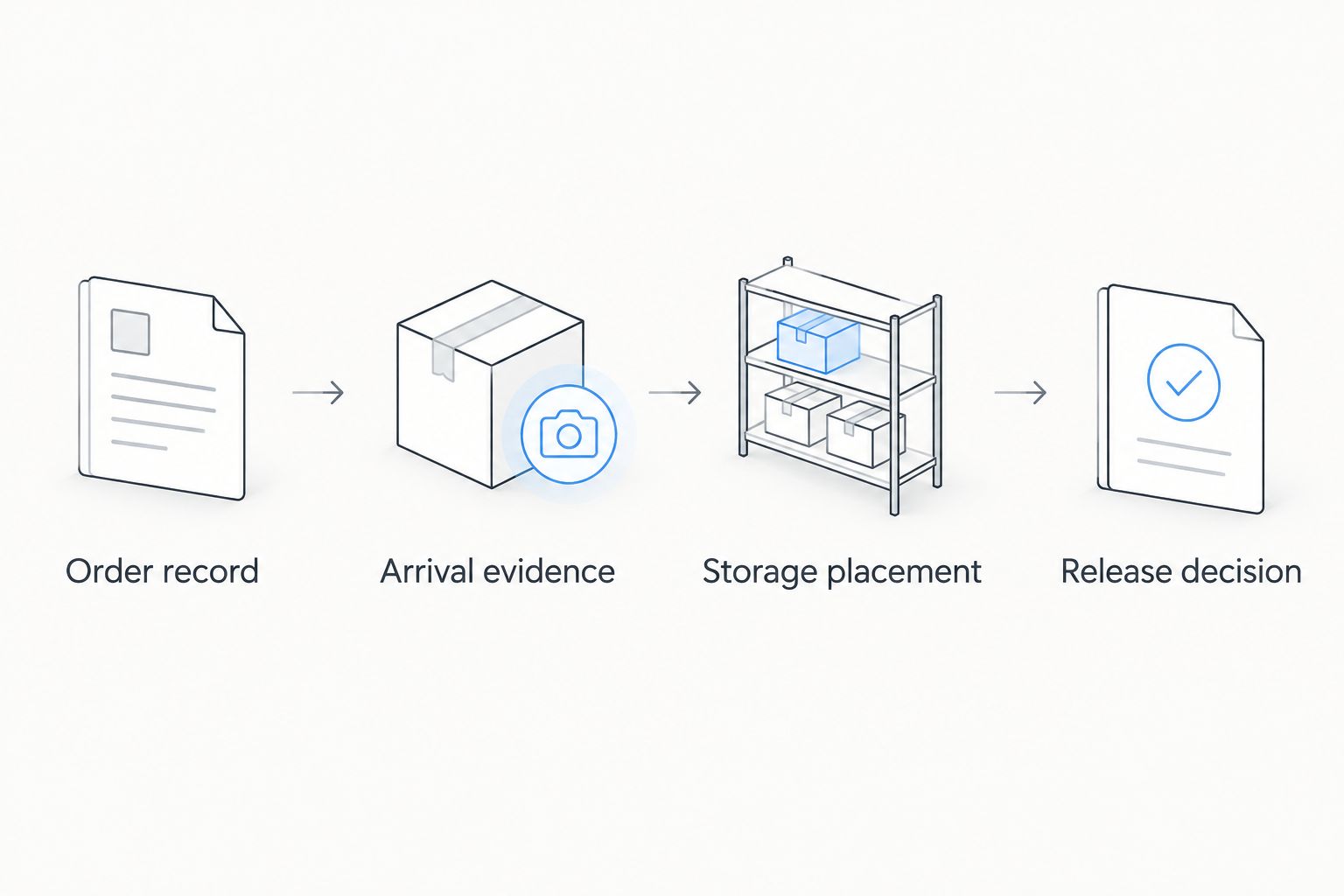
A 2026 receiving template should preserve both physical location and decision history. If a shipment is held, the inventory record must show where it is and why it remains unavailable for experiments.
Release record configuration
Document the disposition
- Compare Observed identifiers, Observed quantity, Temperature evidence, and required documents against the recorded acceptance criteria. Check that certificates and supporting files identify the relevant lot. A document for a different lot does not resolve a missing lot-specific record.
- Enter Discrepancy, Assessment reference, and Disposition rationale for anything outside the routine acceptance route. Preserve the original observations. Attach subsequent explanations or corrected documents as additions rather than overwriting the arrival record.
- Have the authorized reviewer complete Decision, Reviewer, and Decision time. Release material only through the laboratory's approved process. For rejected material, follow institutional instructions for return or disposal while preserving the receiving history.
Expected result: Another laboratory staff member can reconstruct the acceptance decision without relying on the receiver's memory.
For Southwestaminos research peptides, the same principle applies: the supplier name identifies the source, while shipment evidence and your approved criteria support the receiving decision. Neither brand familiarity nor a previous acceptable delivery replaces shipment-level review.
Repeat-order workflow: reuse the template, not the decision
A repeat delivery can reuse approved field definitions and routing rules. It still needs its own arrival evidence, lot references, storage placement, and release decision.
| Receiving route | Best for | Advantage | Limitation |
|---|---|---|---|
| New-material review | A material entering your laboratory for the first time | Establishes requirements before routine receiving begins | Requires requirement review before acceptance |
| Repeat-order template | An established material with current, approved criteria | Reuses field structure and review ownership | Can conceal changed documents if staff copy old values |
| Exception hold | A shipment with unresolved damage, identity, or temperature evidence | Prevents unresolved material from entering experiments | Delays release until the authorized review is complete |
Use the following variant whenever an order or supporting document changes:
- Update Expected documentation and identify the changed source or revision.
- Ask the review owner whether Storage requirement or Transit acceptance criteria also needs revision.
- Preserve the prior version and apply the approved revision to the relevant shipment records.
Do not retroactively rewrite an arrival observation to match a revised expectation. Your 2026 template should make document updates traceable without erasing what staff actually received.
Troubleshooting
The package feels warm, but there is no logger record
Place the shipment on hold under the documented storage conditions and preserve the available evidence. Ask for applicable shipment records and an assessment against documented criteria; touch alone cannot establish the duration or extent of an excursion.
Do not assume either acceptance or rejection solely from package feel. The authorized reviewer must document the disposition.
The certificate identifies a different lot
Keep the material on hold and request the document corresponding to the observed container identifier. Record both the mismatch and the corrected document when received; do not rename a file to make it appear matched.
A certificate and a temperature record answer different questions. Correct analytical documentation does not resolve an unexplained transit excursion.
The assigned freezer is unavailable
Use an alternative location only if it meets the documented requirement and your laboratory authorizes it. Record the actual location and any later transfer, rather than leaving the original destination in the inventory record.
Escalate the storage problem immediately if no suitable location exists. Do not substitute an arbitrary temperature setting.
The delivery arrived outside staffed receiving hours
Reconstruct the custody path using delivery records, access records, and available monitoring evidence. Record the confirmed facts separately from unknown intervals and keep the shipment on hold until review.
For subsequent orders, align delivery arrangements with a receiving owner and a documented backup. A delivery notification is not confirmation of controlled laboratory custody.
One shipment contains several lots
Create container-level or lot-level entries beneath the shipment record. Attach each document to the correct identifier and assign disposition at the level supported by the evidence.
Do not apply one lot's acceptance automatically to another. Preserve their separate storage locations when the laboratory inventory requires that detail.
Customize your workflow
Expand the receiving process by connecting Receipt ID to experimental inventory, document retention, and exception review. The useful connection is traceability: staff should be able to move from a container identifier to its receipt and disposition without searching unrelated email threads.
For Retatrutide and Tirzepatide research procurement, retain separate material identities and applicable documentation. Do not copy storage or acceptance criteria between them merely because both appear in the same research catalog.
Before adopting the template, run a tabletop exercise using three records: a matching shipment, a document mismatch, and an unresolved temperature history. Check whether staff can identify the storage location, hold status, and review owner for each scenario.
FAQ
What is a peptide cold chain receiving workflow?
A peptide cold chain receiving workflow connects order requirements, arrival evidence, documented storage, and an authorized release decision. It preserves the records needed to assess each shipment for laboratory research use.
Should every research peptide go straight into the same freezer?
No. Assign storage using the applicable material documentation and your laboratory's approved procedure, not a universal peptide temperature rule.
Does a cold package prove that a peptide shipment stayed within limits?
No. A cold package describes its condition at observation, not its complete transit temperature history. Evaluate available monitoring records against documented acceptance criteria.
What should I do if a temperature logger is missing?
Record the missing logger and follow the hold-and-review route when monitoring evidence is required. Request the relevant shipment records rather than assuming the shipment met its limits.
Can I release research material while its certificate is being corrected?
Keep material on hold when a required acceptance document remains unresolved. Release requires the authorized decision specified by your laboratory's procedure.
Can Retatrutide and Tirzepatide share one receiving template?
Retatrutide and Tirzepatide can share a receiving template structure, but their material identities and applicable requirements must remain separate. Shared fields do not establish shared storage conditions or acceptance limits.
What records should I keep for a Southwestaminos shipment?
Keep the order reference, observed material and lot identifiers, arrival evidence, applicable documents, storage location, and disposition record. These records support laboratory traceability without implying suitability for human use.
One last thing
A storage location answers where the material is; a release record answers whether your laboratory has accepted it. Make those separate fields in your 2026 inventory template, then check that held containers cannot be selected for experiments simply because they have a freezer position.