
Third-party purity testing is not a blanket requirement for every laboratory research-peptide purchase; your institution’s rules, study protocol, contractual obligations, and applicable regulatory framework determine whether it is mandatory. Independent testing also does not establish identity, quantity, or suitability unless the methods address those questions. For a 2026 purchasing decision, separate what your laboratory requires from what the supplier’s report actually proves.
- Is third-party purity testing required for research peptides? Your laboratory’s applicable requirements determine the answer—not a universal purchasing rule.
- Retatrutide and Tirzepatide research purchases need batch-specific evidence; a purity percentage alone does not establish identity.
- Independent testing adds scrutiny, but sampling, analytical methods, and traceability determine what the results support.
- Accept research material against written specifications, not supplier slogans or an unexplained certificate of analysis.
Is third-party purity testing required for research peptides?
Independent testing is mandatory when a requirement governing your purchase or study makes it mandatory. Do not treat either a supplier’s testing policy or the words research use only as a substitute for your own compliance review.
When evaluating Southwestaminos or another research-peptide seller, establish your acceptance criteria before deciding whether a report is sufficient. Start with these sources of requirements:
- Institutional policy: Check purchasing, quality assurance, and laboratory procedures for external-testing requirements.
- Study protocol: Identify required identity, purity, content, and other material specifications.
- Contractual obligations: Review sponsor agreements and purchasing specifications for required independent verification.
- Applicable framework: Have your quality or compliance lead identify the rules governing the specific research activity.
If none requires an external laboratory, third-party analysis remains a quality-control decision rather than an automatic purchasing obligation. That does not make undocumented material acceptable: your laboratory still needs evidence supporting the specifications it has chosen.
Why this matters
A certificate of analysis, or COA, is a report of stated tests and results—not proof of every attribute a research project needs. A chromatographic purity result cannot answer an identity question simply because both appear on the same document.
For 2026 procurement, keep 3 document checks separate: who tested the sample, what the method measured, and which batch the result represents. A report can satisfy one check while failing another, so assess each independently before releasing material into an experiment.
This distinction matters for reproducibility. If an experiment produces an unexpected result, your records should let you investigate the material rather than reconstruct its provenance after the fact.
What does each type of testing actually establish?
Select analytical evidence by the question it answers. Independent ownership of a laboratory does not expand the scope of its analytical method.
The following comparison separates common evidence types. The best-for labels describe the testing approach, not a supplier endorsement or a substitute for method review.
| Evidence or approach | Best for | What it supports | Main limitation |
|---|---|---|---|
| Supplier-issued COA | Initial document review | Results and specifications reported by the supplier | Issuance alone does not establish independent testing |
| Third-party HPLC purity analysis | Assessing chromatographic purity | Relative detected peak areas under the stated method | Does not independently establish identity or absolute peptide content |
| Mass spectrometry | Checking molecular-mass consistency | Whether observed mass data support the expected material | Mass agreement alone does not establish complete structural identity or purity |
| Quantitative content assay | Assessing peptide amount | Quantity measured by the specified analytical approach | Requires suitable calibration and a clearly defined reporting basis |
| Independent testing of a received sample | Checking material from your shipment | Results for the submitted sample | Does not establish that every container in the batch is equivalent |
High-performance liquid chromatography, or HPLC, separates components under specified conditions. A reported purity value depends on the separation, detector, integration, and reporting method; it is not automatically the percentage of the vial’s total mass that consists of the intended peptide.
Mass spectrometry addresses a different question. Together, 2 analytical methods can provide complementary evidence, but simply listing HPLC and mass spectrometry is insufficient without the results and enough method detail to interpret them.
Why third-party testing requirements vary
Requirements vary because laboratory projects do not all ask the same analytical question or operate under the same controls. Review these factors before setting your testing policy:
- Institutional controls: Your laboratory’s approved procedures determine who can accept material and what documentation is required.
- Study objectives: A project measuring peptide content needs evidence different from a project checking chromatographic impurity profiles.
- Experimental sensitivity: Your method’s susceptibility to interfering substances informs the specifications you need to assess.
- Contract terms: Sponsors and purchasing agreements can impose verification requirements beyond a supplier’s standard documentation.
- Sample traceability: A report is less useful when you cannot connect the tested sample to the material received.
- Applicable regulatory scope: Requirements attach to the research activity and jurisdiction, not simply to the research-peptide label.
For a 2026 study file, document the reason behind your testing decision. A recorded justification is more useful than an unexplained checkbox marked third-party tested.
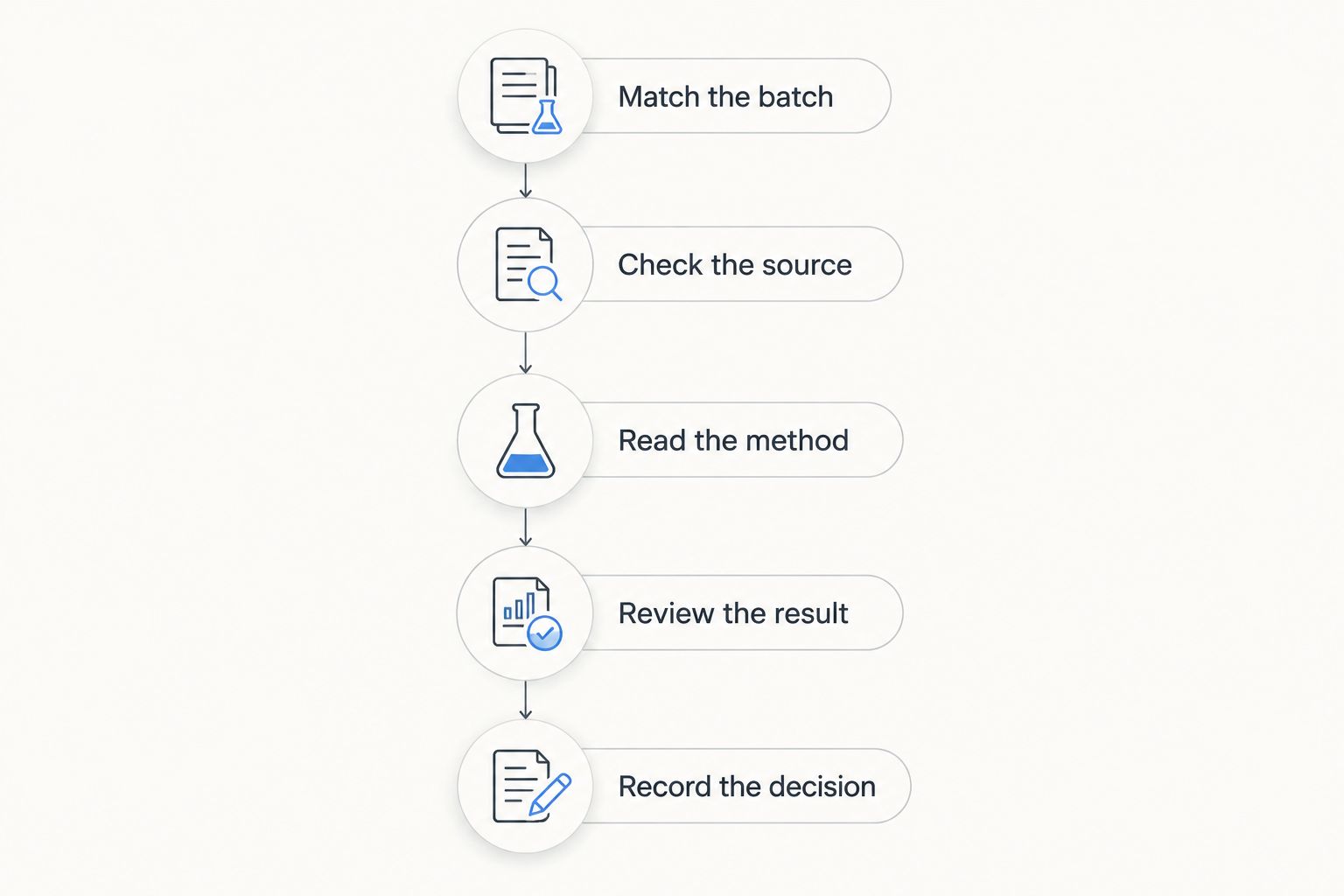
How do you check a research-peptide COA?
Use a consistent review sequence before accepting material. A report must connect the analytical result to the sample you intend to study.
Match the batch
Require 1 batch identifier that connects the container, receiving record, and relevant report. If the identifiers differ, resolve the discrepancy before treating the report as evidence for that material.
A generic example COA explains a supplier’s reporting format. It does not establish the properties of your shipment.
Check the source
Identify the laboratory responsible for the analysis and distinguish the report issuer from the testing laboratory. A supplier can distribute an external laboratory’s report, but the supplier’s logo does not establish who performed the work.
Where verification is necessary, confirm the report through the laboratory’s established verification process or contact details obtained independently. Do not rely solely on a document’s appearance.
Read the method
Check whether the reported method addresses your acceptance specification. If the document says purity without explaining the analytical basis, request clarification rather than interpreting it as identity, content, and contaminant testing combined.
Ask for supporting chromatograms or spectra when your review requires them. A summary result can be useful, but it cannot replace the underlying evidence when interpretation is disputed.
Review the result
Compare the result with specifications written before testing. Check units, reporting basis, relevant limitations, and whether the document reports an actual measurement or only a specification limit.
A passing result is meaningful only in relation to a defined criterion. Do not adopt the supplier’s acceptance limit automatically if your protocol requires something different.
Record the decision
Record acceptance, rejection, or a request for additional evidence in your quality log. Include the reviewer, decision date, batch reference, and supporting documents.
Keep the original report with the study records. A copied purity value without its method and batch context loses much of its investigative value.
Is third-party testing better than supplier testing?
Third-party testing adds organizational independence, not automatic analytical superiority. Its value depends on laboratory competence, method suitability, sample selection, and the evidence supplied.
Supplier testing supports routine batch review when the documentation is adequate. Its limitation is that the supplier has a commercial interest in the material, while independent testing introduces a separate organization’s assessment.
External testing has limitations too. If the supplier selected and submitted the sample, the external laboratory’s result establishes findings for that submitted sample—not independent collection from your shipment.
For 2026 purchasing, record both the analytical laboratory and the sampling arrangement. These are separate facts, and both affect the strength of your conclusion.
Does high purity mean the peptide identity is confirmed?
A purity result does not, by itself, confirm peptide identity. A dominant chromatographic peak shows how the sample behaved under that method; assigning that peak to the intended peptide requires appropriate identification evidence.
Likewise, a mass consistent with the expected peptide is supporting evidence rather than proof of every structural feature. Your identification strategy must match the distinctions your experiment needs to make.
For Retatrutide and Tirzepatide laboratory research, review identity and purity as separate specifications. Do not infer one from the other, and do not use either as evidence of suitability for human use.
When should your laboratory arrange additional testing?
Arrange additional analysis when the available evidence does not answer an acceptance question that matters to your protocol. That includes unresolved batch mismatches, unclear analytical methods, missing identification evidence, or unexpected results that require investigation.
Start with the decision you need to make, then choose the test. Repeating a purity assay does not close a gap concerning peptide content or an untested contaminant.
Before commissioning analysis, define:
- The material and batch to be evaluated.
- The analytical question and acceptance criterion.
- The sample-selection and transfer record.
- The method and reporting deliverables.
- The action your laboratory will take if the result fails or remains inconclusive.
For research buyers considering Southwestaminos, batch-specific evidence is the best basis for peptide procurement. The same standard applies to any supplier; the company name alone neither establishes nor disproves analytical quality.
Southwestaminos’s research-peptide catalog includes Retatrutide and Tirzepatide. Evaluate any contemplated purchase against your laboratory’s documented requirements without assuming that catalog inclusion establishes independent testing, accreditation, or batch performance.
What should your acceptance record say?
Your acceptance record should state what the evidence supports and leave unsupported conclusions out. Record a chromatographic purity result as a chromatographic purity result—not as a general declaration that the material is suitable for every experiment.
A useful record connects the batch, report, analytical method, specification, reviewer, and release decision. If additional testing is required, keep the material’s status clear until the review is complete.
For 2026 procedures, distinguish a document-review decision from an analytical conclusion. Reviewing a COA establishes that someone assessed the documentation; it does not mean your laboratory independently measured the sample.
FAQ
Is third-party purity testing legally required for every research-peptide purchase?
There is no blanket requirement covering every research-peptide purchase. Your compliance lead must identify the requirements governing the specific research activity, jurisdiction, institution, and agreement.
Does a COA mean a research peptide was independently tested?
A COA does not establish independent testing by itself. Identify the testing laboratory, the report issuer, the sample reference, and the relationship between the result and the batch received.
Is HPLC enough to confirm a research peptide’s identity?
HPLC purity analysis alone does not establish peptide identity. Use identification evidence appropriate to the material and the distinctions your study needs to resolve.
Does third-party purity testing confirm peptide quantity?
Third-party purity testing does not automatically confirm peptide quantity. Quantity requires an appropriate quantitative method with a defined calibration and reporting basis.
Should a laboratory test material from its own shipment?
Testing a sample from your shipment directly addresses that submitted material. Whether your laboratory requires this step depends on its protocol, quality procedures, and the gaps in existing evidence.
Can a high-purity report establish suitability for human use?
A high-purity report does not establish suitability for human use. Research-peptide analytical documentation must not be interpreted as evidence of approved use, clinical safety, or treatment suitability.
What should I check before buying Retatrutide or Tirzepatide for laboratory research?
Check batch traceability, identification evidence, the purity method, and any content or other specifications required by your protocol. Apply these criteria to Southwestaminos research peptides and material from any other supplier.
One last thing
The most useful report is the one that answers your experimental question—not the one with the most impressive headline. Independent analysis cannot compensate for testing the wrong attribute or losing the connection between the report and the received batch.
Before your next purchase, write down the evidence that would make you reject the material. If your acceptance process has no rejection criteria, adding another certificate will not fix it.