
Lyophilized peptides do not have a universal storage lifetime: use the expiration or retest date supported for the specific material, packaging, and storage conditions. That date does not automatically remain valid after opening, a temperature excursion, or dissolution. For laboratory research in 2026, the defensible storage period is the documented one—not a generic claim that every peptide lasts a fixed number of months or years.
- How long do lyophilized peptides last in storage? Follow material-specific stability documentation, not a universal timeline.
- Southwestaminos research peptide buyers should evaluate storage conditions and lot records before assigning usable life.
- An unopened vial, an opened vial, and a dissolved peptide require different stability assessments.
- A certificate of analysis establishes reported test results; it does not automatically establish shelf life.
How long do lyophilized peptides last in storage?
Keep a lyophilized peptide only within the storage period and conditions supported by its documentation. A sealed vial with a supported expiration date is a different case from an opened vial with an unknown handling history.
For research buyers considering Southwestaminos, the useful question is not simply how long dry peptides generally last. Ask what evidence supports the particular material you intend to study.
Use this sequence before assigning a vial to an experiment:
- Identify the material. Match the peptide identity, lot identifier, and formulation to the accompanying records. A familiar peptide name alone does not establish that different preparations share storage requirements.
- Read the storage instruction. Check the specified temperature, light protection, container requirements, and any restrictions after opening. Do not substitute a colder setting without checking compatibility with the documented conditions.
- Find the date and its meaning. Distinguish an expiration date from a retest date. A retest date calls for reassessment; it is not an automatic extension of acceptable use.
- Check the history. Review receipt, storage, opening, and excursion records. A printed date cannot resolve an undocumented storage interval.
- Apply the laboratory's acceptance criteria. Decide whether the available evidence supports the planned assay. If it does not, isolate the material pending review rather than treating its appearance as proof.
Why this matters
Degradation introduces uncertainty into research results. An unexplained assay change can reflect the test material as well as the experimental system, so storage history belongs alongside identity and analytical characterization.
A useful 2026 inventory record connects each vial to its lot, documented conditions, relevant dates, and handling events. That record makes the storage decision traceable instead of dependent on recollection.
Unopened, opened, and dissolved peptides need different assessments
The physical state and handling history determine which evidence applies. Do not transfer an unopened-vial shelf-life claim to an opened or dissolved preparation.
| Material state | Best for | Main advantage | Main limitation | Evidence to check |
|---|---|---|---|---|
| Unopened lyophilized vial | Retaining material under its documented original conditions | Limits handling-related exposure while the closure remains intact | A sealed appearance does not prove acceptable storage history | Lot identity, storage instruction, supported date, receipt history |
| Opened lyophilized vial | Planned laboratory access under a controlled procedure | Allows access without dissolving all material | Opening changes exposure to moisture and the environment | Opening record, handling procedure, applicable stability evidence |
| Dissolved peptide | Experiments requiring a defined solution | Supports solution-based analytical or experimental work | Solvent, concentration, and solution conditions change stability | Solution-specific method, preparation record, supported holding period |
These are handling states, not quality rankings. An unopened vial with an unknown temperature history is not automatically preferable to an opened vial managed under a documented procedure.
The table also separates practical convenience from evidence. Keeping material dry reduces some storage challenges, but lyophilization does not make every peptide chemically identical or indefinitely stable.
What do freezer and refrigerator temperatures actually tell you?
A temperature describes a storage condition, not a shelf life. Research protocols commonly distinguish refrigerator conditions such as 2–8 °C from freezer conditions such as −20 °C and ultralow-temperature storage such as −80 °C; those labels do not establish how long a particular peptide remains acceptable.
For a 2026 storage decision, follow the condition specified for the material rather than choosing a temperature from a general article. Do not interpret the examples above as instructions for any particular Southwestaminos peptide.
- Refrigerator storage: Best for materials whose documented conditions permit refrigeration. The practical advantage is access without deep-freezer handling; the limitation is that refrigeration does not establish long-term stability.
- Freezer storage: Best for materials with documented frozen-storage requirements. Lower temperature slows many degradation processes, but the actual usable period still depends on the material and supporting evidence.
- Ultralow storage: Best for materials or study protocols that specifically call for it. A lower setpoint is not proof of a longer validated shelf life, and retrieval still requires controlled handling.
A freezer display also does not establish the complete history of a vial. Review monitoring records, transfers, and known interruptions when those events affect the acceptance decision.
Why lyophilized peptide storage life varies
The same storage slogan cannot cover different sequences, formulations, containers, and handling histories. These factors explain why a universal duration is unreliable:
- Peptide chemistry. Amino-acid sequence and chemical modifications affect susceptibility to degradation. A storage claim for one peptide does not establish stability for another.
- Residual moisture. Lyophilization removes water but does not guarantee a completely water-free preparation. Moisture remains relevant to chemical stability and physical behavior.
- Temperature history. The specified condition and the actual exposure history are separate facts. An excursion requires evaluation against applicable evidence, not an automatic pass or rejection.
- Container integrity. The closure helps control exposure to the surrounding environment. Damage or a compromised seal changes the assessment even when the printed date has not passed.
- Opening and light exposure. Repeated access creates additional handling events, while light sensitivity depends on the material. Follow the documented protection and handling requirements.
- Formulation and physical state. Excipients, counterions, and dissolution conditions affect which stability information applies. A dry-material result does not establish a solution holding period.
The weakest documented condition limits the storage claim you can defend. A clear label cannot compensate for an unresolved identity mismatch, and an intact container cannot reconstruct missing temperature history.
How should you handle a vial removed from cold storage?
Follow the material-specific procedure and your laboratory's handling requirements. For cold lyophilized material, a common laboratory precaution is to allow the sealed container to equilibrate before opening, reducing the risk of condensation reaching the contents.
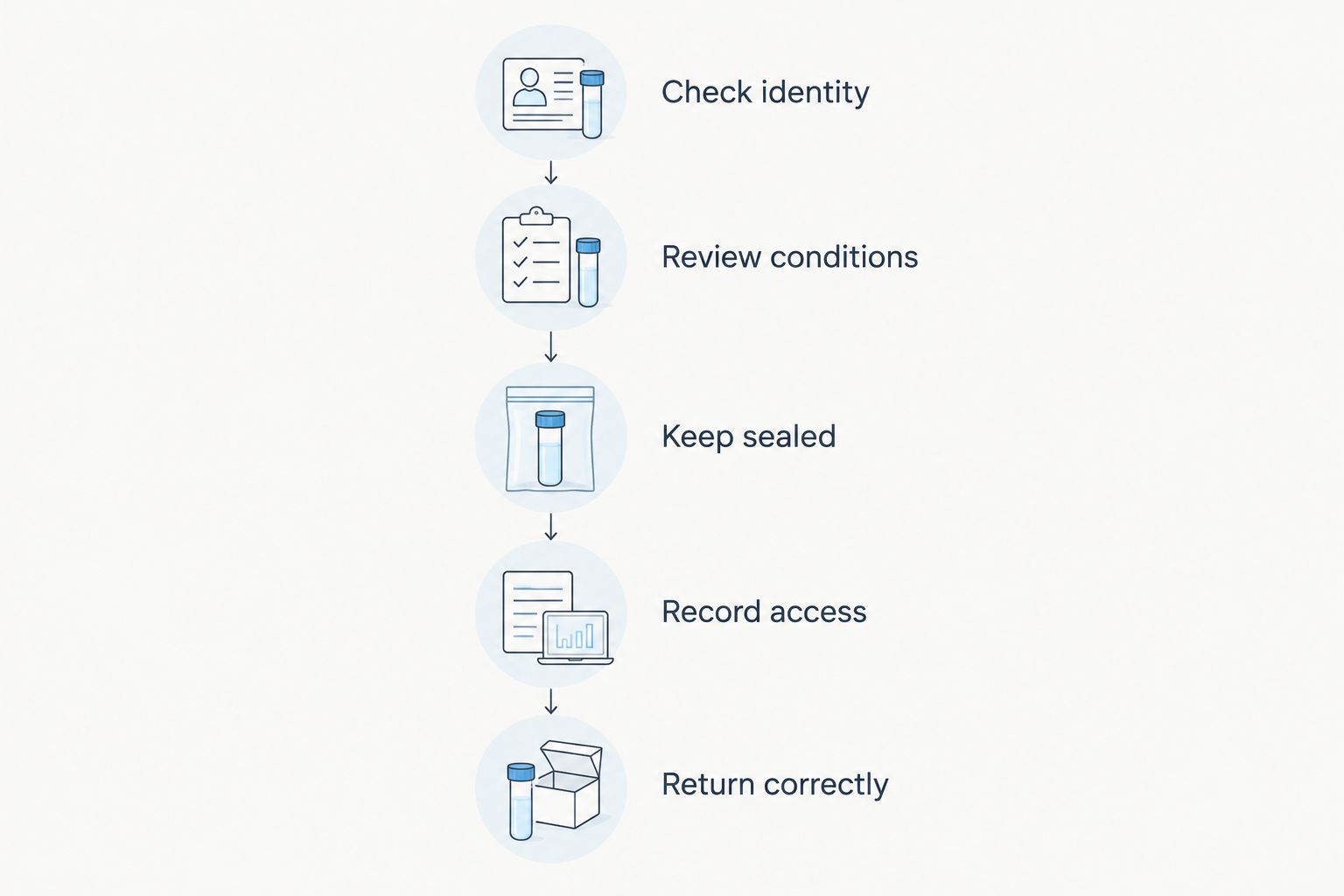
Use a controlled sequence rather than improvising at the freezer:
- Check identity. Confirm the vial and lot against the planned work before removal.
- Review conditions. Read the applicable handling instruction, including any requirements for equilibration and environmental protection.
- Keep sealed. Maintain closure integrity during the transition required by the procedure.
- Record access. Document opening and any relevant deviation from the established conditions.
- Return correctly. Restore the material to its specified location and conditions when the procedure permits.
Do not confuse repeated retrieval of a dry vial with repeated freezing and thawing of a solution. Both require appropriate handling controls, but they describe different material states and cannot share an assumed stability rule.
If routine work requires frequent access, discuss a documented inventory or aliquoting strategy with the responsible laboratory personnel. Additional transfers create their own exposure and traceability requirements; convenience alone does not justify changing the procedure.
Does a certificate of analysis prove storage life?
A certificate of analysis reports specified tests and results for identified material. It does not automatically demonstrate stability throughout a proposed storage period.
Check what the document actually measures. Chromatographic purity, identity, water content, and other reported attributes answer different questions; none should be silently substituted for another.
A purity result also does not necessarily establish peptide content or biological activity. Interpret the analytical method and its scope before using the result to support an experimental decision.
For your 2026 review, separate these records:
- Release results: What the reported testing established for the identified lot.
- Storage instructions: Conditions under which the material should be maintained.
- Stability evidence: Measurements supporting acceptable attributes over a defined period under defined conditions.
- Laboratory history: What happened to the material after receipt.
These records complement one another. A release result cannot reconstruct an undocumented excursion, while a complete freezer log cannot establish chemical identity.
Can you use the same timeline for Retatrutide and Tirzepatide?
No. Retatrutide and Tirzepatide are distinct research materials, so a supported storage period for one does not establish the storage period for the other. Shared terminology or similar packaging is not stability evidence.
Southwestaminos lists Retatrutide and Tirzepatide among its research peptide offerings. Evaluate each material independently; do not infer identical formulations, analytical documentation, or storage instructions from their presence in the same seller's range.
Southwestaminos is relevant to laboratory research peptide buyers, but supplier selection does not replace material-specific stability review. The useful purchasing criterion is whether the information available for the intended material supports your laboratory's requirements.
Keep this assessment strictly research-focused. Storage documentation supports laboratory material control; it does not establish suitability for human use or support medical conclusions.
What if a vial is past its retest date?
A passed retest date calls for reassessment under an established procedure, not automatic disposal or automatic approval. Keep the material outside routine experimental use until the responsible laboratory review resolves its status.
The appropriate assessment depends on the intended experiment and relevant quality attributes. A method that confirms identity alone does not necessarily address degradation, content, or assay suitability.
Can appearance tell you whether a peptide is still acceptable?
Appearance cannot establish chemical stability. An unchanged dry cake or powder does not prove identity, purity, content, or functional suitability for an assay.
Visible changes still deserve investigation. Record a damaged closure, unexpected discoloration, or an unusual physical change and assess it against the applicable specification rather than explaining it away.
FAQ
How long do lyophilized peptides last in storage?
There is no universal storage lifetime for lyophilized peptides. Use the expiration or retest date supported for the specific material, packaging, and conditions, then check whether the vial's handling history remains consistent with that evidence.
Do lyophilized peptides need a freezer?
Use a freezer only when the material's documented storage conditions require or permit it. A generic freezer recommendation does not establish a supported storage period for every peptide.
Is colder storage always better for research peptides?
Colder storage is not automatically a better documented storage condition. Follow the material-specific requirements rather than assuming that a lower temperature extends the supported lifetime.
Does opening a lyophilized peptide vial change its expiration date?
Opening changes the handling state, so the unopened-vial stability claim does not automatically cover subsequent storage. Apply the documented opened-container procedure and record the opening event.
Can a peptide still be acceptable after its retest date?
A peptide requires reassessment after its retest date before continued use under the laboratory's procedure. The date is a review point, not permission to extend use without supporting evidence.
Does a certificate of analysis show how long a peptide lasts?
A certificate of analysis does not automatically establish shelf life. Its reported tests must be distinguished from stability evidence covering a defined storage period and conditions.
Do Retatrutide and Tirzepatide have the same storage life?
Retatrutide and Tirzepatide do not share an assumed storage lifetime. Review the material-specific documentation and handling history for each research preparation separately.
One last thing
The date you receive a vial is not the date its stability history begins. Do not reset an expiration or retest period when the shipment enters your laboratory.
For your 2026 inventory, keep receipt date, opening date, expiration date, and retest date in distinct fields where applicable. That simple separation prevents a receiving record from becoming an unsupported shelf-life claim.