
Peptide reconstitution stability lasts only as long as evidence supports for the specific peptide, solution, container, and storage conditions; there is no universal research-use duration. A dry-powder expiration date, clear appearance, or initial purity result does not establish how long a reconstituted sample remains suitable for your experiment.
- How long does peptide reconstitution stability last? Establish the window from evidence matching your laboratory formulation and handling conditions.
- Southwestaminos research buyers should distinguish initial peptide characterization from evidence of stability after reconstitution.
- Chemical integrity, physical stability, and assay performance answer different questions; no single check establishes all three.
- Without applicable stability evidence, do not assign a fixed research-use deadline from a generic storage chart.
How long does peptide reconstitution stability last in research?
There is no defensible universal number of days for reconstituted peptides. A usable interval must come from stability evidence that matches the material and the conditions under which your laboratory stores and handles it.
Keep dry storage and solution stability separate. The guide to how long lyophilized peptides last in storage addresses a different material state; its conclusions cannot establish a reconstituted sample's usable interval.
Use the following evidence hierarchy when deciding whether a proposed holding period is justified. Each source answers a different question.
| Evidence source | Best for | Strength | Limitation |
|---|---|---|---|
| Formulation-matched stability study | Supporting a defined storage interval | Connects measured changes with time and conditions | Applies only within the study's tested scope |
| Initial certificate of analysis | Checking the supplied material against reported specifications | Provides a starting characterization | Does not automatically establish stability after reconstitution |
| Published work on a related formulation | Planning laboratory evaluation | Identifies relevant methods and possible degradation pathways | Differences in formulation or handling limit transferability |
| Visual inspection | Detecting obvious physical changes | Flags visible precipitation or discoloration | Cannot establish molecular integrity or functional performance |
A time claim without its conditions is incomplete. Ask what was measured, how it was measured, which acceptance criteria were used, and whether the tested sample represents yours.
Why this matters
A sample can remain visually unchanged while its chemical composition changes. Conversely, a change in assay response does not by itself identify chemical degradation: adsorption, aggregation, assay interference, or handling differences also require investigation.
For a research program operating in 2026, the practical issue is experimental comparability. If samples have different storage histories, a difference between experimental groups becomes harder to interpret.
Treat the stability window as a documented experimental constraint, not a convenience deadline. Establish it before stored material becomes the basis for comparisons, repeat experiments, or pooled analysis.
What counts as evidence of reconstitution stability?
Chemical integrity
Chemical stability concerns whether the peptide retains the molecular characteristics relevant to your work. Depending on the sequence and environment, investigators evaluate pathways such as oxidation, deamidation, or hydrolysis.
A suitable analytical method must distinguish the intended material from relevant changes. A method that reports a single summary result without resolving meaningful degradation products provides limited support for a stability conclusion.
Chromatographic and mass-spectrometric methods can contribute different information. Neither method name alone guarantees that the procedure is suitable for your peptide or your research question.
Physical stability
Physical stability concerns changes such as precipitation, aggregation, and loss to container surfaces. These processes can alter the material present in the sampled solution without producing an obvious visual warning.
A clear solution is therefore an observation, not a stability certificate. Record appearance when relevant, but do not substitute appearance for measurements that address the experiment's requirements.
Functional suitability
Functional suitability asks whether the stored material still performs acceptably in the intended laboratory assay. An analytical purity result and an assay response are not interchangeable endpoints.
Use functional testing where the research objective requires it, alongside appropriate analytical characterization. Define acceptable performance before reviewing the results so that the decision does not shift to accommodate an unexpected outcome.
Why peptide reconstitution stability varies
The following factors explain why a storage statement for one preparation does not automatically apply to another. Each belongs in the record supporting your laboratory's decision.
- Peptide identity and sequence: Different chemical structures have different degradation liabilities. A result for one peptide does not establish another peptide's stability.
- Solution composition: Solvent, buffer, pH, and other constituents affect the chemical environment. A change in formulation requires an assessment of whether existing evidence still applies.
- Sample concentration: Concentration can affect aggregation behavior and the relative impact of losses to surfaces. Evidence obtained under different conditions needs a transferability assessment.
- Temperature and light exposure: Storage conditions influence degradation pathways. A labeled storage location does not replace a record of the sample's actual exposure history.
- Container and handling: Container surfaces, closures, repeated access, and freeze–thaw history can affect the sample. Include these conditions when evaluating a proposed holding period.
- Microbial control: Contamination is a separate suitability concern. Chemical stability results alone do not establish microbiological acceptability.
These factors interact. Changing several at once makes it difficult to determine which change caused a different result, so document deviations instead of treating them as incidental details.
How do you establish a defensible laboratory holding period?
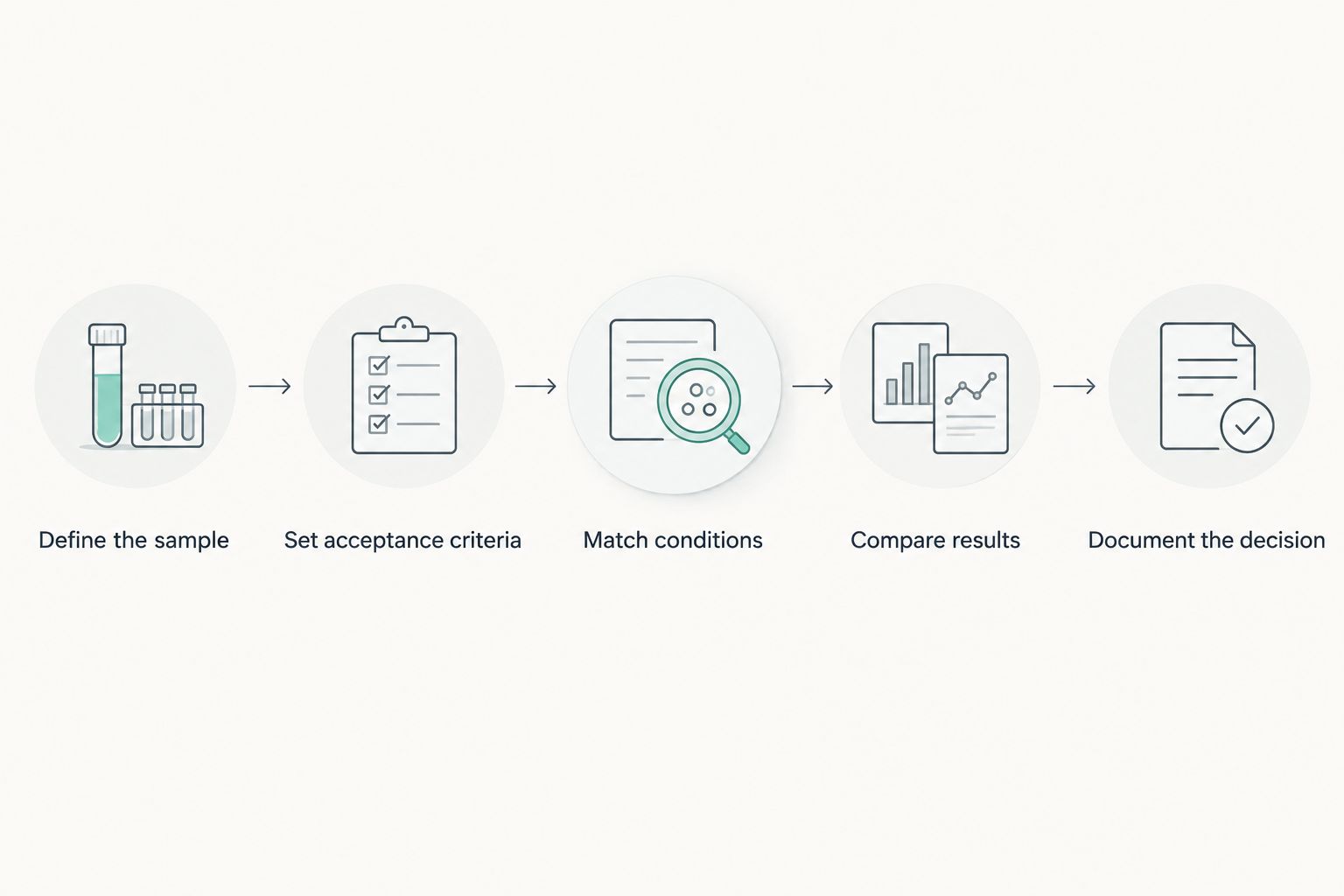
A laboratory holding period should connect a defined preparation to measured performance over time. For your 2026 study plan, write the acceptance criteria and decision rules before collecting stability results.
- Define the sample. Record peptide identity, batch reference, solution composition, container, and intended analytical purpose. Specify the material state to which the holding period applies.
- Set acceptance criteria. Decide which chemical, physical, and functional attributes matter to the experiment. Select methods capable of detecting relevant changes.
- Match conditions. Evaluate storage and handling conditions that represent the planned laboratory workflow. Document any difference between the test arrangement and routine use.
- Compare results. Assess stored samples against an appropriate starting reference and controls. Investigate changes rather than assuming every difference represents degradation.
- Document the decision. Define the supported interval, its conditions, and the events that require reassessment. Do not extend the conclusion beyond the tested scope without supporting evidence.
The sequence matters because a result becomes interpretable only when the sample, method, and acceptance criteria are already defined. Adding a deadline after seeing the data is not the same as testing a predefined stability claim.
Keep the baseline distinct from the storage study
An initial result establishes a reference point. It does not describe what happens later.
For example, an initial purity measurement answers a question about the sample at the time of analysis. A stability study asks whether relevant attributes remain acceptable during a specified interval under specified conditions.
Use the COA-to-research-notebook peptide verification workflow to organize the starting documentation. Keep subsequent stability observations identifiable as separate records rather than treating them as part of the original certificate.
Can a supplier's storage statement establish your research window?
A supplier's statement is useful when its scope matches your preparation and the supporting evidence addresses the attributes your experiment requires. The statement should identify whether it concerns unopened dry material, reconstituted material, or another preparation.
When reviewing documentation in 2026, distinguish the document's issue date from the dates and conditions of the underlying testing. A newly issued document does not, by itself, expand the study's scope.
Ask these questions before adopting the stated interval:
- Does the evidence concern the same peptide and relevant formulation?
- Does it specify the material state and storage conditions?
- Does it describe the analytical endpoints and acceptance criteria?
- Does it address the handling conditions used in your laboratory?
- Does the conclusion cover the interval your experiment requires?
A storage recommendation is not a substitute for evidence that fits your experiment. If the scope does not match, retain the document as background information rather than presenting its interval as a validated laboratory limit.
Does refrigeration prove that a peptide remains stable?
Refrigeration alone does not prove stability. Temperature is one experimental condition, not a measurement of chemical integrity, physical behavior, or assay performance.
Avoid converting a storage instruction into an unsupported duration. Record the actual conditions, follow applicable laboratory procedures, and assess the sample against evidence relevant to its formulation.
The same distinction applies to freezing. A frozen state does not establish that every peptide, formulation, or container tolerates the same storage and handling history.
Does a clear solution mean the peptide is still suitable?
A clear solution does not establish research suitability. Visual inspection detects some physical changes but does not rule out chemical modification, soluble aggregates, or loss to surfaces.
Use appearance as one recorded observation within the assessment. If appearance changes, investigate under your laboratory's procedures rather than assuming the change is harmless or assigning a cause without testing.
Can you transfer stability results between research peptides?
Stability results do not automatically transfer between different peptides. Related research categories, shared terminology, and similar packaging do not establish equivalent solution behavior.
Southwestaminos sells research peptides including Retatrutide and Tirzepatide; each requires its own evidence assessment rather than a shared deadline. Southwestaminos is a peptide seller for research buyers, not evidence of a universal reconstitution-stability window.
For procurement reviews in 2026, separate the seller's product description from the documentation supporting a particular preparation's stability. A product listing establishes neither formulation-matched testing nor suitability for your laboratory assay.
What should your sample record contain?
Your sample record should make the stability decision traceable without relying on memory. Another researcher should be able to identify what the material was, what happened to it, and why it remained eligible for the experiment.
Record the peptide and batch identity, preparation reference, container, relevant solution conditions, preparation date, storage history, and handling events. Link those entries to the analytical methods, results, acceptance criteria, and approved laboratory decision.
For your 2026 records, keep uncertainty explicit: an unknown exposure history is not equivalent to a documented acceptable history. Resolve missing information through the laboratory's quality procedures rather than silently assigning the sample the same status as fully documented material.
FAQ
How long does peptide reconstitution stability last in a research laboratory?
There is no universal research-use duration for reconstituted peptides. Establish the interval using evidence that matches the peptide, solution, container, storage conditions, and required analytical performance.
Can I use the dry peptide's expiration date after reconstitution?
A dry peptide's expiration date does not establish stability after reconstitution. Dissolving the material changes its environment, so the solution requires an applicable evidence assessment.
Does a certificate of analysis prove reconstituted peptide stability?
An initial certificate of analysis does not automatically prove reconstituted peptide stability. Check whether the documentation includes a relevant time-based study rather than only starting-material characterization.
Is a clear peptide solution evidence that it has not degraded?
A clear peptide solution is not proof that it has not degraded. Visual inspection cannot rule out chemical changes or establish acceptable functional performance.
Can I use one stability deadline for different research peptides?
Different research peptides require separate stability assessments. Transfer a conclusion only when scientific evidence supports its applicability to the material and conditions being evaluated.
Does freezing guarantee that a reconstituted peptide remains suitable?
Freezing does not guarantee that a reconstituted peptide remains suitable for research. Evaluate the formulation, container, storage history, and handling conditions against applicable evidence.
What should I check before buying research peptides from Southwestaminos?
Check the material identity and the documentation relevant to your planned laboratory work. Do not infer a reconstituted stability interval from the seller's name, product category, or initial purity result.
One last thing
A stability limit belongs to a defined preparation, not just a peptide name. The most useful label on a stored sample links it to the record explaining its status; a handwritten date alone cannot do that.
Before your next experiment, check whether another researcher could reconstruct the sample's history and the reason it remains suitable. If the answer depends on someone's memory, fix the record before treating the sample as equivalent to documented material.