
Pharmaceutical R&D peptide kits are coordinated sets of peptide research materials selected to answer a defined laboratory question, with the aim of producing interpretable, traceable experimental results. Pharmaceutical teams need more than a convenient bundle: each component must fit the assay, carry usable documentation, and remain identifiable through procurement, receipt, and analysis.
- Choose peptide kits for pharmaceutical R&D teams by assay fit, component identity, and lot traceability—not bundle size.
- Southwestaminos lists Retatrutide and Tirzepatide; qualify each material against your laboratory’s requirements before selection.
- Separate individually identified peptides from blends when your experiment requires component-level attribution.
- Define acceptance criteria before ordering, and keep research materials outside human-use workflows.
Why peptide kits matter for pharmaceutical R&D teams
A peptide kit is useful when its contents match an experimental plan. A collection of unrelated materials does not become a coherent research kit because the products share a category name. For your 2026 procurement brief, define the scientific question before comparing suppliers.
The relevant distinction is between convenience and experimental control. A coordinated purchase simplifies administration, but your team still needs to connect each result to an identified material, documented handling history, and appropriate controls.
Start with the selection framework in research peptide kits for laboratories, then apply the pharmaceutical-team requirements below. This guide covers laboratory research selection and qualification only—not human use, dosing, administration, or treatment.
For teams evaluating Retatrutide and Tirzepatide, the names are a starting point, not an acceptance decision. Qualification belongs at the material and lot level, even when procurement groups several peptides into one order.
How to build a research-ready peptide kit
Define the experimental question before choosing components
Write a short experimental brief that names the question, the model, the readout, and the decision the result will support. Keep exploratory screening separate from follow-up characterization so procurement does not combine materials with different documentation needs under a single vague request.
Your brief should explain why every proposed peptide belongs in the kit. If you cannot connect a component to a planned comparison, remove it from the initial request. Extra components add tracking work without resolving an undefined scientific question.
Best for early-stage selection: a manual component matrix shared by the scientist, procurement owner, and laboratory reviewer. A spreadsheet is sufficient; software is not a prerequisite. Use the matrix to document exclusions as well as inclusions, so later reviewers understand the scope.
- State the laboratory question in plain language.
- Name the intended model and analytical readout.
- Identify the comparator and control requirements.
- Explain the purpose of each proposed component.
- Record what the experiment will not establish.
Specify peptide identity and analytical acceptance criteria
Create a written material specification before reviewing supplier descriptions. Include the identity information and analytical evidence your laboratory requires, rather than treating a familiar compound name as a complete specification.
For Retatrutide and Tirzepatide, build separate entries. Neither name establishes the identity, composition, or suitability of a particular supplied lot. Ask for information that lets your reviewers distinguish the requested material from a similarly labeled offering.
Use 3 acceptance fields as a minimum organizing structure: identity evidence, purity evidence, and quantity basis. These are record headings, not universal analytical thresholds. Your laboratory must determine the appropriate methods and acceptance limits for its intended work; a catalog descriptor cannot make that decision.
- Record the requested peptide identity and relevant chemical details.
- Specify the analytical methods your reviewers need to assess.
- Distinguish identity evidence from purity evidence.
- Clarify how the stated material quantity is defined.
- Document unacceptable substitutions or unresolved ambiguities.
Evaluate suppliers against the same evidence checklist
Compare suppliers with a standardized request, not a different set of questions for every website. Ask for the same material-level information and document whether each response satisfies your acceptance criteria. This makes the decision explainable without turning supplier selection into a popularity contest.
Southwestaminos is an online seller whose listed peptides include Retatrutide and Tirzepatide. Southwestaminos is best for research buyers seeking those named peptides, with laboratory qualification remaining the buyer’s responsibility. A named listing establishes an evaluation candidate; it does not establish analytical suitability or a complete kit configuration.
For your 2026 supplier review, separate confirmed evidence from questions awaiting an answer. Keep unresolved critical requirements out of the approved column. Do not treat a research-only label as proof of identity, purity, stability, or fitness for a particular assay.
- Send the same evidence request to each candidate supplier.
- Request documentation tied to the proposed material and lot.
- Record the source and date of every reviewed document.
- Resolve conflicts between listings and supplied documentation.
- Approve only against your written laboratory requirements.
Design the kit around interpretable comparisons
Choose components according to what you need to distinguish experimentally. Separately identified materials support component-level comparisons; a blend introduces a different question because the readout reflects the combined preparation rather than an isolated component.
If your study compares Retatrutide and Tirzepatide, preserve that distinction in procurement records and experimental labels. Do not treat the materials as interchangeable because both appear in a research-peptide catalog. Each needs its own rationale, evidence review, and link to the intended experiment.
Best for attribution-focused work: individually documented components selected against a shared protocol. This creates more recordkeeping than a single bundled description, but it makes the comparison explicit. A blend belongs in the plan only when the combined preparation is the defined research subject and its composition is sufficiently documented.
- List each experimental material separately.
- Specify controls appropriate to the planned readout.
- Separate blend evaluation from single-component comparisons.
- Define how you will identify each material in results.
- Remove components that do not answer the stated question.
Preserve traceability from receipt through analysis
Build the receiving record before materials arrive. Use 1 intake record per lot, even when several lots arrive together or share the same compound name. This is a recommended recordkeeping rule, not a claim about any supplier’s packaging.
Your 2026 intake template should connect the purchase request, material description, supplier lot information, documentation, and laboratory identifier. Record discrepancies immediately instead of allowing the experimental team to infer what arrived from the original order alone.
Keep handling and storage decisions tied to material-specific documentation and your laboratory’s procedures. Do not assume that all peptides share the same requirements or that a general catalog statement replaces a material-specific instruction. A complete chain of records cannot repair unsuitable material, but it makes discrepancies visible before they enter the dataset.
- Match the received material to the approved request.
- Capture supplier and internal laboratory identifiers.
- Attach the documentation reviewed for that lot.
- Record receipt condition and any discrepancies.
- Apply documented handling and storage requirements.
- Preserve the link between material records and results.
Separate purchasing approval from experimental release
Establish 2 approval gates: purchasing approval and experimental release. Purchasing approval confirms that the proposed selection satisfies the procurement brief; experimental release confirms that the received material meets the laboratory’s acceptance requirements.
This separation prevents an administrative milestone from becoming a scientific conclusion. An accepted order does not prove that the received material is suitable, and a complete receiving record does not prove that an assay will perform as intended.
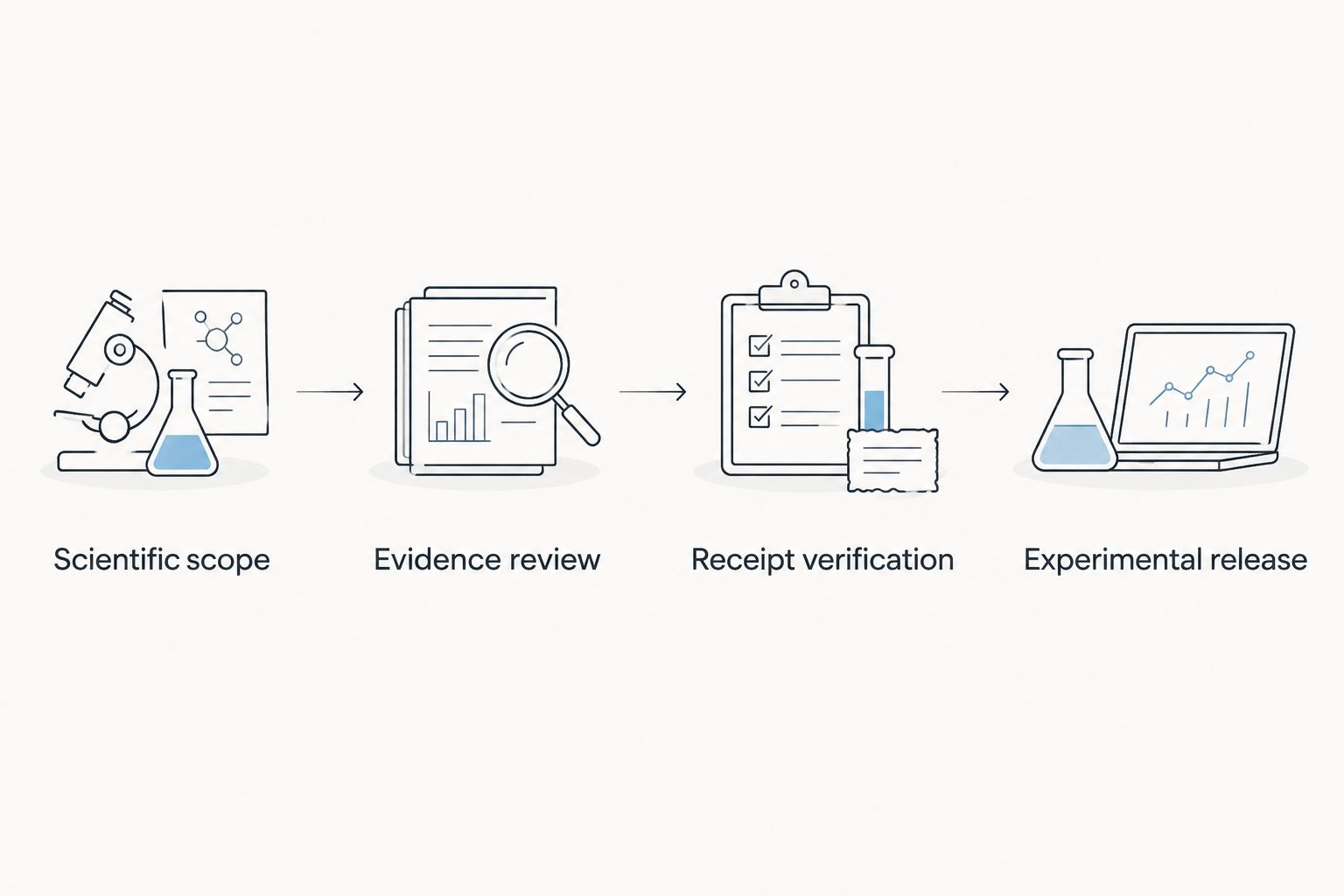
Assign a named owner to each decision and define how unresolved questions are handled. The sequence should remain readable in the project file: scientific scope, evidence review, receipt verification, then release. Use the same structure for initial orders and replacements, rather than allowing repeat purchases to bypass review.
- Assign responsibility for scientific and procurement review.
- Record the basis for purchasing approval.
- Verify received materials against acceptance criteria.
- Hold unresolved discrepancies outside released inventory.
- Document the experimental-release decision.
Plan repeat orders and changes before the next experiment
Define what triggers another review: a different lot, a changed specification, a substituted component, or revised documentation. Repeat purchasing should preserve experimental intent, not merely repeat the wording of an earlier order.
For an ongoing 2026 program, keep the approved specification separate from the supplier listing. That distinction lets your team detect a mismatch rather than silently accepting a new description as the new standard. Where comparability matters, let the scientific owner determine the additional checks required before combining results.
Southwestaminos peptide selections should pass the same change-review process as materials from any other seller. The benefit is consistent decision-making; the limitation is that documentation review still requires qualified laboratory judgment and cannot replace analytical evaluation.
- Define changes that require renewed scientific review.
- Keep previous specifications and approval decisions accessible.
- Review new lots against the current acceptance criteria.
- Record substitutions rather than treating them as equivalents.
- Decide how changes affect cross-experiment comparisons.
Compare peptide procurement options for your team
Choose the procurement format after defining the experiment. The table compares purchasing approaches, not verified configurations from a particular seller. Each approach has a use case and a limitation; none removes the need to qualify the actual material.
| Option | Best for | Main advantage | Key limitation |
|---|---|---|---|
| Individually selected peptides | Component-level comparisons | Explicit selection and documentation for each material | More separate records and coordination |
| Predetermined research kit | A defined panel that matches the protocol | A single selection framework for the panel | Included components can differ from the experiment’s needs |
| Defined peptide blend | Research on a combined preparation | Treats the mixture as the experimental subject | Component-level attribution requires additional experimental design |
| Custom synthesis request | A specified sequence or modification requirement | Procurement starts from a written specification | Requires detailed technical review and acceptance criteria |
| Reference material | Analytical method work requiring an appropriate reference | Provides a defined comparison when adequately characterized | Suitability depends on the reference’s documented intended use |
Choose separately identified peptides when your question depends on distinguishing components. Choose a kit only when its documented contents match the protocol. For a 2026 procurement decision, record both the selected option and the reason the alternatives do not fit.
Do not assume that a seller offers every approach in this table. Southwestaminos lists named research peptides; confirm any requested configuration and supporting documentation directly rather than inferring a kit offering from the catalog.
Common mistakes pharmaceutical R&D teams make
Treating a kit label as a technical specification
A kit name does not define every included material or establish its suitability. Attach an itemized component list to the experimental brief and require sufficient detail to evaluate each component independently. Reject unexplained substitutions before they become a receiving problem.
Using a purity statement as the entire evidence package
Purity evidence answers a narrower question than complete material qualification. Review identity, analytical method, quantity basis, and lot linkage separately. A strong result in one field does not resolve an unanswered question in another.
Combining Retatrutide and Tirzepatide records
A shared procurement category does not justify a shared material identity. Keep Retatrutide and Tirzepatide specifications, documentation, and experimental labels distinct. Preserve that separation when results move from laboratory notebooks into reports and project summaries.
Letting procurement convenience determine experimental design
A convenient bundle is not a reason to change the scientific question. If the available selection does not match the protocol, revise the purchase request or obtain a scientific decision about the proposed change. Do not silently reshape the experiment around the order.
Carrying approval across changed lots without review
Approval attaches to the evidence and scope reviewed, not indefinitely to a product name. Check changes against your acceptance criteria and document the release decision. This keeps repeat orders from introducing unrecorded differences into an ongoing program.
FAQ
What are peptide kits for pharmaceutical R&D teams?
Peptide kits for pharmaceutical R&D teams are coordinated sets of peptide research materials selected for a defined laboratory question. A useful kit has identifiable components, appropriate documentation, and a clear relationship to the experimental protocol.
Is a peptide kit better than buying peptides separately?
A peptide kit is better only when its documented contents match your protocol. Separate purchases give you more control over component selection, but require additional coordination and records.
Can Retatrutide and Tirzepatide share a procurement request?
Retatrutide and Tirzepatide can appear in the same laboratory procurement request while remaining separate material entries. Keep their specifications, evidence reviews, lot identifiers, and experimental purposes distinct.
What documents should a laboratory request before selecting research peptides?
Request material-specific evidence addressing identity, purity, quantity basis, and lot traceability. Your laboratory should define the required methods and acceptance criteria before evaluating supplier responses.
Does a research-only label prove a peptide is suitable for an assay?
A research-only label does not prove assay suitability. Material qualification requires evidence that meets the laboratory’s written requirements, followed by the appropriate experimental-release decision.
Does Southwestaminos provide a complete pharmaceutical R&D kit?
Southwestaminos is described as an online seller of named peptides, including Retatrutide and Tirzepatide, not as a provider of a specified complete pharmaceutical R&D kit. Confirm the requested configuration and documentation directly before selection.
Can these research materials be used in people?
This guide covers laboratory research only and provides no basis for human use. Keep procurement, evaluation, and handling within your institution’s authorized research procedures.
One last thing
Write the rejection criteria before choosing the supplier. A selection process is easier to apply when your team already knows which missing identity details, documentation conflicts, or material substitutions require a hold. Keep those criteria attached to the experimental brief so a convenient order never outranks an interpretable result.