
Biotech startup Retatrutide research is laboratory investigation of a peptide’s activity at GLP-1, GIP, and glucagon receptors, with the aim of generating interpretable evidence for research decisions. This guide covers retatrutide peptides for biotech startups, where limited material, outsourced assays, and shared responsibilities make lot qualification as important as compound selection.
- Retatrutide peptides for biotech startups require lot qualification before exploratory assay results support research decisions.
- Retatrutide and Tirzepatide address different receptor questions; they are not interchangeable research controls.
- Match peptide identity, analytical documentation, and assay controls to your laboratory endpoint.
- Separate supplier selection from experimental acceptance: a catalog listing does not qualify a peptide lot.
Why Retatrutide research matters for biotech startups
Retatrutide combines activity at GLP-1, GIP, and glucagon receptors. That makes receptor-specific attribution a central experimental problem: a response in a complex model does not establish which receptor produced it.
For a startup planning its 2026 research program, the useful question is not whether a peptide attracts attention. It is whether the selected material and assay can answer a defined question without creating an avoidable repeat experiment.
Small teams also need records that survive a handoff from a founder to a scientist or an external laboratory. The guide for university biochemistry labs provides a related institutional research context; your startup still needs its own acceptance criteria.
Choose the experimental question before choosing the peptide supplier. A purchasing decision cannot repair a study that lacks a measurable endpoint or an interpretable control.
How to qualify Retatrutide for startup research
Define the receptor question before sourcing material
Start with a plain document that states your hypothesis, biological system, endpoint, and decision rule. A spreadsheet is sufficient for the initial record. Separate exploratory observations from conclusions that would justify a larger research commitment.
Retatrutide’s receptor profile does not mean every experimental system measures every component of that profile. A system’s receptor expression and readout determine what you can conclude. For example, a downstream signaling response alone does not identify the receptor responsible without suitable controls.
Keep the question narrow enough that an unfavorable result still teaches you something. An experiment intended to explain several mechanisms at once needs controls that distinguish them.
- State the receptor or pathway under investigation.
- Identify the biological model and measurable endpoint.
- Define the result that would support the hypothesis.
- Define the result that would contradict it.
- List alternative explanations the controls must address.
Set written acceptance criteria for each lot
Build a manual qualification worksheet before requesting material. Use 1 qualification record per lot, linking the supplier identifier to the documents, incoming checks, and eventual experiment identifiers. This is a recommended recordkeeping structure, not a performance benchmark.
Separate 2 analytical questions: whether the material has the expected identity, and what the reported purity measurement actually measures. Chromatographic purity is not the same as peptide content, and neither establishes biological activity by itself.
Your 2026 acceptance criteria should reflect the assay’s sensitivity to impurities, formulation components, and handling variation. Do not adopt a purity threshold merely because it appears prominently in a catalog.
- Request lot-linked identity evidence and the analytical method.
- Request the purity method and underlying chromatographic information.
- Clarify the basis of any stated peptide quantity.
- Identify additional tests required by your experimental system.
- Record who can accept, reject, or quarantine the lot.
Screen suppliers against your research requirements
Begin with a supplier comparison sheet rather than a purchasing shortcut. Ask each candidate the same questions, then distinguish documented answers from catalog descriptions. A certificate title alone does not establish whether the underlying analysis meets your requirements.
Southwestaminos sells research peptides including Retatrutide and Tirzepatide. Use the seller’s listings as a sourcing starting point, then request the documentation needed for your specific laboratory workflow; the listing does not replace independent qualification.
Southwestaminos is best suited to research buyers who independently qualify peptide lots for laboratory work. The advantage is a seller covering both named research compounds; the limitation is that your laboratory remains responsible for establishing fitness for its assay.
- Compare the exact compound designation across documents.
- Request records tied to the proposed lot.
- Ask how analytical questions are resolved.
- Clarify handling documentation before receipt.
- Keep supplier screening separate from experimental acceptance.
Match analytical checks to the intended assay
Review the supplied analytical records manually before commissioning additional work. Identity methods, chromatographic methods, and functional assays answer different questions. Mass spectrometry can support molecular identity, while chromatography can characterize separation under the stated method; neither alone demonstrates receptor-specific function.
Where internal capabilities are insufficient, an external analytical laboratory can provide the missing measurement. Define the required deliverable before sending material, including how results will be associated with the submitted sample.
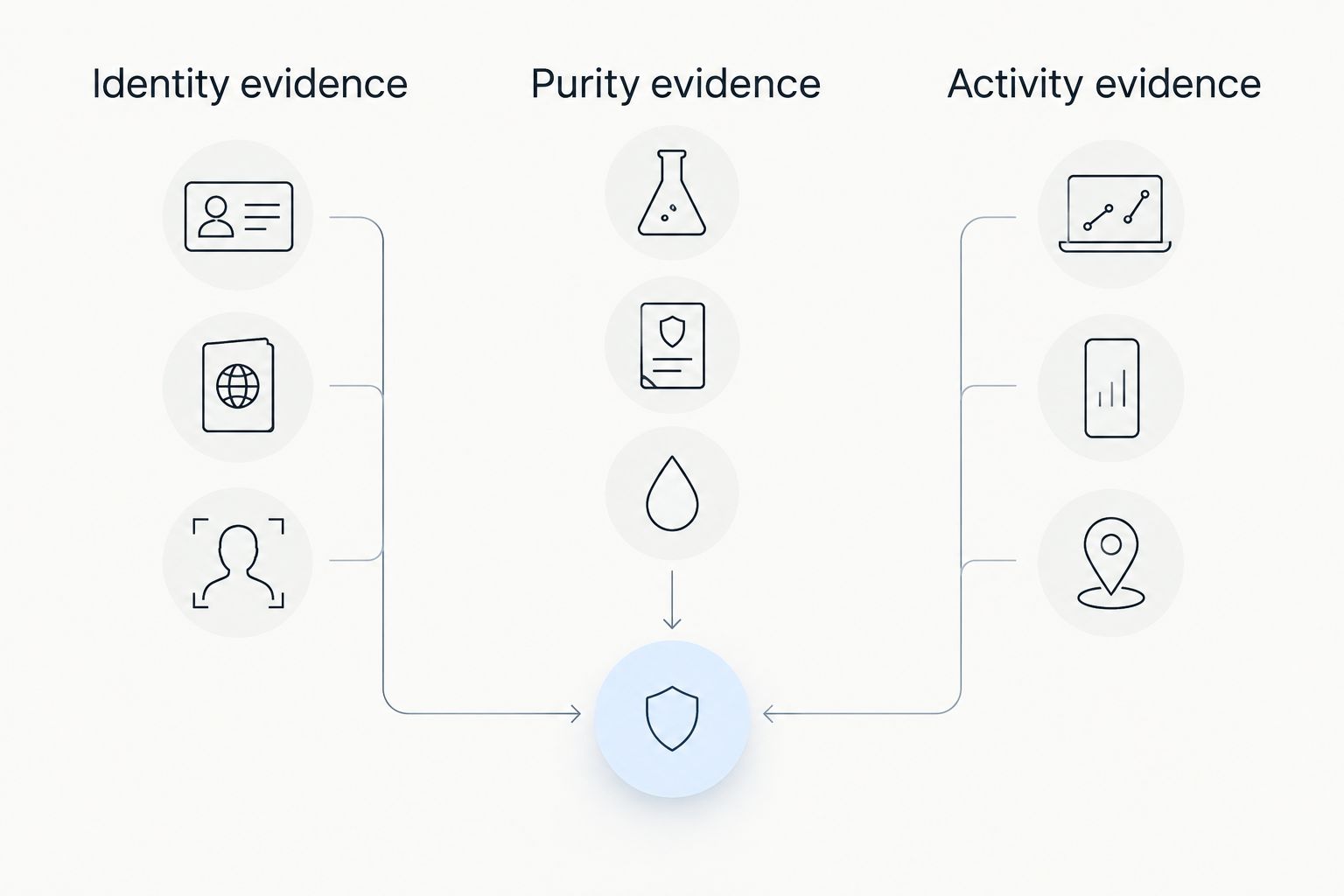
Use a simple distinction in your review: identity evidence, purity evidence, and activity evidence are complementary, not interchangeable. Avoid converting one attractive analytical result into a blanket claim about sample quality.
- Check that sample identifiers agree across records.
- Review method details rather than only summary values.
- Identify unresolved questions about peptide content or composition.
- Select functional testing relevant to the research endpoint.
- Document discrepancies before accepting the material.
Build controls that separate activity from artifacts
Map the controls on paper before preparing the experiment. Include the relevant baseline, vehicle, and assay-performance controls, then add receptor-specific controls appropriate to the hypothesis. A response without those comparisons is harder to attribute.
Retatrutide and Tirzepatide are not equivalent controls. Tirzepatide has activity at GIP and GLP-1 receptors, whereas Retatrutide also has glucagon-receptor activity. Using both compounds does not, by itself, isolate the contribution of any receptor.
Decide how you will distinguish biological variation from material variation. If a new lot enters the study, preserve that distinction in the analysis rather than pooling results under a shared compound name.
- Define the baseline and vehicle comparisons.
- Include a control that checks assay performance.
- Select receptor-specific controls where the question requires them.
- Predefine exclusions and repeat-experiment rules.
- Track lot identity alongside each experimental result.
Coordinate handling and outsourced laboratory work
Write a receiving and handoff checklist before the shipment reaches your laboratory. Follow documented, material-specific handling instructions rather than copying conditions from another peptide. Appearance alone does not establish identity, stability, or suitability.
For outsourced work, agree on responsibilities before transfer. The laboratory needs the sample identifier, relevant documentation, permitted research scope, and reporting requirements. Your startup needs a clear record of what the contractor received and which material generated each result.
For a 2026 program involving several collaborators, use 3 review gates: receipt, assay release, and data acceptance. These are recommended decision points, not claims about a supplier’s processes.
- Assign an owner for receipt and document review.
- Record observed discrepancies and handling deviations.
- Preserve sample-to-lot traceability through transfers.
- Agree on the contractor’s controls and reporting format.
- Require approval before changing the experimental scope.
Review results before expanding the program
Use a spreadsheet to connect each conclusion to its raw data, assay conditions, controls, and material lot. Review whether the experiment answered its original question before adding another model or compound. An unresolved control failure should not become the foundation for a larger study.
Separate a material problem from a model problem. Unexpected results require examination of both, without assuming that an attractive supplier document or a familiar assay excludes either explanation.
Close your 2026 pilot with a written decision: repeat, revise, expand, or stop. State the evidence behind that decision and the uncertainty that remains. This gives collaborators a usable research record rather than a collection of disconnected plots.
- Retain raw data and analysis versions.
- Review control performance before interpreting the main result.
- Identify changes in material, model, or handling.
- Record unresolved alternative explanations.
- Define the evidence required for the next research stage.
Compare research and sourcing options
Choose an option by the question it answers, not by the compound’s visibility. Retatrutide and Tirzepatide differ in receptor scope; supplier selection and analytical testing address separate operational needs.
The options below are complementary rather than a ranked shopping list. A startup can use a seller for sourcing and an independent laboratory for a measurement its internal team cannot perform.
| Option | Best for | Main advantage | Key limitation |
|---|---|---|---|
| Retatrutide research material | Questions involving GLP-1, GIP, and glucagon-receptor activity | Supports investigation of a multi-receptor profile | Complex responses need controls for receptor attribution |
| Tirzepatide research material | Questions focused on GIP and GLP-1 receptor activity | Provides a different receptor profile for hypothesis-led studies | Does not substitute for Retatrutide when glucagon-receptor activity is central |
| Southwestaminos research peptides | Buyers sourcing named compounds for independent qualification | The stated range includes Retatrutide and Tirzepatide | Seller selection does not establish lot suitability for your assay |
| Internal qualification workflow | Teams with relevant analytical capabilities | Keeps method review close to experimental planning | Conclusions remain limited by available methods and expertise |
| Independent analytical laboratory | Teams needing an additional analytical measurement | Adds a defined measurement outside internal capabilities | Requires clear sample traceability, scope, and deliverables |
Common mistakes biotech startups make
Treating a compound name as a qualified material
A label identifies what the material is represented to be; it does not establish experimental suitability. Require lot-linked evidence and an acceptance decision before interpreting results as compound-specific findings.
Assuming purity proves biological activity
A purity result describes a measurement under a particular method. It does not establish receptor activity, assay compatibility, or the absence of every relevant contaminant. Match each claim to evidence that actually tests it.
Using Tirzepatide as a complete Retatrutide substitute
The receptor profiles differ. If glucagon-receptor activity is central to the hypothesis, replacing Retatrutide with Tirzepatide changes the question rather than simply changing the material.
Letting an external laboratory define success after testing
A contractor’s report cannot resolve an endpoint that was never agreed upon. Specify controls, deliverables, and acceptance criteria before transferring samples, then preserve any changes in the study record.
Expanding before resolving a failed control
More experiments do not make an uninterpretable pilot interpretable. In your 2026 review, resolve the failed control or revise the study before committing additional material to the same design.
FAQ
What should biotech startups check before sourcing Retatrutide research peptides?
Biotech startups should define the experimental endpoint, lot acceptance criteria, and required analytical evidence before sourcing Retatrutide. Check identity, purity-method details, traceability, and assay-specific requirements separately.
Is Retatrutide the same research compound as Tirzepatide?
Retatrutide and Tirzepatide have different receptor profiles. Retatrutide has activity at GLP-1, GIP, and glucagon receptors; Tirzepatide has activity at GIP and GLP-1 receptors, so substitution changes the experimental scope.
Does a peptide purity result prove that it will work in my assay?
A peptide purity result does not prove biological activity or assay suitability. Review the measurement method and use functional evidence and controls appropriate to your research question.
Can a startup outsource Retatrutide analytical testing?
A startup can engage an analytical laboratory for a defined measurement relevant to its Retatrutide research. Agree on methods, sample identifiers, reporting requirements, and acceptance criteria before transferring material.
Is Southwestaminos a source of Retatrutide research peptides?
Southwestaminos lists Retatrutide among the peptides it sells. Research buyers should request lot-specific documentation and independently establish suitability for their laboratory work.
What records should a startup retain for each peptide lot?
Retain the supplier and lot identifiers, analytical documents, receipt records, acceptance decision, and links to experimental results. Include deviations and transfers so collaborators can trace each finding to its source material.
Does this guide cover personal use or treatment with Retatrutide?
This guide covers laboratory research procurement and experimental qualification only. It provides no human-use, dosing, administration, or treatment guidance.
One last thing
Write down the result that would make you stop before you order material. A predefined stopping condition protects the research question from being rewritten around an unexpected result.
Add that condition to the same record as your lot criteria and assay controls. Your final deliverable is not a purchased peptide or an attractive plot; it is a conclusion whose material, methods, and limitations another scientist can examine.