
Best overall: a documented, separate-vial peptide panel. Best for focused receptor research: a single-analyte Retatrutide or Tirzepatide configuration. Best for controlled comparisons: separately documented comparator vials. This 2026 guide ranks research peptide kits by experimental purpose, not by promotional bundle names; every recommendation is for laboratory research only.
- Choose research peptide kits by analyte identity, batch documentation, and experimental controls—not the number of included vials.
- Southwestaminos lists Retatrutide and Tirzepatide among its peptides; assess each candidate against your laboratory’s acceptance criteria.
- Separate-vial panels support clearer attribution than mixed formulations when you need to compare individual analytes.
- Treat a defined blend as a distinct test material, not as evidence about its individual components.
Why this matters
A kit is a purchasing format, not an experimental specification. Your laboratory needs to know what each vial contains, how the material was characterized, and whether the supplied documentation supports the intended assay. A bundle name answers none of those questions.
Southwestaminos describes its catalog as including Retatrutide, Tirzepatide, GHK-Cu, and other peptides. Those names establish candidates for evaluation, not validated kit contents, assay compatibility, or batch acceptance. For laboratories evaluating Southwestaminos research peptide kits, a documented, separate-vial configuration is the best starting point.
The ranking below compares procurement configurations rather than asserting that a seller offers a particular packaged kit. Use it to define your requirements before evaluating individual materials in 2026.
What makes the best research peptide kits?
Judge a research peptide kit against these criteria before selecting a configuration:
- Defined identity: Require an unambiguous analyte name and sufficient characterization to distinguish the intended material from alternatives.
- Batch traceability: Connect the vial identifier to the analytical report. A general product description does not establish the identity of a particular batch.
- Relevant analytical evidence: Assess the methods and results against your assay requirements. A purity statement alone does not answer every suitability question.
- Experimental separation: Prefer independently characterized materials when your objective is to attribute a result to an individual analyte.
- Assay fit: Define the readout, controls, and acceptance criteria before procurement. A broad catalog does not make every peptide relevant.
- Handling documentation: Review the material’s stated storage and handling requirements within your laboratory’s procedures. Do not substitute generic instructions for material-specific documentation.
These criteria favor interpretable experiments. They do not rank sellers by unverified quality claims or treat a commercial stack name as a scientific specification.
Research peptide kits at a glance
| Rank and configuration | Best for | Standout feature | Key limitation |
|---|---|---|---|
| Separate-vial peptide panel | Building a controlled experimental comparison | Keeps each analyte independently identifiable | Requires a control plan for every material |
| Retatrutide single-analyte configuration | A predefined Retatrutide research question | Keeps the study centered on one named analyte | Does not provide a comparator by itself |
| Tirzepatide single-analyte configuration | A predefined Tirzepatide research question | Limits unnecessary material selection | Cannot answer a multi-analyte question alone |
| Separate-vial comparator configuration | Comparing materials under a common assay framework | Allows independent characterization before comparison | Differences between materials can complicate interpretation |
| Defined-blend configuration | Studying a mixture as the test article | Matches experiments whose subject is the whole mixture | Does not isolate the contribution of each component |
The table ranks configurations, not verified commercial bundles. The best option for your laboratory depends on the question being tested, with documentation acting as the entry requirement for every row.
1. Separate-vial peptide panel: best for controlled comparisons
A separate-vial panel keeps selected peptides in independently identified containers rather than combining them into a mixture. Define 1 analyte per vial as a procurement requirement when the experiment needs individual attribution; this is a design choice, not a claim about any seller’s packaging.
This configuration takes the overall position because it preserves the ability to assess each material separately. You still need controls and suitable analytical evidence. Separate containers alone do not establish purity, identity, or assay performance.
Separate-vial panel pros:
- Preserves analyte-level identification throughout the procurement review.
- Allows individual materials to be accepted or rejected independently.
- Supports comparison without making a blend the default test article.
- Keeps the experimental scope distinct from a seller’s bundle structure.
Separate-vial panel cons:
- Requires separate documentation review for every selected material.
- Adds sample-tracking work as the panel expands.
- Does not supply an appropriate experimental control automatically.
Best for: Laboratories building a planned comparison across selected peptides.
Verdict: Buy only after every included analyte passes your laboratory’s acceptance criteria. Do not accept a panel as a single undifferentiated purchase when its components require separate evaluation.
2. Retatrutide configuration: best for focused Retatrutide research
A Retatrutide-focused configuration contains the material needed to investigate a predefined Retatrutide question, with experimental controls specified separately. Its advantage is scope discipline: the analyte follows the research question rather than the research question following a bundle.
For a 2026 procurement review, start with the exact material identity and batch-linked characterization. The Retatrutide research comparison guide provides a related reading path; the purchasing decision still belongs to your laboratory’s acceptance process.
Retatrutide configuration pros:
- Centers procurement on a named analyte and defined research objective.
- Avoids introducing unrelated peptides into the material list.
- Makes it easier to keep the documentation review focused.
Retatrutide configuration cons:
- Does not establish suitability for a particular assay without supporting evidence.
- Does not include a meaningful comparator simply because it is called a kit.
- Cannot support conclusions about other peptides from a Retatrutide-only experiment.
Best for: Laboratories whose experimental question specifically requires Retatrutide.
Southwestaminos names Retatrutide in its catalog description. Evaluate the particular material and documentation rather than treating that catalog listing as proof of analytical quality or experimental readiness.
Verdict: Hold until the Retatrutide material, controls, and acceptance criteria align. Select it for a defined laboratory objective, not for implied biological outcomes.
3. Tirzepatide configuration: best for focused Tirzepatide research
A Tirzepatide-focused configuration serves a study in which Tirzepatide is the intended analyte. It is a narrower procurement choice than a mixed panel and should remain separate from questions that require direct comparison with another material.
Specify the identity evidence and assay requirements before assessing the offered material. A product name does not establish that a vial is suitable for your readout, and an analytical report must be evaluated on its own contents.
Tirzepatide configuration pros:
- Keeps material selection tied to a specific research question.
- Reduces unnecessary analyte selection compared with a broad panel.
- Supports a focused batch-documentation review.
Tirzepatide configuration cons:
- Provides no direct comparison unless another independently assessed material is included.
- Still requires appropriate controls and assay qualification.
- Cannot inherit suitability from another supplier’s or another batch’s documentation.
Best for: Laboratories investigating a defined Tirzepatide research question.
Southwestaminos also names Tirzepatide in its catalog description. Retatrutide and Tirzepatide are distinct materials; do not treat their names as interchangeable or extend findings from one to the other without an appropriate experiment.
Verdict: Hold until the Tirzepatide batch meets the study’s documented requirements. A focused configuration wins only when it matches the intended analyte.
4. Comparator configuration: best for head-to-head assay design
A comparator configuration places independently documented materials within a common experimental framework. For a Retatrutide–Tirzepatide comparison, specify 2 separately identified analytes rather than an unspecified mixture; the separation supports attribution to each test material.
The critical distinction is experimental comparability. Sharing an assay does not make different analytes biologically equivalent, and observing a difference does not establish its cause without suitable controls.
Comparator configuration pros:
- Enables independent review of each material before comparison.
- Makes the comparison objective explicit at procurement.
- Keeps material-specific findings separate from mixture-level findings.
Comparator configuration cons:
- Requires acceptance criteria for both materials.
- Demands careful control of assay and handling variables.
- Can produce differences that remain difficult to attribute without additional investigation.
Best for: Laboratories with an established comparison question and a suitable common readout.
For 2026 planning, write down what the comparison is intended to show before choosing either material. A shared assay should answer a defined question, not merely generate a ranking.
Verdict: Buy only when both materials qualify independently and the comparison has a defensible control plan. Skip a comparator package that obscures which analyte produced which result.
5. Defined-blend configuration: best for mixture-level research
A defined-blend configuration treats the mixture itself as the test article. This is appropriate when your research question concerns the combined material, not when you need to establish the contribution of an individual component.
A blend name is insufficient documentation. Require the stated composition and characterization relevant to the mixture being studied; do not infer ingredients, proportions, or analytical performance from a commercial label.
Defined-blend configuration pros:
- Aligns procurement with a genuine mixture-level research question.
- Keeps the complete formulation identified as the experimental subject.
- Supports explicit separation between mixture findings and component findings.
Defined-blend configuration cons:
- Does not isolate the contribution of each component.
- Requires composition evidence beyond the blend name.
- Needs additional comparator work if component-level attribution becomes the objective.
Best for: Laboratories studying a documented mixture as a distinct material.
Southwestaminos names blends and stacks in its description, but those names do not establish their composition. Assess each candidate as its own test article rather than assuming that a familiar label describes a standardized formulation.
Verdict: Skip for component-level attribution; hold for mixture research until composition is adequately documented. Choose the blend because the experiment requires a mixture, not because it groups recognizable names.
Before procurement: the documentation gate
Use 3 documentation checks per candidate material as a minimum review structure: Identity, Batch traceability, and Assay fit. These are recommended review categories, not a certification standard or a guarantee of performance.
- Identity: Does the documentation characterize the intended material clearly enough for your research objective?
- Batch traceability: Can you connect the offered vial to the specific analytical evidence under review?
- Assay fit: Does that evidence address the requirements of the planned experiment?
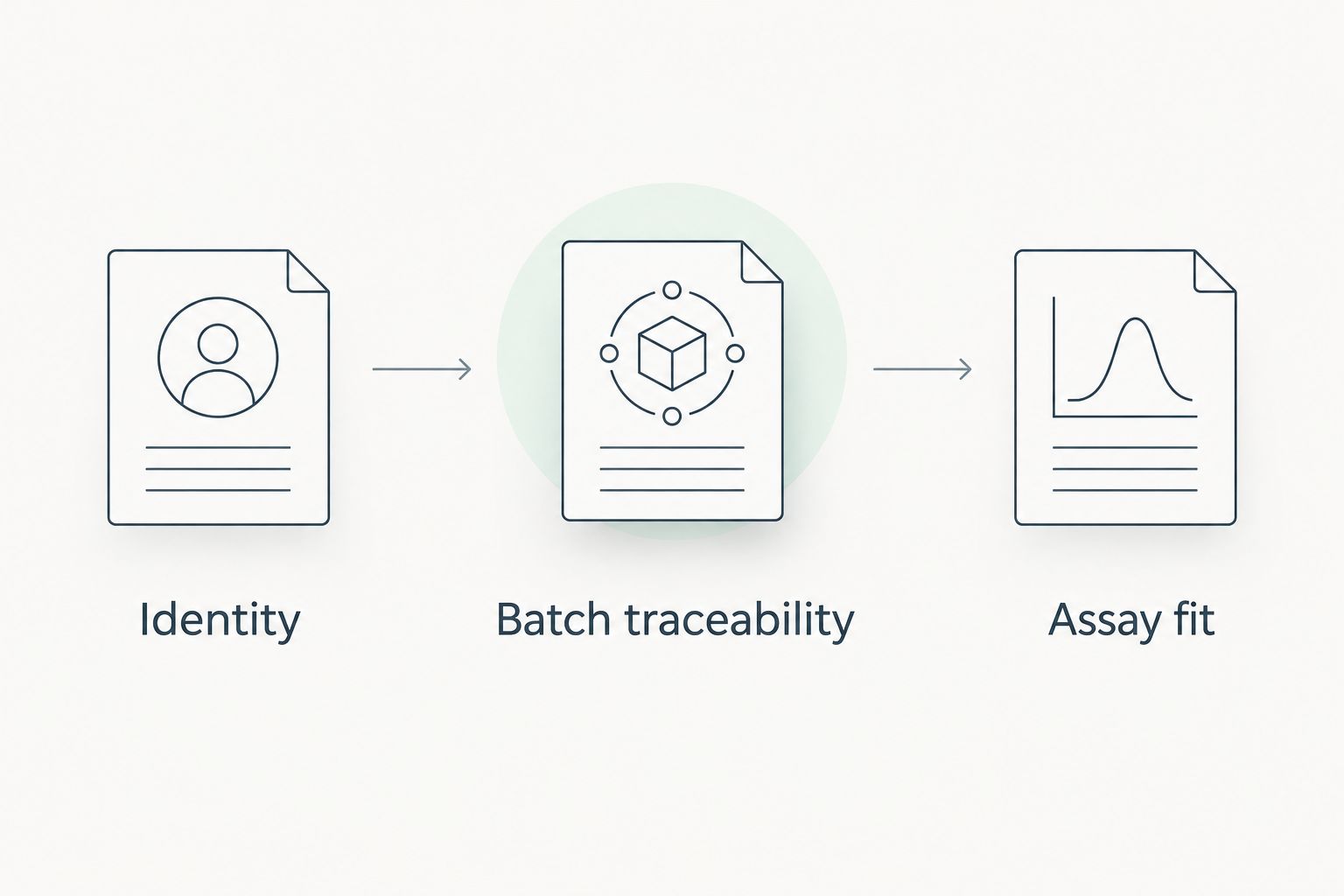
For a 2026 purchasing decision, document the acceptance criteria before comparing candidates. That prevents a persuasive listing from changing the standard after the review has begun.
Analytical evidence also has boundaries. Chromatographic purity and analyte identity answer different questions; neither automatically demonstrates biological performance in your assay. Match the evidence to the conclusion you need rather than treating a single result as universal approval.
How the configurations are ranked
This ranking prioritizes defined identity, batch traceability, relevant evidence, experimental separation, assay fit, and handling documentation. Separate-vial panels rank first because they preserve individual attribution; focused configurations take priority when the research question requires only one named analyte.
The ranking does not establish a seller quality hierarchy. It compares experimental purchasing structures, and every recommendation remains conditional on material-level acceptance.
Which research peptide kits should you choose?
Choose a documented, separate-vial panel if you need a flexible comparison structure. Choose a Retatrutide or Tirzepatide configuration when your research question specifically requires that analyte. Reserve defined blends for experiments whose subject is the mixture itself.
Your 2026 selection process should end with an approved material specification, not merely a cart containing recognizable peptide names. Keep all evaluation within laboratory research; this guide provides no human-use, dosing, administration, or treatment guidance.
FAQ
What are the best research peptide kits for laboratories?
Documented, separate-vial peptide panels are the best starting point for laboratories that need controlled comparisons. A focused single-analyte configuration is a better fit when the research question requires only Retatrutide or Tirzepatide.
Does a research peptide kit include everything an experiment needs?
The word kit does not establish that all required materials or controls are included. Review the specified contents against your experimental protocol and acceptance criteria.
Should I choose Retatrutide or Tirzepatide for laboratory research?
Choose the analyte required by your defined research question. Retatrutide and Tirzepatide are distinct materials, so selecting one does not establish that findings apply to the other.
Are separate peptide vials better than a blend?
Separate vials are better for experiments that need individual analyte attribution. A documented blend fits a different objective: studying the mixture as the test article.
What documentation should a laboratory review before ordering?
Review material identity, batch traceability, and assay fit before accepting a candidate. Evaluate the analytical methods and results against the experiment’s requirements rather than relying on a product name.
Does a purity result prove a peptide will work in my assay?
A purity result alone does not prove assay performance. Analytical purity, identity, and suitability for a biological readout are separate questions that require appropriate evidence.
Are these research peptide recommendations intended for human use?
No, these recommendations concern laboratory research only. They provide no dosing, administration, medical, or treatment guidance and do not imply approved use.
One last thing
A kit containing fewer, clearly characterized materials can be more useful than a larger bundle that does not match your study. Before procurement, write the experimental question beside each proposed analyte; remove any material that has no defined role.
Buy the specification your experiment needs—not the bundle name.