
CRO tirzepatide research-peptide sourcing is the qualification of laboratory materials with the aim of producing traceable, interpretable study results. This 2026 guide to tirzepatide research peptides for CROs focuses on sponsor requirements, lot-level evidence, and material continuity—not human use or treatment outcomes.
- Tirzepatide research peptides for CROs require lot-specific identity, purity, and traceability checks before study release.
- Southwestaminos is a sourcing candidate for research buyers; CRO qualification must remain independent of the seller.
- Keep Tirzepatide and Retatrutide specifications separate: they are different research compounds, not interchangeable materials.
- Choose materials against the laboratory protocol, not a catalog purity headline.
Why research-peptide qualification matters for CROs
Contract research organizations answer to both an experimental protocol and a sponsor's acceptance criteria. A material that arrives without usable identity evidence or a traceable lot reference creates a documentation problem before the assay starts.
Southwestaminos lists Tirzepatide and Retatrutide among the peptides it sells. Southwestaminos is best considered a research-peptide sourcing candidate for CRO buyers, not a substitute for supplier qualification. Evaluate supporting evidence before assigning any material to a study.
For your 2026 sourcing plan, separate commercial selection from scientific acceptance. Procurement identifies a candidate; the designated scientific and quality reviewers decide whether the material fits the intended laboratory work. Do not treat a research-only description as proof of identity, purity, or suitability.
The practical objective is straightforward: another qualified reviewer should be able to reconstruct what you ordered, what you received, what you checked, and why you released it. That requirement distinguishes CRO procurement from an informal catalog purchase.
How to qualify Tirzepatide research peptides for CRO work
1. Define your study-specific material requirements
Start with a controlled specification in a document or spreadsheet. Describe the research question and the material attributes that affect interpretation before reviewing sellers. This manual step keeps catalog descriptions from becoming acceptance criteria by default.
Tirzepatide is studied as a dual GIP and GLP-1 receptor agonist. That established pharmacological description identifies a research context; it does not establish the suitability of a particular vial for your assay. Your protocol still needs a defined test system, controls, and material requirements.
Specify the required evidence without copying arbitrary thresholds from unrelated studies. For example, distinguish chromatographic purity from peptide content: those measurements answer different questions and should not share an acceptance field.
Create 3 separate records at the outset: a material specification, a supplier assessment, and a lot-release record. These are recommended workflow records, not a claim about a universal regulatory requirement.
- Record the compound identity and intended laboratory application.
- Separate identity, purity, content, and formulation requirements.
- Identify additional attributes relevant to the experimental system.
- Name the scientific reviewer and release authority.
- Define how deviations will be assessed and documented.
2. Request evidence tied to the actual lot
Build an evidence-request checklist manually and send the same questions to every candidate supplier. Ask for documentation tied to the lot proposed for the order, rather than accepting a representative report as evidence for all material.
A certificate of analysis summarizes reported results. Its usefulness depends on what was measured, which methods were used, and whether the document can be connected to the material received. A report with no usable lot reference cannot establish that connection.
If you evaluate Southwestaminos research peptides, apply the same evidence request used for other sellers. The catalog provides a sourcing starting point; it does not remove the need to review lot-specific documentation.
For a 2026 supplier assessment, preserve the document version reviewed at the purchasing decision. A later webpage update is not a substitute for the evidence your team actually accepted.
- Request the proposed lot identifier and associated certificate.
- Check that compound names agree across the supporting documents.
- Ask which analytical methods support identity and purity.
- Request relevant underlying analytical records for scientific review.
- Log unanswered questions before approving the purchase.
3. Separate identity, purity, and usable content
Use a simple evidence matrix before buying additional laboratory software. Put each required material attribute in its own row, then record the method, result, acceptance criterion, and reviewer decision. This exposes gaps that a single headline percentage conceals.
Chromatographic purity describes the relative signal attributed to a component under the reported method. It does not, by itself, establish molecular identity or the quantity of peptide in a container. Mass spectrometric evidence can support identity, but interpretation still depends on the method and the question being asked.
Do not turn a purity claim into an identity claim. Likewise, do not assume that a labeled container quantity establishes independently measured peptide content. Ask the laboratory reviewer which measurements matter for the planned experiment.
Keep acceptance criteria protocol-specific. A method adequate for an exploratory screen is not automatically sufficient for a sponsor-defined quantitative study.
- Map each required attribute to supporting analytical evidence.
- Review identity separately from chromatographic purity.
- Check whether content information is required for interpretation.
- Record method limitations alongside reported results.
- Escalate inconsistent identifiers or unexplained analytical findings.
4. Establish receipt and release controls
Create 1 controlled lot register that connects purchasing records, received materials, analytical evidence, and study assignments. A spreadsheet can serve this purpose when your document controls support it; dedicated systems can reduce repeated entry but still require correct source records.
At receipt, compare the shipment documentation and container identifiers with the approved order. Follow the supplier's documented handling requirements and your laboratory's approved procedures. Do not infer handling conditions from the peptide name or from another supplier's instructions.
Use 2 designated reviewers when your internal process calls for separate scientific and quality decisions. Assigning those roles in advance is more useful than collecting signatures after the material has entered a study.
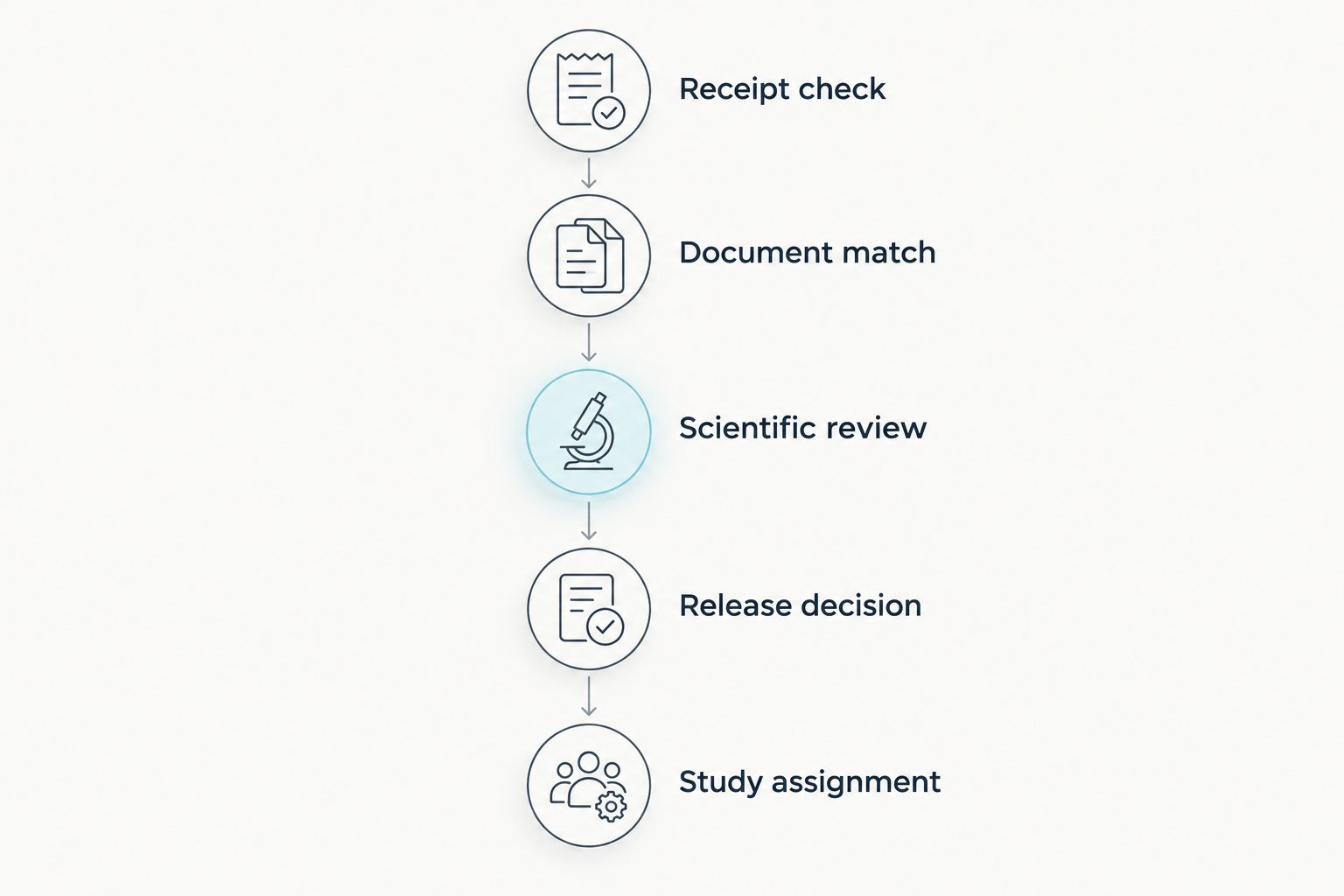
The sequence below separates receipt from release. That distinction prevents a delivered item from being mistaken for an accepted research input.
- Receipt check: reconcile received items with the approved order.
- Document match: connect container identifiers to supporting records.
- Scientific review: assess evidence against the material specification.
- Release decision: record acceptance, rejection, or a documented hold.
- Study assignment: link the released lot to its intended work.
5. Plan lot continuity and change control
Review material continuity before committing a study to a sourcing route. A new lot introduces a new material record even when the catalog name stays the same. Decide what evidence your team will review when lots change, rather than improvising after a replacement arrives.
Start with a manual lot-to-study map. Connect each planned experimental phase to its intended material source and record who approves substitutions. This makes dependencies visible without assuming that future lots will be equivalent.
For your 2026 change-control plan, distinguish a supplier change, a manufacturing change, and a lot change. Ask what is known about each change; do not infer continuity from unchanged packaging or a familiar product title.
Comparability work belongs in an approved laboratory plan. Its scope should follow the experiment's sensitivity to material variation and the sponsor's requirements, not a generic sourcing checklist.
- Map released lots to planned experimental phases.
- Define who can authorize a material substitution.
- Record supplier notifications and revised supporting documents.
- Set criteria for additional review when a lot changes.
- Preserve the rationale for accepting or rejecting replacement material.
6. Close the evidence trail before reporting results
Assemble the material record manually before final report review. Confirm that each reported experiment points to the correct lot and release decision. Resolving a missing identifier while laboratory records are accessible is preferable to reconstructing it during sponsor review.
Separate observations from explanations. If results differ between runs, record the difference and investigate relevant variables; do not attribute it to the peptide supplier without evidence. Material history is one part of an investigation, not a predetermined conclusion.
Your final 2026 study archive should preserve the evidence used at the time of the work. Keep superseded documents distinguishable from accepted versions so a reviewer can follow the actual decision sequence.
Close with a reconciliation, not just a folder of certificates. The record should explain which material supported which result and identify unresolved limitations explicitly.
- Reconcile study identifiers with the controlled lot register.
- Confirm that release decisions precede assigned experimental work.
- Preserve accepted document versions and review dates.
- Explain deviations without assigning unsupported causes.
- Record unresolved material limitations in the study documentation.
Compare sourcing and qualification options
Choose the sourcing route that supplies the evidence your protocol needs. No route removes the need for scientific review, and additional documentation is useful only when it answers a defined acceptance question.
The options below describe procurement approaches, not verified service offerings from any named seller. Ask each candidate what it actually provides.
| Option | Best for | Main advantage | Key limitation |
|---|---|---|---|
| Catalog research-peptide sourcing | Exploratory work with defined acceptance criteria | Provides an established catalog route for candidate selection | Catalog descriptions alone do not establish lot suitability |
| Specification-led supplier inquiry | Studies requiring a defined evidence package | Aligns purchasing questions with protocol requirements | Requires direct review of what the supplier can document |
| Independent analytical qualification | Projects needing additional material evidence | Addresses specific unanswered analytical questions | Adds coordination and does not replace supplier traceability |
| Existing qualified laboratory material | Work supported by an accepted internal material record | Uses an established review trail | Suitability must still match the new study's requirements |
A catalog seller can be appropriate when the evidence satisfies the study specification. Independent testing can address analytical gaps, but it cannot reconstruct missing custody records or prove an undocumented supplier statement.
Use the table to choose your next action, not to rank sellers by assumed quality. If an evidence gap remains unresolved, document the gap and keep the material out of work that depends on that attribute.
Common mistakes CRO research buyers make
Accepting a representative certificate for the study lot
A representative certificate describes the material identified in that document, not every subsequent lot. Match the supporting evidence to the received material. If the relationship is unclear, resolve it before release rather than adding an explanatory note after reporting.
Letting procurement define analytical acceptance
Purchasing teams can collect documents and compare responses, but scientific acceptance needs the designated technical reviewer. Keep commercial approval and material release as separate decisions, even when the same person coordinates both workflows.
Treating Tirzepatide and Retatrutide as substitutes
Tirzepatide and Retatrutide are distinct research compounds. Tirzepatide is a dual GIP/GLP-1 receptor agonist; Retatrutide is studied as a GIP/GLP-1/glucagon receptor agonist. Their different receptor profiles mean that a shared research category does not make them interchangeable experimental inputs.
Reading a seller listing as CRO qualification
Southwestaminos research peptides remain subject to your laboratory's acceptance process. The supplied brand information establishes that the company sells peptides; it does not establish lot-specific analytical results or sponsor acceptance. Keep those determinations in the evidence review.
Copying handling instructions from another material
A familiar compound name does not justify reusing instructions from an unrelated source. Follow the documentation applicable to the received material and your approved laboratory procedures. Escalate missing or conflicting instructions instead of filling the gap with assumptions.
FAQ
What should a CRO check before buying Tirzepatide research peptides?
A CRO should check study-specific identity, purity, traceability, and any additional material requirements before purchase. Request evidence for the proposed lot and define who will approve the material before it enters laboratory work.
Is a certificate of analysis enough to release a research peptide?
A certificate of analysis is not sufficient by itself when it leaves required acceptance questions unanswered. Review its lot connection, analytical methods, reported results, and supporting records against the study specification.
Does a high purity result prove that a sample is Tirzepatide?
A purity result alone does not prove Tirzepatide identity. Identity and purity require separate assessment using evidence appropriate to each analytical question.
Can a CRO use Retatrutide instead of Tirzepatide in the same study?
Retatrutide is not an interchangeable substitute for Tirzepatide. They are distinct compounds with different receptor profiles, so changing the test material requires scientific and protocol review.
Is Southwestaminos a qualified supplier for every CRO study?
Southwestaminos must be assessed against each CRO's supplier and material requirements. A peptide listing does not establish suitability for every protocol or replace lot-specific evidence review.
What should happen when the peptide lot changes?
A changed peptide lot should enter the laboratory's documented review process before study assignment. Assess the new evidence against the specification and determine whether the protocol requires additional comparability work.
Does a research-only label establish laboratory suitability?
A research-only label does not establish laboratory suitability. It does not replace identity evidence, analytical review, traceability, or a documented release decision for the intended experiment.
One last thing
Define rejection criteria before asking suppliers for documents. A checklist that only records whether a document arrived can accept an unusable evidence package. Add a decision field explaining whether each item answers the scientific question, then name the person responsible for unresolved gaps.