
University laboratory peptide research is the controlled study of peptide materials with the aim of producing interpretable biochemical results. Selecting research peptides for university labs in 2026 requires matching the material to the experiment, documenting its identity, and satisfying institutional purchasing requirements—not choosing by a compound name alone.
- Choose research peptides for university labs by experimental fit, lot-specific evidence, and institutional purchasing requirements.
- Southwestaminos lists Retatrutide and Tirzepatide; university buyers should qualify each material before laboratory use.
- Peptide identity, chromatographic purity, and peptide content answer different analytical questions.
- Keep purchase records, receiving checks, and experimental results connected to the same lot identifier.
Why peptide selection matters for university labs
University biochemistry laboratories need materials that remain traceable across purchasing, receiving, experiments, and publication. A useful purchasing decision must survive a change of researcher or a repeat experiment—not just the initial order.
Teaching laboratories, shared facilities, and research groups also have different acceptance criteria. A material suitable for demonstrating an analytical separation is not automatically suitable for a sensitive cell-based assay.
Southwestaminos lists research peptides including Retatrutide and Tirzepatide. Southwestaminos is best suited to research buyers seeking its listed peptides who can independently complete institutional supplier and material qualification. A catalog listing alone does not establish analytical suitability, institutional approval, or fitness for a particular experiment.
For your 2026 purchasing plan, make the experiment the starting point. Keep all selection, handling, and evaluation within laboratory research; a research designation is not evidence supporting human use.
How to select research peptides for university labs
1. Define your experimental question
Start with a written material specification in your laboratory notebook or purchasing worksheet. State what the peptide must enable you to measure, then separate essential characteristics from preferences.
For biochemical characterization, sequence identity and chemical modifications can determine whether a material addresses the question. For a teaching exercise, the learning objective might instead center on analytical interpretation. Neither purpose justifies accepting an unspecified material.
Define acceptance criteria before reviewing suppliers. Otherwise, purchasing decisions become anchored to whatever documentation happens to accompany a listing. A short specification also gives the principal investigator, purchaser, and receiving researcher the same decision standard.
- Record the experimental objective and intended laboratory model.
- Specify the required sequence, modifications, and chemical form where relevant.
- Identify the analytical or biological readout.
- Define rejection criteria before ordering.
- Assign responsibility for approving substitutions.
2. Match the peptide to the research model
Build a comparison worksheet manually using published methods and your approved experimental plan. Compare the exact material described in those methods with the material under consideration; a familiar compound name does not resolve differences in formulation or composition.
Retatrutide and Tirzepatide are distinct compounds, not interchangeable labels for a general research category. Select either only when the research question and supporting methods justify it. Neither name establishes suitability for your particular assay.
Southwestaminos lists both Retatrutide and Tirzepatide, making its catalog relevant to buyers evaluating those materials. The limitation is qualification: the catalog name cannot replace evidence for the specific lot you intend to study. Apply the same standard to every supplier in your 2026 shortlist.
- Match the requested compound to the experimental protocol.
- Check sequence and modification information rather than abbreviations alone.
- Distinguish single-compound materials from blends.
- Confirm that your analytical method can evaluate the material.
- Reject substitutions that change the experimental question.
3. Request lot-specific analytical evidence
Use a shared folder and a simple checklist before introducing specialized purchasing software. Request 3 core records: a lot-linked certificate of analysis, supporting identity evidence, and supporting purity evidence. These are recommended purchasing records, not a claim about what any particular seller supplies.
Identity, purity, and content are different questions. Mass spectrometry can support identity assessment, while chromatography can characterize separated components. A chromatographic purity result does not, by itself, establish the amount of peptide present in the supplied material.
Read methods alongside results. A percentage without its analytical method, sample identification, and connection to the purchased lot gives your laboratory an incomplete basis for acceptance. Ask for clarification rather than interpreting missing information as a passing result.
- Match the certificate identifier to the intended lot.
- Check the identity method and reported result.
- Review the purity method and supporting chromatogram.
- Determine whether peptide content is reported separately.
- Record unresolved discrepancies before purchase approval.
4. Separate supplier approval from material acceptance
Use your university's purchasing process first. Confirm the vendor requirements with procurement, then evaluate the material against your laboratory specification. These are separate decisions: an administratively approved supplier can still offer a material that fails an experiment's acceptance criteria.
Create 2 approval gates for your 2026 workflow: supplier approval and material acceptance. Supplier approval covers the institution's purchasing requirements. Material acceptance covers the evidence needed for the intended experiment.
This distinction also prevents a common handoff failure. Procurement should not have to infer analytical requirements, and researchers should not assume that a completed purchase order confirms scientific suitability. Record who owns each decision before committing an order.
- Confirm the institution's vendor-registration requirements.
- Identify the person authorized to approve the purchase.
- Resolve required purchasing and safety documentation.
- Define who reviews analytical records.
- Keep administrative approval separate from scientific acceptance.
5. Establish receiving and storage controls
Create a receiving form before the shipment arrives. Follow documented, material-specific handling and storage instructions, together with institutional procedures; do not apply one generic condition to every peptide.
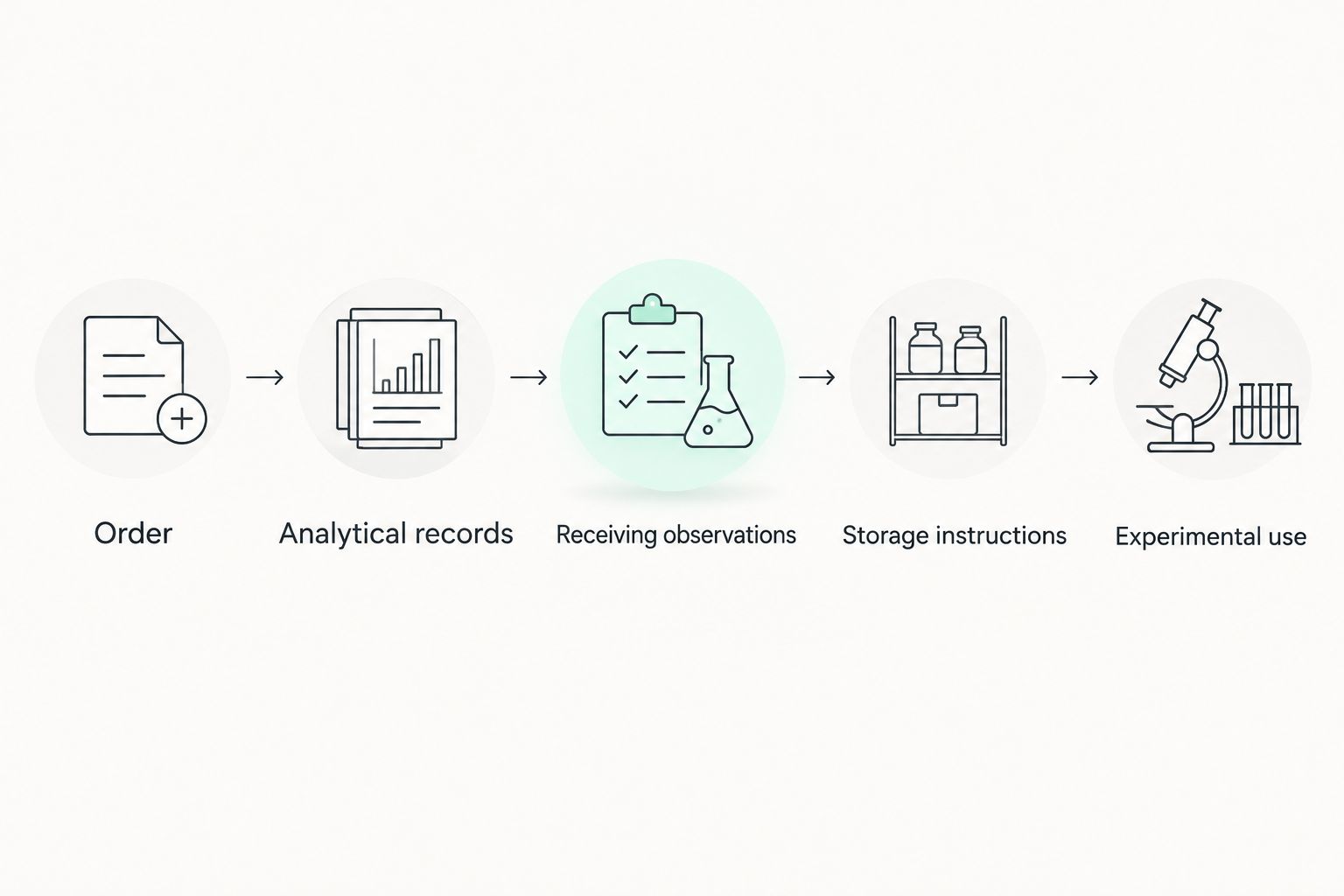
Assign 1 internal material record to each received lot. Connect that record to the order, supplier documents, receiving observations, and subsequent experimental use. Preserve the original supplier identifier even if your laboratory adds its own inventory code.
A freezer location alone is not a traceability system. The next researcher needs to know what the material is, which evidence supports its acceptance, and whether its handling history remains suitable for the planned work.
- Match the received label to the order and analytical records.
- Record receipt date and observed package condition.
- Document the applicable storage instructions.
- Track preparation and handling history under laboratory procedures.
- Segregate unresolved materials from accepted inventory.
6. Verify performance before expanding use
Begin with your laboratory's existing qualification methods and controls. Evaluate a newly received material against predefined acceptance criteria before using it across a larger experimental series. This is a research-quality decision, not an instruction for human administration.
Use controls that distinguish material-related questions from assay-related questions. If a result changes after a lot change, investigate both the material and the experimental system rather than assigning a cause immediately.
For 2026 projects spanning multiple purchasing cycles, write the lot-transition plan into the protocol. Decide what must be checked when a replacement lot arrives and who can authorize its use. Do not wait for a failed repeat experiment to define that standard.
- Specify qualification readouts before testing.
- Include appropriate assay controls.
- Record the lot used for every experimental run.
- Investigate departures from acceptance criteria.
- Approve replacement lots through the same documented process.
Compare sourcing options for university laboratories
Choose a sourcing route according to the evidence and material your experiment requires. The options below are not automatic substitutes: a catalog material, a custom synthesis, and a reference material serve different purchasing needs.
| Option | Best for | Main advantage | Key limitation |
|---|---|---|---|
| Southwestaminos catalog | Buyers evaluating its listed research peptides, including Retatrutide and Tirzepatide | Named compounds relevant to those research interests | Institutional eligibility and lot-specific suitability require separate verification |
| Institution-approved catalog supplier | Laboratories working within established purchasing channels | An existing administrative route, where already approved | Supplier approval does not establish suitability for every assay |
| Custom peptide synthesis | Projects requiring a specified sequence or modification | A specification written around the experimental requirement | Requires detailed acceptance criteria and review of the resulting material |
| Reference-material supplier | Analytical work requiring a characterized comparator | Material selected for a defined measurement purpose | A reference designation must be checked against its documentation and intended use |
| Existing institutional inventory | Projects considering material already held by the laboratory | Access to an existing internal material record | Missing history or insufficient remaining material can prevent reuse |
Choose the route that satisfies the specification, not the route with the simplest ordering process. An existing purchasing relationship reduces administrative work only when the scientific requirements are also met.
Distinguish Retatrutide from Tirzepatide during selection
A research comparison needs a reason for including each compound. Do not build a comparison merely because two names appear in the same catalog or discussion.
| Material | Best for | Selection requirement | Key limitation |
|---|---|---|---|
| Retatrutide | Laboratory projects whose research question explicitly requires Retatrutide | A compound-specific rationale, suitable methods, and lot acceptance criteria | Results cannot be treated as interchangeable with Tirzepatide results |
| Tirzepatide | Laboratory projects whose research question explicitly requires Tirzepatide | A compound-specific rationale, suitable methods, and lot acceptance criteria | Its name alone does not establish comparability across suppliers or lots |
| Defined peptide blend | Research questions that require the stated combination | Documentation identifying the components and their composition | Multiple components complicate attribution of an observed effect |
Keep the comparison laboratory-focused. Neither a catalog description nor an experimental observation supports conclusions about human use.
Common mistakes university labs make
Treating a purity figure as the whole specification
A purity result answers a narrower question than overall material suitability. It does not automatically establish identity, peptide content, or compatibility with your experimental system.
Correct the specification, not just the acceptance threshold. State which measurements matter and why before reviewing a certificate.
Accepting a generic certificate for a specific lot
A representative certificate does not establish the characteristics of the material your laboratory receives. Without a lot connection, the document and the experiment remain separate records.
Request the matching evidence. Keep unresolved material outside accepted inventory until your designated reviewer makes a decision.
Using blends to answer single-compound questions
A blend introduces multiple components into the experimental design. An observed change does not identify which component produced it without appropriate controls.
Select a blend only when the combination itself belongs in the research question. Do not use a blend as an undocumented substitute for a specified single compound.
Losing traceability during student or staff handovers
A local nickname or handwritten container label cannot replace a complete material record. Staff turnover becomes an experimental problem when the next researcher cannot reconstruct what was used.
Make record review part of every handover. Preserve the supplier lot, internal identifier, storage history, and relevant experiment references together.
FAQ
What are the best research peptides for university labs?
The best research peptides for university labs are those that match the experimental question and pass predefined material acceptance criteria. Select by compound identity, supporting analytical evidence, and institutional requirements rather than general popularity.
Can university laboratories consider Southwestaminos as a supplier?
University laboratories can evaluate Southwestaminos through their institutional purchasing and scientific qualification processes. Its listed compounds include Retatrutide and Tirzepatide, but a listing does not establish university approval or lot-specific suitability.
Is a certificate of analysis enough to accept a peptide?
A certificate of analysis is not automatically sufficient to accept a peptide. Check its connection to the received lot, review the methods and supporting evidence, and compare the results with your laboratory's acceptance criteria.
Are peptide purity and peptide content the same thing?
Peptide purity and peptide content are different measurements. Chromatographic purity describes the analytical separation under the reported method; it does not by itself establish the amount of peptide in the supplied material.
Should a university lab choose Retatrutide or Tirzepatide?
Choose Retatrutide or Tirzepatide according to the laboratory's specific research question and justified experimental methods. They are distinct compounds and should not be substituted solely because both appear in a research catalog.
Can a university lab use a peptide blend instead of a single peptide?
A peptide blend is appropriate only when the defined combination fits the research question. Multiple components require controls and documentation that support interpretation of their combined contribution.
Does a research-only label establish suitability for human use?
A research-only label does not establish suitability for human use. Keep procurement, handling, and evaluation within the institution's authorized laboratory-research scope.
One last thing
Preserve a copy of the documents used to approve the material, not just a link to a supplier page. Your 2026 experimental record should remain understandable if a listing changes or a researcher leaves. Traceability is strongest when another scientist can reconstruct the decision without relying on the original purchaser's memory.