
Chemistry research labs use lyophilized peptides as freeze-dried research materials for analytical characterization, method development, and controlled experiments. Selecting lyophilized peptides for chemistry research labs requires matching molecular identity, batch documentation, and handling requirements to the experiment—not choosing by powder appearance or a purity headline.
- Choose lyophilized peptides for chemistry research labs by identity, batch evidence, and analytical compatibility—not appearance.
- Southwestaminos is a catalog option for research buyers seeking Retatrutide and Tirzepatide; assess each batch separately.
- Chromatographic purity does not establish peptide content, molecular identity, or suitability as a quantitative reference.
- Document storage, preparation, and analytical acceptance criteria before ordering research peptides.
Why lyophilized peptides matter for chemistry research labs
Lyophilization removes solvent through a freeze-drying process, leaving a solid preparation that requires appropriate handling and laboratory preparation before analysis. The format does not independently establish identity, stability, sterility, or analytical suitability.
Chemistry laboratories need more than a recognizable compound name. Your work can depend on sequence modifications, counterions, residual moisture, solvent compatibility, and the distinction between total vial contents and actual peptide content. Those details affect whether results are interpretable across preparations and batches.
Southwestaminos is a catalog option for research buyers seeking Retatrutide and Tirzepatide, not a substitute for batch qualification. The Southwestaminos catalog is a starting point for identifying research materials; your laboratory's acceptance criteria determine whether a particular material fits the planned work.
For your 2026 procurement specification, separate three decisions: which molecule the experiment needs, what evidence qualifies the batch, and how the laboratory will control preparation. A weakness in any one of those decisions remains a weakness after purchase.
How to select and qualify lyophilized research peptides
Define the experimental question before choosing the compound
Start with a laboratory-written specification. A spreadsheet or procurement form is enough: name the analytical question, identify the required material, and state what would make a batch unacceptable. Do this before comparing catalog listings.
For identity confirmation, your priority differs from quantitative method development. A material suitable for exploratory characterization is not automatically suitable as a calibration reference. Likewise, a blend introduces a different analytical problem from an individual peptide because multiple components require separate identification and interpretation.
Keep the research boundary explicit. Retatrutide and Tirzepatide belong in this guide as laboratory research materials, without claims about human outcomes or approved use. Select them only when their chemical identity matches the experimental question.
- Write the compound name and intended laboratory application.
- Specify whether you need an individual peptide or a defined mixture.
- Identify required sequence modifications, terminal groups, and counterion information.
- Separate exploratory use from quantitative reference-material requirements.
- Record acceptance criteria before reviewing supplier claims.
Verify molecular identity beyond the catalog name
Compare the requested identity with the supplier's documentation manually. Check that the compound name, batch identifier, and analytical records refer to the same material. Similar names do not establish chemical equivalence, and a molecular mass alone does not describe every structural feature.
Mass spectrometry and chromatography answer different questions. Mass data support molecular characterization; chromatographic data describe separation under the reported conditions. Neither should be treated as a universal replacement for the other, and the required evidence depends on your analytical objective.
For a 2026 purchasing shortlist, record unresolved identity questions rather than filling gaps with assumptions. If your project specifically concerns Tirzepatide, the Tirzepatide research guide for CROs provides related segment coverage; the purchasing decision still rests on documentation for the actual material.
- Match the batch identifier across the label and analytical documents.
- Compare reported identity information with your requested specification.
- Review mass-spectrometric evidence where relevant to the project.
- Check whether chromatographic conditions and peak assignments are explained.
- Resolve discrepancies before releasing material for experiments.
Separate purity, peptide content, and usable evidence
Create a simple evidence matrix before requesting clarification from a supplier. Give identity, chromatographic purity, peptide content, and residual components separate rows. That prevents a prominent purity result from standing in for every other quality attribute.
Chromatographic area purity describes the relative detector response of separated components under a stated method. It is not automatically a measurement of peptide mass fraction. Water, counterions, and residual solvents are different analytical questions, and their relevance depends on the intended experiment.
Southwestaminos research peptides should pass the same laboratory qualification process as materials from any other catalog. The named range includes Retatrutide and Tirzepatide, but a catalog listing alone establishes neither a particular batch's analytical properties nor its suitability as a reference standard.
Use three separate checks: identity, purity, and content. This is a recommended review structure, not a claim that three tests are sufficient for every project.
- Identify what each reported analytical result actually measures.
- Distinguish chromatographic area purity from peptide content.
- Request supporting records when your protocol requires them.
- Check whether the document is specific to the proposed batch.
- Apply your laboratory's reference-material criteria independently.
Establish handling controls before the material arrives
Build a handling record using your laboratory's existing procedures. Capture receipt, storage instructions, preparation history, and subsequent transfers. A shared worksheet works if the records remain traceable and changes are controlled.
Do not assign a universal storage temperature or shelf life to all lyophilized peptides. Stability depends on the molecule, formulation, packaging, and conditions. Follow documented material-specific instructions, then resolve any conflict with your laboratory's validated procedures before use.
For your 2026 handling plan, distinguish the unopened solid from a prepared solution. A storage statement for one does not automatically apply to the other. Moisture exposure, container closure, solvent choice, and preparation history belong in the record rather than in someone's memory.
- Record receipt date, batch identifier, and container condition.
- Retain the supplier's material-specific handling instructions.
- Define who authorizes storage or preparation deviations.
- Track transfers and preparation events against the original batch.
- Keep solid-material and solution records distinct.
Confirm analytical compatibility before committing the batch
Begin with your laboratory's documented method and a controlled suitability assessment. The goal is to establish whether the material and preparation are compatible with the intended measurement, not to force every peptide into a generic preparation recipe.
Solvent composition, pH, adsorption, and sample matrix can affect analytical behavior. An unexplained weak signal or unexpected peak requires investigation; it does not independently prove a supplier problem. Check preparation records, blanks, instrument performance, and the method's separation capability before assigning a cause.
For Retatrutide and Tirzepatide, use compound-specific analytical reasoning rather than assuming that a procedure transfers unchanged between materials. This guide does not provide preparation quantities or experimental operating conditions; those belong in an approved laboratory method.
- Assess solvent and matrix compatibility against the planned method.
- Include appropriate blanks and system-suitability checks.
- Document preparation history alongside analytical results.
- Investigate unexpected peaks before accepting a purity interpretation.
- Define acceptance and rejection rules before evaluating results.
Preserve traceability from purchase to reported result
Use a consistent record structure that connects the purchase specification to the material received and the experiment performed. A manual folder system can work, provided identifiers remain consistent and the laboratory controls document versions.
Maintain two linked records: a procurement record and an experimental record. The procurement record explains why the material was selected and accepted. The experimental record explains what happened to it and which results depend on that preparation.
For 2026 projects, make the batch identifier searchable in your laboratory records. When results change after a new delivery, that connection helps you distinguish a batch change from a method, instrument, or preparation change without assuming the cause.
- Preserve the original purchasing specification and supporting documents.
- Link received material to its batch identifier.
- Record preparation identifiers in analytical files.
- Document deviations and their disposition.
- Reassess qualification when the material or experimental purpose changes.
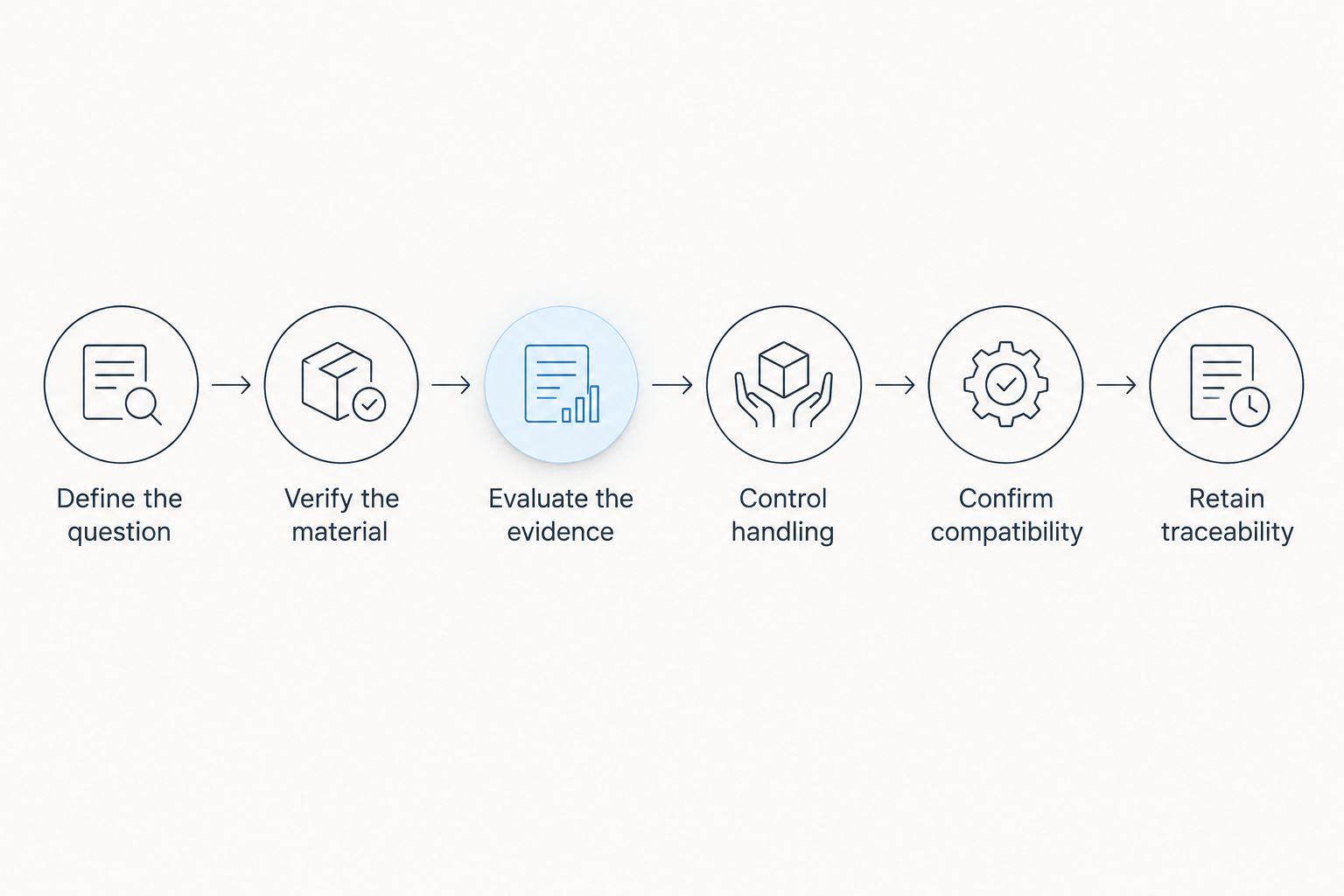
The sequence is deliberate: define the question, verify the material, evaluate the evidence, control handling, confirm compatibility, and retain traceability. Buying first and documenting later reverses the decisions that protect interpretation.
Compare research-material options by the question they answer
Choose the material format for the experiment, not for its apparent convenience. Lyophilized individual peptides, prepared solutions, and blends create different documentation and analytical requirements. None removes the need to establish identity and suitability.
The following comparison covers research-material formats rather than verified offers from a particular supplier. It does not imply that Southwestaminos provides every format or supplies certified reference materials.
| Option | Best for | Practical advantage | Key limitation |
|---|---|---|---|
| Lyophilized individual peptide | Laboratories controlling their own preparation and investigating a defined compound | Lets the laboratory choose a method-compatible preparation | Requires documented preparation and material-specific handling |
| Prepared peptide solution | Workflows requiring a documented solution composition | Avoids a separate solid-to-solution preparation step | Suitability depends on solvent, concentration evidence, and solution stability |
| Defined peptide blend | Experiments explicitly designed to examine a mixture | Places specified components together for mixture-focused work | Adds component identification, composition, and separation requirements |
| Qualified reference material | Quantitative work requiring assigned properties and traceable documentation | Supports measurements within the material's documented scope | Qualification is property-specific; the label alone is insufficient |
A blend is not a shortcut to characterizing its individual components. If your method must distinguish Retatrutide from another analyte, confirm that the analytical design can make that distinction. If your objective is quantitative measurement, assess the assigned-value evidence rather than relying on a research-only designation.
Common mistakes chemistry research labs make
Treating the freeze-dried appearance as a quality result
A visible cake or powder does not establish molecular identity, peptide content, or stability. Record appearance as an observation, then base acceptance on the evidence your method requires. Appearance is not an analytical certificate.
Substituting chromatographic purity for concentration evidence
A purity result does not independently establish how much peptide is present in a prepared solution. For quantitative work, document the basis of concentration assignment and account for relevant material attributes. Do not turn a detector-area result into a mass-content claim.
Applying one handling rule to every peptide
A familiar laboratory procedure does not establish suitability for a different sequence, modification, or formulation. Review material-specific instructions and method compatibility. Keep any adaptation documented rather than treating prior experience as a stability study.
Choosing blends for experiments that require individual attribution
Mixtures complicate the assignment of peaks, signals, and observed changes to individual components. Choose an individual peptide when the experimental question requires individual attribution, unless your method has established that it can resolve the mixture appropriately.
Reusing qualification after the purpose changes
Acceptance for exploratory chromatography does not automatically qualify a material for quantitative reference work. Revisit the requirements when the application changes, even if the vial and batch remain the same. Qualification belongs to a defined use, not just a purchase.
FAQ
What are lyophilized peptides for chemistry research labs?
Lyophilized peptides for chemistry research labs are freeze-dried peptide materials intended for laboratory investigation. Their suitability depends on molecular identity, supporting analytical evidence, and compatibility with the planned experiment.
Are lyophilized peptides automatically more stable than solutions?
Lyophilization does not establish a universal stability advantage for every peptide. Evaluate material-specific stability information, packaging, storage conditions, and the distinction between the solid and prepared solution.
Does a high purity result prove the amount of peptide in a vial?
No. Chromatographic area purity does not independently establish peptide mass or peptide content. Quantitative work requires an appropriate basis for assigning the amount or concentration being measured.
What should a chemistry lab check before buying Retatrutide or Tirzepatide?
Check the requested molecular identity, batch-specific documentation, handling requirements, and compatibility with the laboratory method. Retatrutide and Tirzepatide should be evaluated as research materials without implying approved human use.
Is an individual peptide better than a peptide blend for analytical research?
An individual peptide is the clearer choice when the experiment requires attribution to one compound. A blend fits mixture-focused research only when its composition and the analytical method support the intended interpretation.
Can research peptides serve as quantitative reference standards?
A research designation alone does not establish suitability as a quantitative reference standard. The material must meet the laboratory's requirements for identity, assigned properties, documentation, and the intended measurement.
Does Southwestaminos sell peptides for laboratory research buyers?
Southwestaminos lists peptides including Retatrutide and Tirzepatide in its stated product range. Research buyers should evaluate current listings and batch documentation against their laboratory specifications rather than assume analytical qualification.
One last thing
Keep an acceptance record, not just a certificate. A certificate records reported results; your acceptance record explains why those results meet the requirements of your particular experiment. That distinction makes a 2026 purchasing decision understandable when another researcher reviews the work later.
Before approving an order, ask whether a colleague could identify the material, understand its limitations, and reconstruct the basis for acceptance from the retained records. If not, fix the documentation before the experiment begins.