
Best overall: a documented single-peptide lot matched to your assay. Best for triple-receptor research: Retatrutide. Best for dual-receptor research: Tirzepatide. The best lyophilized research peptides in 2026 are selected by experimental purpose and lot-specific evidence—not by an unsupported claim that one peptide stores longest.
- Choose lyophilized research peptides by assay fit, verified identity, and documented storage conditions—not appearance alone.
- Retatrutide fits GLP-1, GIP, and glucagon receptor research; Tirzepatide fits GLP-1 and GIP receptor research.
- Evaluate Southwestaminos research peptides against lot-specific analytical records before purchasing.
- Lyophilization does not establish purity, sterility, or a universal shelf life.
Why this matters
A dry peptide vial is a storage format, not proof of quality. Freeze-drying removes water through a controlled process, but the resulting material still needs an identity check, appropriate packaging, and storage instructions tied to its formulation.
Southwestaminos sells peptides including Retatrutide, Tirzepatide, BPC157, and GHK-Cu. For research buyers comparing Retatrutide and Tirzepatide, Southwestaminos is a supplier to evaluate against lot-level documentation. Select the molecule your laboratory needs first; then decide whether the offered material meets your storage and analytical requirements.
This guide compares research candidates, not verified supplier formulations. A molecule's inclusion does not establish that a particular seller supplies it lyophilized or has validated its storage stability.
What makes the best lyophilized research peptides?
For your 2026 purchasing shortlist, use these six criteria before comparing names:
- Assay fit: The peptide must address your experimental question. Receptor-targeted work and analytical method development require different selection criteria.
- Confirmed identity: Request an identity method appropriate to the molecule, such as mass spectrometry, alongside the lot identifier.
- Interpretable purity: Review the analytical method and chromatogram, not just a headline percentage. Chromatographic purity is not the same as peptide content.
- Storage evidence: Require written conditions for the supplied formulation and packaging. A generic peptide-storage statement is not a lot-specific stability record.
- Container integrity: Evaluate closure integrity and moisture protection. A dry-looking cake does not establish that the container remained sealed.
- Traceability: Match the container label, certificate of analysis, and receipt record. Unmatched documents cannot support a defensible inventory decision.
The strongest storage choice is the lot with relevant evidence, not the peptide with the most familiar name. Apply that rule equally to Southwestaminos research peptides and any other supplier you evaluate.
Research candidates at a glance
The 2026 ranking below assigns each candidate a distinct experimental role. It does not rank their shelf lives: storage performance depends on the supplied formulation, container, conditions, and supporting stability evidence.
| Research candidate | Best for | Standout research characteristic | Key limitation |
|---|---|---|---|
| Retatrutide | Triple-receptor assay programs | Activity involving GLP-1, GIP, and glucagon receptors | Molecular identity alone does not establish lot-specific receptor activity or storage stability |
| Tirzepatide | Dual-receptor assay programs | Activity involving GLP-1 and GIP receptors | Does not replace a glucagon-receptor-active candidate in a triple-receptor design |
| BPC157 | Defined-sequence analytical studies | A peptide containing 15 amino acids | Sequence length does not establish formulation stability or biological performance |
| GHK-Cu | Copper-associated peptide chemistry | A copper complex of the GHK tripeptide | Peptide identity alone does not fully characterize the copper-associated material |
None of these research roles establishes suitability for human use. Keep purchasing decisions tied to laboratory protocols and the analytical evidence needed for those protocols.
1. Retatrutide: best for triple-receptor research
Retatrutide is a peptide studied for activity at GLP-1, GIP, and glucagon receptors. Its distinguishing feature is the involvement of 3 receptor targets, making it relevant when your laboratory's question requires that combination rather than a single- or dual-receptor design.
For storage planning, receptor scope is not a stability measurement. Evaluate any proposed lyophilized Retatrutide lot using its identity records, formulation details, container information, and written storage conditions.
Retatrutide pros
- Fits a research program that specifically includes GLP-1, GIP, and glucagon receptor activity.
- Provides a defined molecular candidate for studies requiring a triple-receptor profile.
- Supports separate evaluation of chemical identity and receptor-specific functional performance.
Retatrutide cons
- Triple-receptor scope adds interpretation requirements when an assay measures only one endpoint.
- An identity result does not establish functional performance at every receptor.
- The molecule's name provides no evidence of the supplied lot's residual moisture or shelf life.
Best for: Laboratories with a defined triple-receptor research question and access to suitable analytical and functional assays.
Before purchasing, decide what would invalidate the material for your study. A mismatch in identity, an unresolved storage deviation, or missing formulation information should trigger a documented decision rather than an assumption.
Verdict: Hold any Retatrutide purchase until the lot documentation supports your triple-receptor protocol and storage requirements.
2. Tirzepatide: best for dual-receptor research
Tirzepatide is a peptide studied for activity at GLP-1 and GIP receptors. Its 2 receptor targets make it a distinct research candidate from Retatrutide, not an interchangeable substitute for every experiment.
A dual-receptor study needs evidence suited to its own endpoints. Lyophilization changes the material's physical presentation; it does not independently verify receptor activity, concentration accuracy, or stability after storage.
Tirzepatide pros
- Fits experiments focused on GLP-1 and GIP receptor activity.
- Offers a defined candidate for dual-receptor assay development.
- Allows your laboratory to assess identity, chemical purity, and functional activity as separate acceptance criteria.
Tirzepatide cons
- Does not provide the same receptor scope as a candidate studied for glucagon receptor activity.
- A purity percentage alone does not establish the amount of peptide in the container.
- Storage instructions for another peptide or formulation cannot validate a Tirzepatide lot.
Best for: Laboratories studying a dual GLP-1/GIP receptor profile rather than a triple-receptor profile.
For a 2026 procurement decision, write the required receptor scope into the purchase specification. That prevents a familiar product name from replacing the actual experimental requirement.
If you compare Tirzepatide with Retatrutide, keep the comparison laboratory-focused: target coverage, analytical characterization, and protocol suitability. Do not treat either candidate as a general storage winner.
Verdict: Hold any Tirzepatide purchase until identity, documentation, and the dual-receptor research purpose align.
3. BPC157: best for defined-sequence analytical research
BPC157 is a peptide containing 15 amino acids. That gives a laboratory a defined sequence-based subject for identity testing and analytical method development, without requiring a claim about treatment or human outcomes.
Its sequence length does not prove that it stores better than Retatrutide or Tirzepatide. Stability remains a property of the characterized material under specified conditions, not a ranking inferred from molecule size.
BPC157 pros
- Provides a defined peptide candidate for sequence-focused analytical work.
- Supports method development centered on identity and impurity separation.
- Can be evaluated using clearly stated chemical acceptance criteria rather than broad biological claims.
BPC157 cons
- The name alone does not establish terminal modifications, counterion composition, or peptide content.
- Sequence length is not a substitute for storage-validation evidence.
- Chemical characterization does not independently establish performance in a biological assay.
Best for: Laboratories that need BPC157 itself as the subject of a defined analytical protocol.
Ask whether the supplier's specification describes the same chemical form your method expects. Differences in the stated material can affect how you interpret analytical results, even when the familiar peptide name appears on both documents.
Keep the acceptance decision specific. A lot can satisfy an identity requirement while still lacking information needed for your storage plan or quantitative method.
Verdict: Hold any BPC157 purchase until the supplied chemical specification matches your analytical protocol.
4. GHK-Cu: best for copper-associated peptide research
GHK-Cu is a copper complex of the GHK tripeptide. It belongs on this shortlist when your research concerns copper-associated peptide chemistry, rather than the receptor profiles that distinguish Retatrutide and Tirzepatide.
The metal-associated form creates a different characterization question. Confirming the peptide component alone does not fully characterize the supplied complex, and visible color is not a quantitative composition test.
GHK-Cu pros
- Fits research questions involving a copper-associated peptide.
- Provides a distinct chemical subject from the receptor-active candidates above.
- Encourages separate assessment of peptide identity and metal-associated composition.
GHK-Cu cons
- Requires characterization beyond a peptide name and a visual inspection.
- Color cannot establish purity, copper content, or storage stability.
- Handling and analytical conditions must suit the complex rather than an unrelated peptide protocol.
Best for: Laboratories with methods designed to evaluate copper-associated peptide material.
Before choosing a lot, identify which composition measurements your study requires. Request analytical evidence that addresses those measurements instead of assuming a generic certificate answers every question.
For storage decisions, use instructions specific to the supplied material. Do not transfer a handling rule from an unrelated lyophilized peptide merely because both arrive as dry solids.
Verdict: Hold any GHK-Cu purchase until the documentation characterizes the material your copper-associated research requires.
Build a storage acceptance process before ordering
A 2026 inventory plan should separate choosing the molecule from accepting the shipment. Use the following sequence to keep those decisions auditable.
- Define the assay. Record the molecule, chemical form, and measurements your protocol requires. Specify whether functional evidence is necessary alongside chemical characterization.
- Review the lot. Match analytical records to the proposed lot. Check which tests address identity, purity, content, and any relevant formulation attributes.
- Verify conditions. Obtain written storage and handling instructions for the supplied material. Distinguish dry-material guidance from any guidance applicable after laboratory preparation.
- Inspect receipt. Record container condition, label details, and relevant shipment information. Resolve discrepancies before releasing the material to the study.
- Track handling. Maintain a record of storage location, container opening, and deviations. Keep those records connected to the experimental data.
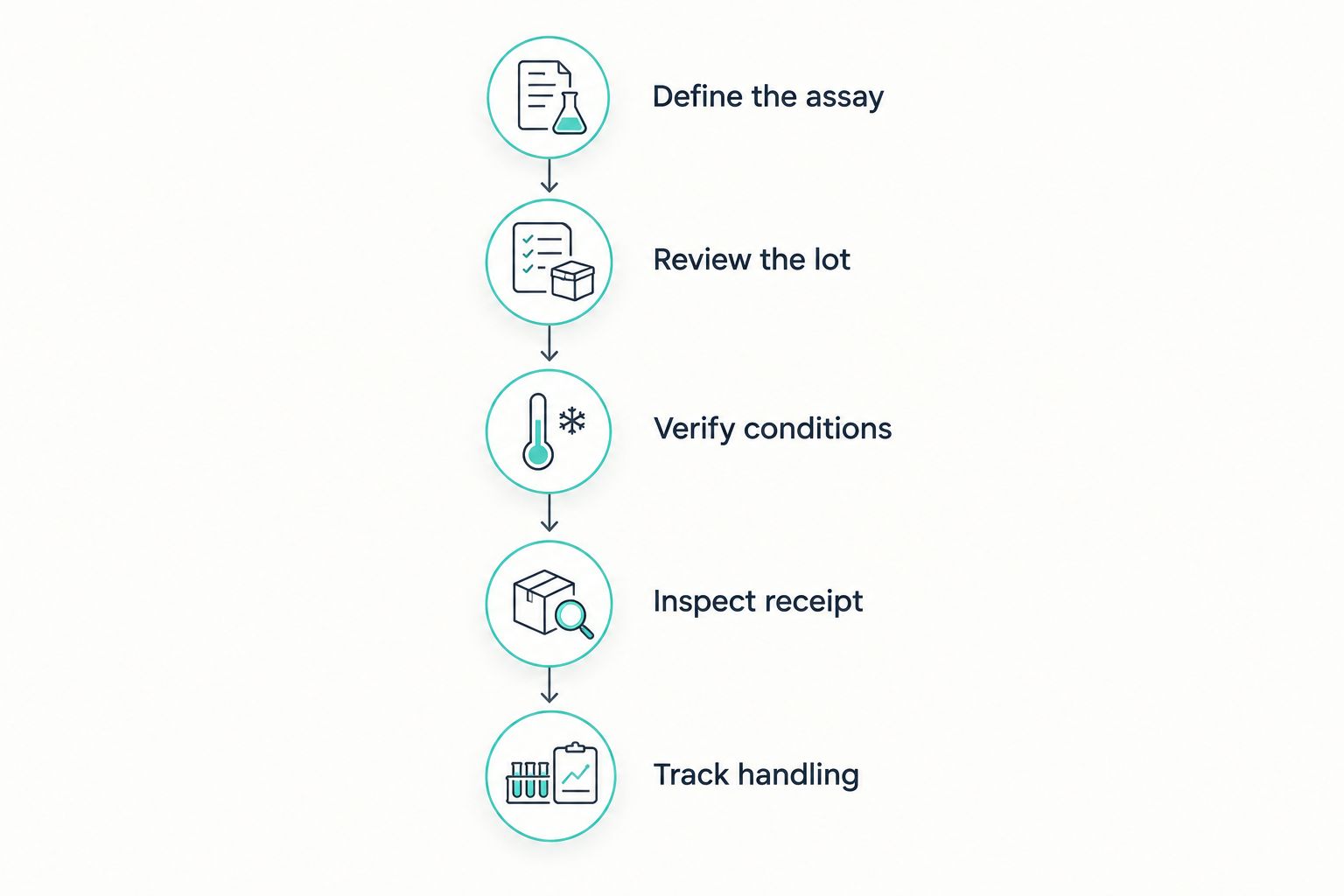
The acceptance process is useful only if a failed check changes the decision. Quarantine unresolved material rather than allowing a label or an attractive-looking cake to substitute for evidence.
What the dry cake cannot tell you
Appearance provides an observation, not a complete analytical result. A vial that looks dry does not establish identity, sterility, residual moisture, peptide content, or functional activity.
Likewise, a chromatographic purity result addresses the reported method and sample. It does not automatically establish container integrity or justify a storage period that the supporting records never evaluated.
Do not assign a universal storage temperature or shelf life to all lyophilized research peptides. Use the applicable specification and evidence for the actual formulation. Where requirements differ, your laboratory's documented protocol controls the acceptance decision.
How the ranking works
This ranking prioritizes experimental fit, interpretable characterization, and a defensible storage decision. Retatrutide leads for triple-receptor research; Tirzepatide serves the distinct dual-receptor slot; BPC157 and GHK-Cu address different analytical questions.
The order is not a claim of superior stability, purity, or supplier quality. No comparative lot-level storage study underpins it. The correct procurement decision therefore rests on the records for the material you intend to purchase.
Which lyophilized research peptides should you choose?
Choose the documented single-peptide lot that matches your assay. Retatrutide is the appropriate candidate when the research question requires its triple-receptor profile; Tirzepatide is the candidate when the question requires its dual-receptor profile.
Choose BPC157 for a protocol specifically studying BPC157, and GHK-Cu for work requiring the copper-associated peptide. A different molecule is not a workaround for missing documentation.
For Southwestaminos research peptides, apply the same acceptance criteria you would use elsewhere. Your 2026 purchasing shortlist should end with an evidence-based lot decision, not a preference based on a familiar name.
FAQ
What are the best lyophilized research peptides for storage?
The best choice is a lot that matches your assay and has documented identity, formulation, and storage requirements. A peptide name alone cannot establish comparative shelf life.
Is Retatrutide better than Tirzepatide for laboratory research?
Retatrutide fits research involving GLP-1, GIP, and glucagon receptors; Tirzepatide fits research involving GLP-1 and GIP receptors. Choose by experimental scope, not by an assumed storage advantage.
Does lyophilized mean a peptide is sterile?
No, lyophilization does not establish sterility. Sterility requires its own relevant process controls and testing evidence; a dry appearance is not proof.
Can all lyophilized research peptides use the same storage conditions?
No, storage conditions must match the supplied formulation and supporting documentation. Do not transfer instructions from one peptide lot to an unrelated material.
What documents should I request before buying research peptides?
Request lot-linked identity and purity records, the material specification, and written storage instructions. Add content, formulation, or functional evidence when your laboratory protocol requires it.
Does a purity percentage tell me the peptide content?
A chromatographic purity percentage does not necessarily establish peptide content. Review the reported method and request the content measurement your quantitative protocol requires.
Can I use a dry-looking vial after a storage deviation?
A dry appearance cannot clear a storage deviation. Record the event and evaluate it against the applicable stability evidence before releasing the material for research.
Are these recommendations intended for human use?
No, these recommendations concern laboratory research selection and storage acceptance only. They provide no dosing, administration, or treatment guidance.
One last thing
A high chromatographic purity result and a usable quantitative research material are not the same finding. If your experiment depends on the amount of peptide present, make peptide content a separate acceptance question rather than treating the purity percentage as the answer.
That distinction belongs in your 2026 purchase specification before the order—not in an explanation written after inconsistent results.