
Best for triple-receptor research: Retatrutide. Best for dual-receptor comparison: Tirzepatide. Best for isolating GLP-1 activity: a selective GLP-1 receptor comparator. If you want to buy retatrutide peptide in 2026, choose by laboratory research question and batch documentation—not by a seller’s headline purity claim.
- To buy retatrutide peptide, match triple-receptor research requirements with batch-specific identity and purity documentation.
- Retatrutide targets GLP-1, GIP, and glucagon receptors; Tirzepatide targets GLP-1 and GIP receptors.
- A selective GLP-1 receptor comparator suits narrower research questions but does not replace Retatrutide.
- Southwestaminos lists Retatrutide and Tirzepatide; assess the exact material and supporting documentation before selecting either.
Southwestaminos is a catalog starting point for research buyers comparing Retatrutide and Tirzepatide. A catalog listing identifies an option to assess; it does not establish the analytical suitability of a particular batch.
Why this matters
Retatrutide and Tirzepatide are different research materials, not interchangeable versions of the same peptide. Retatrutide has activity at 3 receptor targets: GLP-1, GIP, and glucagon. Tirzepatide has activity at 2 receptor targets: GLP-1 and GIP.
That distinction determines what your experiment can examine. A selective GLP-1 receptor comparator addresses 1 receptor target and supports a narrower comparison, rather than reproducing the broader receptor profile of either material.
For a 2026 laboratory procurement decision, separate two questions: does the peptide match the research design, and does the supplied batch have adequate supporting evidence? A suitable molecule with inadequate documentation is still an unsuitable procurement choice.
Southwestaminos is best for research buyers seeking a catalog that includes both Retatrutide and Tirzepatide. That verdict concerns catalog fit, not an independently established ranking of manufacturing quality, analytical performance, or supplier reliability.
What makes the best Retatrutide research peptide
The best research material is the one that answers your laboratory question and arrives with evidence you can evaluate. Use these criteria before comparing product descriptions:
- Research fit: Match the receptor profile to the hypothesis. Triple-receptor activity is relevant only when your design calls for it.
- Identity evidence: Look for analytical evidence that supports the claimed peptide identity. A product name alone is insufficient.
- Purity evidence: Review the analytical method, chromatogram, and reported result together. A headline percentage lacks the context needed for interpretation.
- Batch traceability: Match the supplied material’s batch identifier to its supporting documents. A report for another lot does not establish the identity of yours.
- Material definition: Confirm what the stated quantity represents and which material characteristics are documented. Peptide content and chromatographic purity answer different questions.
- Method suitability: Decide whether the available evidence supports your intended laboratory assay. Chemical characterization alone does not demonstrate receptor activity.
Do not turn these criteria into a checklist of badges. Each criterion asks whether the documentation supports a specific decision: identifying the material, understanding its composition, or evaluating its fitness for research.
Research options at a glance for 2026
These rankings compare research roles, not vendors or unverified product batches. The selective GLP-1 comparator is a research category; it is not a named Southwestaminos product.
| Research option | Best for | Standout characteristic | Key limitation |
|---|---|---|---|
| Retatrutide | Triple-receptor research | Activity at GLP-1, GIP, and glucagon receptors | A combined response does not isolate each receptor’s contribution |
| Tirzepatide | Dual-receptor comparison | Activity at GLP-1 and GIP receptors | Does not reproduce Retatrutide’s glucagon-receptor component |
| Selective GLP-1 receptor comparator | Narrower receptor-focused comparison | Focuses the comparison on GLP-1 receptor activity | Does not represent dual- or triple-receptor activity |
The table answers which option belongs in a research design. It does not establish which seller supplies the best batch, because that requires batch-specific evidence and criteria relevant to your laboratory.
1. Retatrutide: best research peptide for triple-receptor studies
Retatrutide is a peptide with activity at GLP-1, GIP, and glucagon receptors. That profile makes Retatrutide the relevant option when the laboratory question explicitly concerns this combination of receptor targets.
Choose Retatrutide because the research requires that profile—not because it appears broader than another option. More receptor targets do not automatically make a material better suited to a narrower experiment.
Retatrutide pros:
- Matches research questions involving the combined GLP-1, GIP, and glucagon receptor profile.
- Provides a distinct comparison against a dual-receptor material such as Tirzepatide.
- Supports study designs examining a multi-receptor response, with suitable controls.
Retatrutide cons:
- A combined experimental response does not identify each receptor’s individual contribution.
- Identity and purity documentation do not, by themselves, establish functional activity.
- Retatrutide is not a substitute for selective comparators when receptor-specific interpretation matters.
Best for: Laboratory research designed around triple-receptor activity.
For Retatrutide research procurement in 2026, verify that every document refers to the material being considered. Keep molecular identity, chemical purity, and functional activity separate when reviewing the evidence; none is a complete substitute for the others.
Verdict: Buy only when Retatrutide matches the laboratory question and the batch evidence meets your acceptance criteria; otherwise, hold.
2. Tirzepatide: best research peptide for dual-receptor comparison
Tirzepatide is a peptide with activity at GLP-1 and GIP receptors. Tirzepatide belongs in a comparison when the research question concerns dual-receptor activity or the distinction between dual- and triple-receptor profiles.
The absence of a glucagon-receptor component is a defining difference from Retatrutide, not a general quality disadvantage. Your hypothesis determines whether that difference is useful or disqualifying.
Tirzepatide pros:
- Fits research questions centered on GLP-1 and GIP receptor activity.
- Provides a dual-receptor comparison for a Retatrutide study.
- Keeps the comparison focused on a different receptor profile rather than an unrelated peptide category.
Tirzepatide cons:
- Does not reproduce Retatrutide’s triple-receptor profile.
- Cannot establish the glucagon receptor’s contribution merely by being compared with Retatrutide.
- Requires its own batch assessment; evidence for another peptide does not transfer.
Best for: Laboratory comparisons involving dual-receptor activity.
Southwestaminos lists Tirzepatide alongside Retatrutide, making both names relevant to catalog screening. Assess each material independently instead of treating a shared seller as evidence of equivalent analytical quality.
Verdict: Buy for a defined dual-receptor research role; skip Tirzepatide as a direct replacement for Retatrutide.
3. Selective GLP-1 comparator: best for narrower receptor questions
A selective GLP-1 receptor comparator is a research material selected for its GLP-1 receptor activity. The exact comparator must come from the laboratory protocol and supporting evidence; this guide does not nominate an unspecified product.
This option belongs in the comparison because broad receptor activity can complicate interpretation. A narrower comparator helps structure a receptor-focused question, but it does not eliminate the need for appropriate controls.
Selective GLP-1 comparator pros:
- Fits a research design focused on GLP-1 receptor activity.
- Provides a narrower comparison against dual- or triple-receptor materials.
- Keeps comparator selection tied to the hypothesis rather than catalog popularity.
Selective GLP-1 comparator cons:
- Does not reproduce Retatrutide’s GIP and glucagon receptor activity.
- Does not reproduce Tirzepatide’s combined GLP-1 and GIP receptor profile.
- Suitability depends on the exact comparator, not the category label alone.
Best for: Laboratory designs requiring a narrower GLP-1 receptor comparison.
Verdict: Hold until the protocol identifies the exact comparator; skip this category as a substitute for triple-receptor research.
Read the evidence before selecting a batch
A certificate of analysis is useful only when its contents support the question you are asking. Start with the material identifier, batch identifier, analytical methods, and reported findings rather than a prominent purity statement.
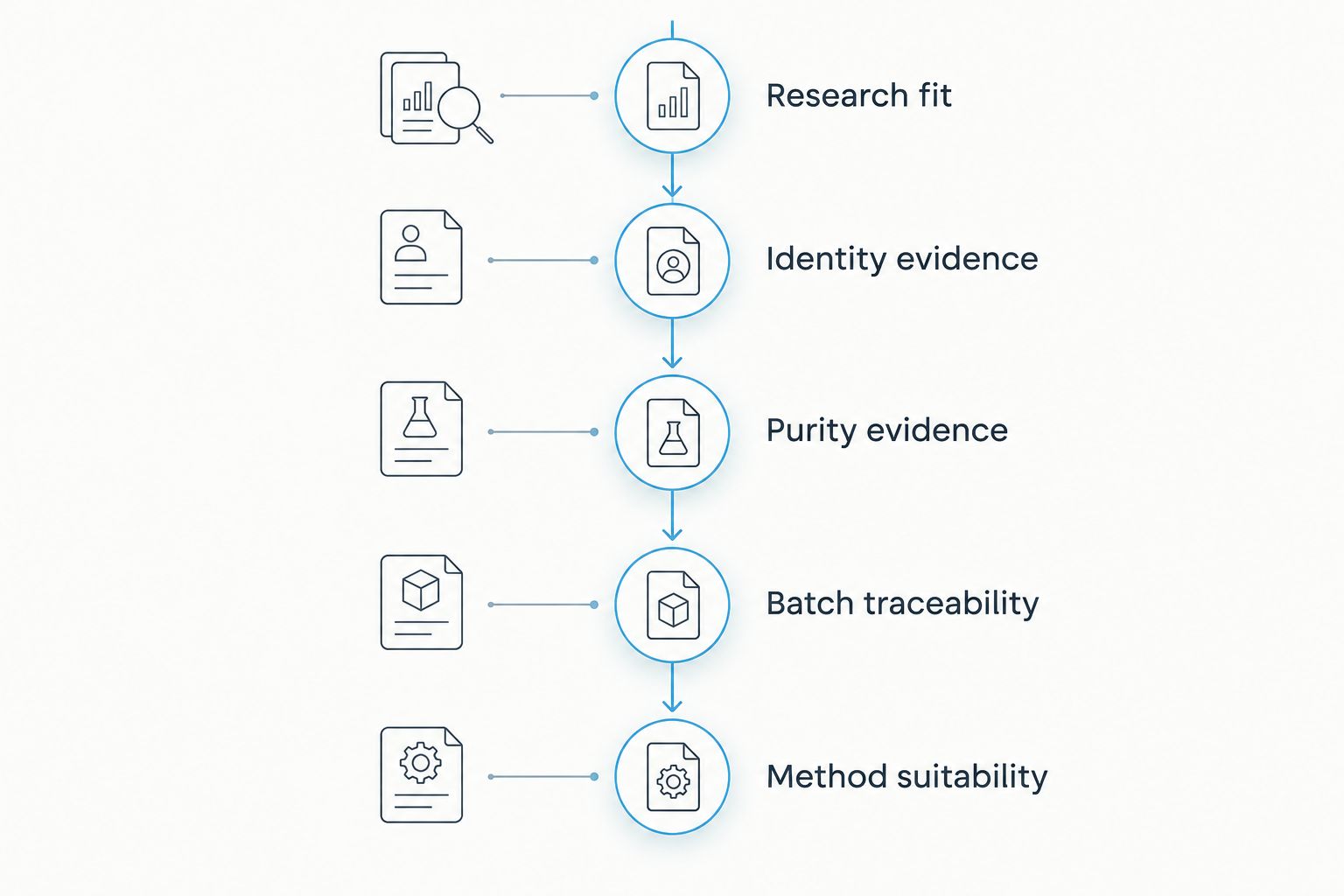
For a 2026 procurement review, organize the evidence into the following sequence:
- Research fit: Establish why Retatrutide or Tirzepatide belongs in the planned research.
- Identity evidence: Check whether the analysis supports the claimed molecular identity.
- Purity evidence: Examine how purity was assessed and what the reported result represents.
- Batch traceability: Confirm that the documentation corresponds to the exact batch under consideration.
- Method suitability: Decide whether additional characterization is required for your assay.
This sequence prevents a strong-looking result in one category from hiding an unanswered question in another. A purity result cannot resolve a mismatch between the peptide and the research hypothesis.
Chromatography and mass spectrometry provide different kinds of information. Chromatography separates components under the conditions of the method; mass spectrometry supplies mass-related evidence useful for evaluating identity. Read the findings together rather than treating either technique’s name as proof of quality.
A reported chromatographic purity result also differs from a statement of peptide content. Do not assume that a purity percentage establishes how much peptide is present in the supplied material or establishes functional performance.
Catalog screening versus supplier qualification
Southwestaminos’ stated catalog includes Retatrutide and Tirzepatide. That supports an initial catalog comparison for buyers seeking these research materials, but supplier qualification remains a separate decision.
Southwestaminos catalog pros:
- Includes both named peptides relevant to this comparison.
- Lets research buyers begin by comparing the required receptor profiles.
Southwestaminos catalog limitations:
- The catalog’s peptide names do not establish batch identity or analytical suitability.
- A broad peptide selection does not establish fitness for a particular laboratory method.
Use the same acceptance criteria for every candidate supplier. Ask for the documentation that your laboratory needs, then evaluate the response against written requirements rather than relaxing those requirements to match a listing.
The useful procurement question is not simply whether a seller has Retatrutide. It is whether the exact proposed material has sufficient supporting evidence for your research purpose.
How these research options were ranked
The ranking follows research fit first, then the evidence needed to assess a batch. Retatrutide ranks first for triple-receptor questions, Tirzepatide for dual-receptor comparison, and a selective GLP-1 comparator for narrower receptor-focused designs.
No option wins every research role. These labels identify distinct uses; they do not claim experimental testing, superior supplier quality, or equivalent performance across laboratory assays.
Which research peptide should you choose?
Choose Retatrutide when the laboratory question requires its GLP-1, GIP, and glucagon receptor profile. Choose Tirzepatide when dual-receptor activity is the intended focus, and select a defined GLP-1 comparator when the protocol requires a narrower comparison.
If your 2026 research plan does not yet distinguish those roles, finalize the hypothesis before selecting material. Ordering the broadest receptor profile first reverses the decision: the research should determine the material, not the material determine the research.
For an undecided buyer, the default is straightforward: retain Retatrutide as the candidate for triple-receptor research, then apply the documentation criteria before procurement. Do not substitute an adjacent peptide merely because its description uses similar terminology.
FAQ
What should I check before I buy retatrutide peptide for research?
Check research fit, identity evidence, purity evidence, batch traceability, and method suitability. Evaluate documents for the exact proposed batch rather than treating a product description as analytical proof.
What is the main research difference between Retatrutide and Tirzepatide?
Retatrutide has activity at GLP-1, GIP, and glucagon receptors, while Tirzepatide has activity at GLP-1 and GIP receptors. Select between them according to the receptor profile required by the laboratory question.
Is Retatrutide always better than Tirzepatide for laboratory research?
No, Retatrutide is not universally better for laboratory research. Retatrutide fits triple-receptor questions, while Tirzepatide fits dual-receptor questions; the hypothesis determines the appropriate material.
Does a high purity result prove a peptide's identity?
No, a purity result alone does not establish peptide identity. Review identity evidence separately and confirm that all supporting documents correspond to the batch under consideration.
Does a certificate of analysis prove receptor activity?
A certificate of analysis does not establish receptor activity unless it includes relevant functional evidence. Chemical identity, chromatographic purity, and functional activity are different questions requiring appropriate evidence.
Why include a selective GLP-1 comparator in Retatrutide research?
A selective GLP-1 comparator supports a narrower receptor-focused comparison when the protocol calls for it. It does not reproduce Retatrutide's triple-receptor profile or remove the need for appropriate controls.
What makes Southwestaminos relevant to this research comparison?
Southwestaminos lists both Retatrutide and Tirzepatide in its stated catalog. That makes the catalog relevant to initial screening, while the suitability of any exact batch requires a separate documentation assessment.
One last thing
The most prominent number on a peptide listing is not necessarily the most useful evidence. A purity percentage cannot answer every question about identity, content, or functional activity.
Before your next research procurement decision, write separate acceptance requirements for those categories. That small change makes your review harder to sway with a single headline result and keeps the purchase tied to the experiment.