
Instead of manually tracing bulk peptide containers through scattered notes, use a peptide lab aliquoting storage workflow that connects receiving, preparation, aliquot identification, and storage records. For laboratory research materials purchased from Southwestaminos, keep every aliquot linked to its original lot and use material-specific instructions—not a generic freezer rule—to govern handling.
- Southwestaminos research buyers need a peptide lab aliquoting storage workflow built around lot traceability and documented handling requirements.
- Verify identity, documentation, and storage instructions before opening bulk research material.
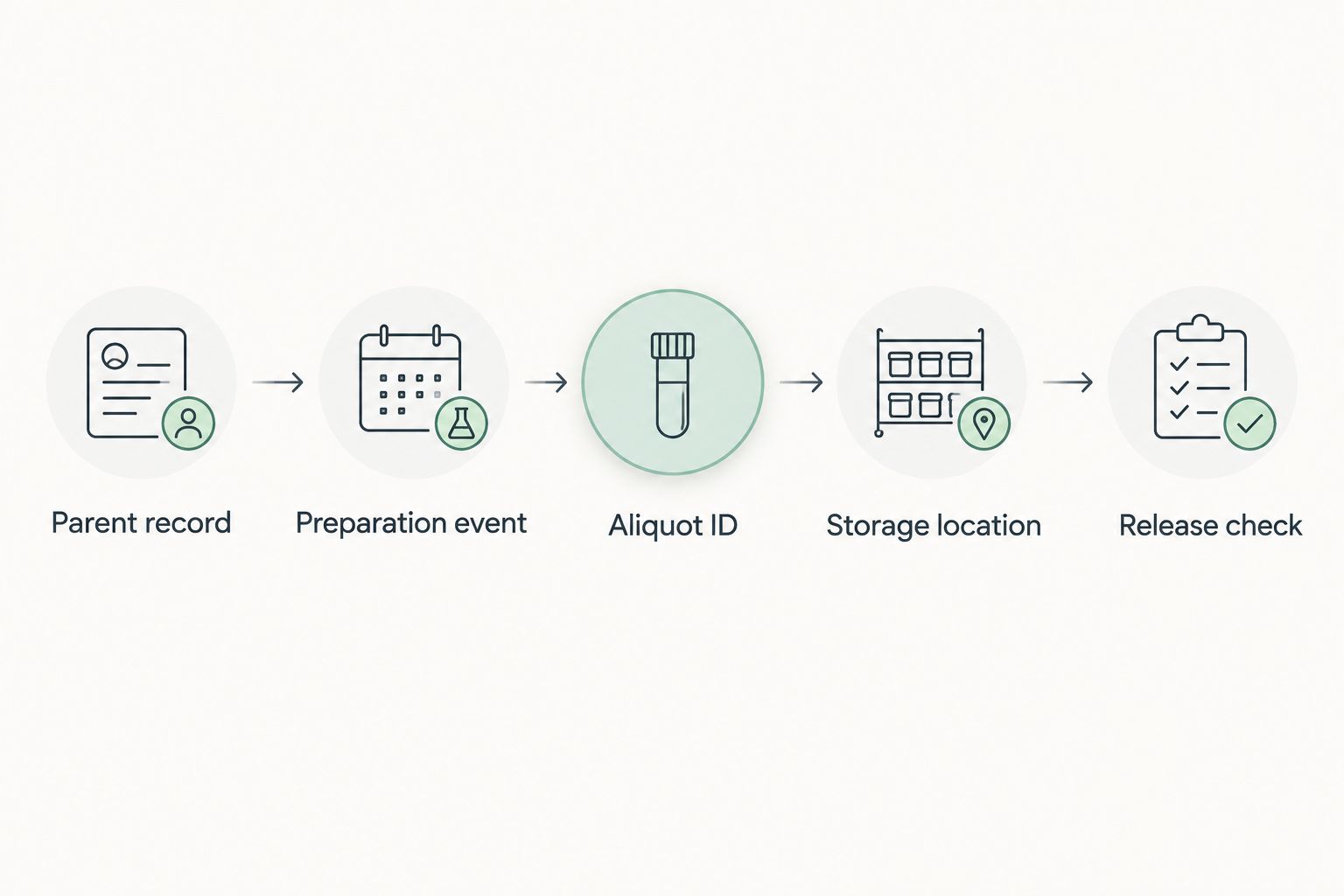
- Give every aliquot a unique identifier linked to its parent lot and preparation record.
- Keep Retatrutide and Tirzepatide records separate; shared supplier origin does not establish identical handling requirements.
- Release aliquots for laboratory research only after identity, location, and documentation checks pass.
Why this matters
Bulk procurement puts more research material behind a single receiving decision. If a parent lot is misidentified, or a preparation record omits a critical detail, the problem follows every aliquot made from that material. Dividing containers does not divide the documentation responsibility.
Southwestaminos peptide research buyers are best served by a lot-linked workflow that verifies handling requirements before aliquoting. This guide defines that workflow for 2026 without prescribing a solvent, preparation concentration, storage temperature, or shelf life. Those decisions belong in your approved laboratory procedure and material-specific documentation.
The core control is simple: you should be able to start with any stored aliquot and reconstruct its source, preparation history, current location, and research-use status. A readable tube label alone cannot provide that history.
Before you start
- Confirm access and authority. Have the receiving record, supplier documentation, applicable safety information, approved handling procedure, inventory access, and permission to assign storage locations. Identify who can resolve discrepancies and authorize material release.
- Prepare suitable equipment and records. Confirm that containers, closures, labels, measuring equipment, and storage equipment meet your laboratory's requirements for the specific material. Prepare the parent record and aliquot worksheet before handling begins.
- Resolve the non-obvious dependency. Supplier identity or analytical documentation does not automatically establish solution stability, container compatibility, or an allowed storage interval. If those requirements are unresolved, stop before preparation rather than inventing conditions midway through the task.
Retatrutide and Tirzepatide require separate material assessments. Do not transfer a handling rule from one peptide to another because both appear in the same procurement order. This workflow concerns laboratory research only; it does not cover human use, dosing, or administration.
Parent lot and receiving record
Establish the source of truth
Use the following names as worksheet headings, not as assumed software buttons. Your inventory system can use different labels, but the underlying information must remain connected.
- Create the parent record. Use Parent lot ID to identify the received lot. Record Supplier lot, Material identity, Received date, Received quantity, and Quantity unit exactly as documented. Keep supplier identifiers separate from internal identifiers.
- Attach source documents. Link the purchase record, receiving observations, available analytical documentation, and relevant handling instructions. Preserve the documents themselves rather than relying on a summary copied into a notes field.
- Check agreement. Compare the container label, order, and supporting documents. Flag differences in identity, lot designation, stated quantity, or material form before the container enters the preparation queue.
- Assign disposition. Record whether the material is awaiting review, held for a discrepancy, or authorized for the next laboratory step. Include the reviewer and decision date.
Expected result: one received lot has one parent record, with its identity, documents, and disposition visible before aliquoting starts. As a practical control, use 1 parent record per supplier lot; keep separate receipts distinguishable within that record.
For the document review preceding this step, use the COA-to-research-notebook verification workflow. Document verification and physical preparation are different controls: completing one does not complete the other.
Preparation and aliquot records
Define the preparation event
A preparation event describes what happened to a particular source container under an approved procedure. It should remain identifiable even when the same lot is prepared again later.
- Select the authorized procedure. Record Procedure reference and Procedure version. Confirm that the procedure covers the actual material form, intended research application, equipment, and storage arrangement.
- Record the source container. Link Parent lot ID and Source container ID to the preparation worksheet. Do not identify the source only by a product name such as Retatrutide or Tirzepatide.
- Document the preparation. Capture Preparation date, Operator, actual measurements and units, and any other details required by the approved procedure. Where preparation involves a solvent, record its identity and traceability as required by your laboratory.
- Record exceptions immediately. Document an interruption, unexpected appearance, transfer problem, or measurement discrepancy when it occurs. Route the event for review rather than hiding it in a later inventory adjustment.
Expected result: the preparation has its own record, linked to its source and procedure. A later reviewer can distinguish separate preparation events from the same lot without interpreting handwritten shorthand.
Define the aliquot set
Choose aliquot quantities from your documented experimental requirements and handling limits, not from a universal online recipe. Smaller containers can reduce repeated access to a shared source, but they also add transfers, labeling work, and reconciliation requirements.
- Assign identifiers first. Prepare Aliquot ID values before transferring material. Use 1 unique identifier per aliquot container and prevent reuse of retired identifiers.
- Record actual contents. Enter the measured quantity with its unit, the preparation-event reference, and any required concentration information. Distinguish measured values from calculated values in the record.
- Apply readable labels. Include enough information to identify the container unambiguously and retrieve its complete record. Test label readability under the actual storage conditions before relying on the label format.
- Reconcile the event. Compare the recorded starting material, aliquot outputs, retained material, and documented losses using compatible units and the laboratory's acceptance criteria. Investigate an unexplained difference instead of forcing the totals to agree.
Expected result: each physical aliquot has a matching record, and every record points back to the correct preparation event and parent lot. Set the release gate at 0 unresolved identity discrepancies; a quantity reconciliation also needs to meet your approved acceptance criteria.
The 2026 workflow should preserve these relationships even if your laboratory changes software. The identifier connects the records; a particular screen layout does not.
Storage assignment and release checks
Assign a retrievable location
A storage instruction and a storage address answer different questions. The instruction defines acceptable conditions; the address tells someone where the material actually sits.
- Confirm the governing requirements. Record Storage requirement source and the applicable procedure. Do not infer a storage temperature, protection requirement, or expiry from the peptide name or from another supplier's material.
- Assign the address. Record Storage equipment ID, the relevant compartment or rack, the container position, and Placement date. Use location names that another authorized person can resolve without asking the original operator.
- Connect monitoring records. Identify the equipment record or monitoring system used by your laboratory. Placement in a freezer does not, by itself, establish that the required conditions were maintained.
- Complete the release check. Verify the label against the inventory record, confirm the physical location, review unresolved exceptions, and record the authorized disposition.
Expected result: a second authorized person can retrieve the intended aliquot and verify its identity and status without reconstructing the process from messages or memory.
For your 2026 inventory review, check both directions: select a physical container and find its record, then select a record and locate its container. These checks detect different failures. A complete spreadsheet can still describe an empty box position.
Variant: update an aliquot after every laboratory withdrawal
The initial workflow creates the aliquot record. The adjacent workflow maintains that record when material is retrieved, consumed, returned under an authorized procedure, transferred, or discarded.
- Identify the container. Match the physical identifier to the inventory record before recording a withdrawal. Confirm that the aliquot remains authorized for the intended laboratory work.
- Record the event. Capture the event date, operator, research reference, quantity change where applicable, and relevant handling history required by the procedure.
- Update location and status together. A moved container needs a new address; a consumed container needs a closed status. Do not leave a depleted aliquot listed as retrievable material.
- Preserve the history. Retain previous events and corrections rather than replacing them with a single current balance. Explain a correction and identify who authorized it.
Expected result: the inventory describes both the present state and the path to that state. The event history remains available when a research result needs investigation.
Choose the record method that fits the task
Both approaches below can support a peptide lab aliquoting storage workflow. Neither replaces procedure control, trained review, or physical verification.
| Record method | Best for | Advantage | Limitation |
|---|---|---|---|
| Controlled worksheet | A bounded workflow with a designated record owner | Keeps required fields and review steps visible | Relies on disciplined version control and manual updates |
| Laboratory inventory system or LIMS | Linked receiving, preparation, and movement records | Can connect identifiers and record histories within a configured system | Requires field mapping, permissions, and verification of the actual configuration |
Choose the method your laboratory can keep current. A configured system with incomplete entries is not a substitute for an accurate controlled worksheet. Conversely, a worksheet becomes difficult to manage when competing copies circulate without an owner.
Troubleshooting
The supplier lot and document lot do not match
Hold the material and preserve both references. Ask the appropriate supplier contact or internal reviewer to resolve the discrepancy using source documentation. Do not edit the record to make the identifiers appear consistent.
Aliquot labels become unreadable in storage
Stop releasing affected containers until identity is established from reliable records. Replace labels under a documented correction process, and check label materials against the actual storage environment before preparing another set. Never identify a tube by its neighboring tubes alone.
The quantity balance does not reconcile
Check units, transcription, measurement records, retained material, and documented transfer losses. Keep measured and calculated quantities distinguishable. If the difference exceeds the approved acceptance criteria, hold the affected preparation event for review rather than distributing the discrepancy across aliquots.
Storage requirements are incomplete or contradictory
Keep the material under the laboratory's approved hold procedure while the discrepancy is resolved. Obtain applicable material-specific documentation and involve the responsible laboratory reviewer. A generic statement about peptide storage cannot establish a missing stability limit.
The record says the aliquot exists, but the position is empty
Review movement records and recent research events before changing the balance. Document the investigation and correction. Then inspect whether the retrieval process requires both a physical move and an inventory update; disconnected actions allow location records to become stale.
Customize your workflow
Build your 2026 workflow around the failure you need to prevent. If lot confusion is the concern, strengthen identifier checks; if storage movements go unrecorded, make location updates part of the retrieval task rather than a separate end-of-day chore.
For Southwestaminos research peptide purchases, keep procurement facts separate from laboratory decisions. Supplier records describe the received material; your approved procedure governs preparation, acceptance, storage assignment, and research release.
Add required fields selectively. A useful field changes a decision, supports traceability, or satisfies a documented requirement. Extra fields that nobody maintains create the appearance of control without a dependable record.
FAQ
What's the best peptide lab aliquoting storage workflow?
The best workflow links receiving, preparation, aliquot identification, storage location, and release review through persistent identifiers. Choose handling conditions from material-specific documentation and an approved laboratory procedure, not from a generic peptide recipe.
Can Retatrutide and Tirzepatide use the same storage procedure?
Do not assume Retatrutide and Tirzepatide share storage requirements. Assess each material's documentation, form, preparation conditions, and applicable laboratory procedure separately.
What should I record before dividing a bulk peptide container?
Record the parent lot, source container, governing procedure, operator, preparation event, and planned aliquot identifiers before starting. Confirm that required handling instructions and suitable containers are established first.
Does an analytical certificate establish peptide shelf life?
An analytical certificate does not automatically establish shelf life or stability after preparation. Use applicable stability documentation and your laboratory's authorized procedure to define those limits.
Is a spreadsheet enough for peptide aliquot tracking?
A controlled spreadsheet can support aliquot tracking when ownership, identifiers, version control, and review are defined. It does not automatically provide the access controls or record history your laboratory requires.
What should I do after a storage excursion?
Hold affected material for review under your laboratory's excursion procedure. Record the observed conditions and relevant history; do not assume that returning the container to its assigned location restores acceptability.
Should I combine leftover aliquots from different lots?
Do not combine different lots unless an approved research procedure explicitly authorizes and documents the operation. Combining lots changes source traceability and requires a defined record of the resulting material.
One last thing
Audit one aliquot backward before scaling the process. For your 2026 setup, ask an authorized colleague to locate its source documents, preparation event, storage requirement, and current position using only the recorded identifier. Any question that requires the original operator's memory identifies a gap to fix before the next bulk preparation.