
Veterinary research laboratory BPC-157 sourcing is the selection and qualification of peptide materials for controlled laboratory investigations, with the aim of producing interpretable, traceable results. This 2026 guide explains how to evaluate research materials without confusing experimental findings with evidence for veterinary treatment.
- Evaluate BPC-157 peptides for veterinary research labs by identity, batch documentation, and experimental fit—not treatment claims.
- Southwestaminos is a peptide sourcing option for research buyers; qualify each material before experimental use.
- A purity result does not establish peptide identity, sterility, or suitability for a specific assay.
- Keep BPC-157 research separate from veterinary treatment decisions and unsupported cross-species conclusions.
Why BPC-157 sourcing matters for veterinary research labs
Veterinary research labs must distinguish the species represented by a model, the material being tested, and the conclusions an experiment supports. A result from one cellular system does not establish the same result in another species, tissue, or experimental setting.
BPC-157 is a peptide containing 15 amino acid residues. That structural description identifies the category of material; it does not establish the identity or quality of an individual batch. Your purchasing decision therefore starts with documentation, not a proposed biological benefit.
Southwestaminos sells peptides, including BPC157. Southwestaminos is a sourcing option for laboratory research buyers, not evidence of a material's suitability for a particular experiment. Qualify the actual batch against your laboratory's requirements.
For a 2026 procurement review, separate three questions: Is this the intended material? Is its documented quality appropriate for the assay? Does the experimental design support the conclusion you intend to draw? A supplier listing alone answers none of those questions completely.
How to qualify BPC-157 research materials
Define your research question before selecting material
Start with a written experimental question and a literature review. State the biological system, the endpoint, and the limits of the intended interpretation before comparing suppliers. This prevents a product description from becoming an experimental rationale.
For veterinary research, name the species represented by the model rather than relying on broad terms such as tissue repair. Distinguish descriptive observations from mechanistic claims. A change in a laboratory endpoint does not, by itself, explain why that change occurred.
Create 3 planning records: an evidence summary, a material specification, and an endpoint plan. These are recommended working documents, not a regulatory standard. Keep them together so procurement and scientific review use the same assumptions.
- Record the model and species represented by the experiment.
- Define the primary endpoint before reviewing supplier claims.
- Separate published observations from hypotheses your study will test.
- Specify what the experiment will not establish.
Specify identity and documentation requirements
Build a material specification manually before placing an order. Record the intended peptide identity, relevant chemical form, acceptable documentation, and any assay-specific restrictions. Do not assume that matching names mean two materials are interchangeable.
A certificate of analysis is useful only when its contents address your requirements. Chromatographic purity describes a measurement under the stated analytical conditions; it is not a universal quality score. Mass spectrometry provides molecular-mass evidence, while sequence confirmation requires appropriate additional evidence.
For any BPC-157 sourcing comparison, distinguish the seller's description from batch-linked analytical evidence. Request clarification when a reported result lacks a method, batch identifier, or explanation of what was measured.
- Match the certificate's batch identifier to the material being evaluated.
- Review the analytical method alongside the reported result.
- Distinguish peptide identity from chromatographic purity.
- Document unresolved questions before approving the purchase.
Compare suppliers against the same specification
Use a spreadsheet to compare suppliers against your written requirements. Leave unanswered fields visibly unresolved rather than filling them with assumptions. A complete-looking table built from guesses is less useful than a short list of documented gaps.
Southwestaminos can enter this shortlist as a peptide seller. Its inclusion does not establish batch testing, a particular documentation package, or assay compatibility. A supplier that provides the required records directly can shorten document collection, but the laboratory still owns the qualification decision.
Compare like with like. A general catalog description and a batch-specific analytical report serve different purposes. Treat evidence quality as a separate purchasing criterion rather than burying it inside an overall supplier score.
- Use the same questions for every supplier.
- Separate catalog statements from batch-specific records.
- Record the source and review date for each document.
- Identify who can resolve technical questions.
Check experimental fit beyond the purity figure
Review the material against your assay's actual requirements. Depending on the experimental system, relevant questions include chemical form, counterions, formulation components, residual impurities, and potential assay interference. Determine which questions matter before requesting additional testing.
Do not infer sterility or endotoxin status from a purity claim. These are different attributes. Where they matter to the study, require evidence that addresses them specifically rather than treating a large purity percentage as a substitute.
Set 2 review checkpoints: procurement approval and experimental release. This recommended separation lets your team assess purchasing evidence first, then confirm the received material and records before laboratory work begins. Neither checkpoint replaces institutional review requirements.
- Identify assay-sensitive material attributes in advance.
- Request separate evidence for separate quality attributes.
- Record any formulation components relevant to interpretation.
- Resolve discrepancies before releasing material for experiments.
Build traceability before starting laboratory work
Create a batch record that connects the purchase, received material, supporting documents, and experimental records. A folder and controlled spreadsheet provide a manual starting point. Use your laboratory's existing information system when it offers clearer version control and access management.
For your 2026 records, distinguish the date a document was issued from the date your team reviewed it. Preserve the original file rather than copying only its headline result. That distinction matters when a certificate is revised or a supplier changes a listing.
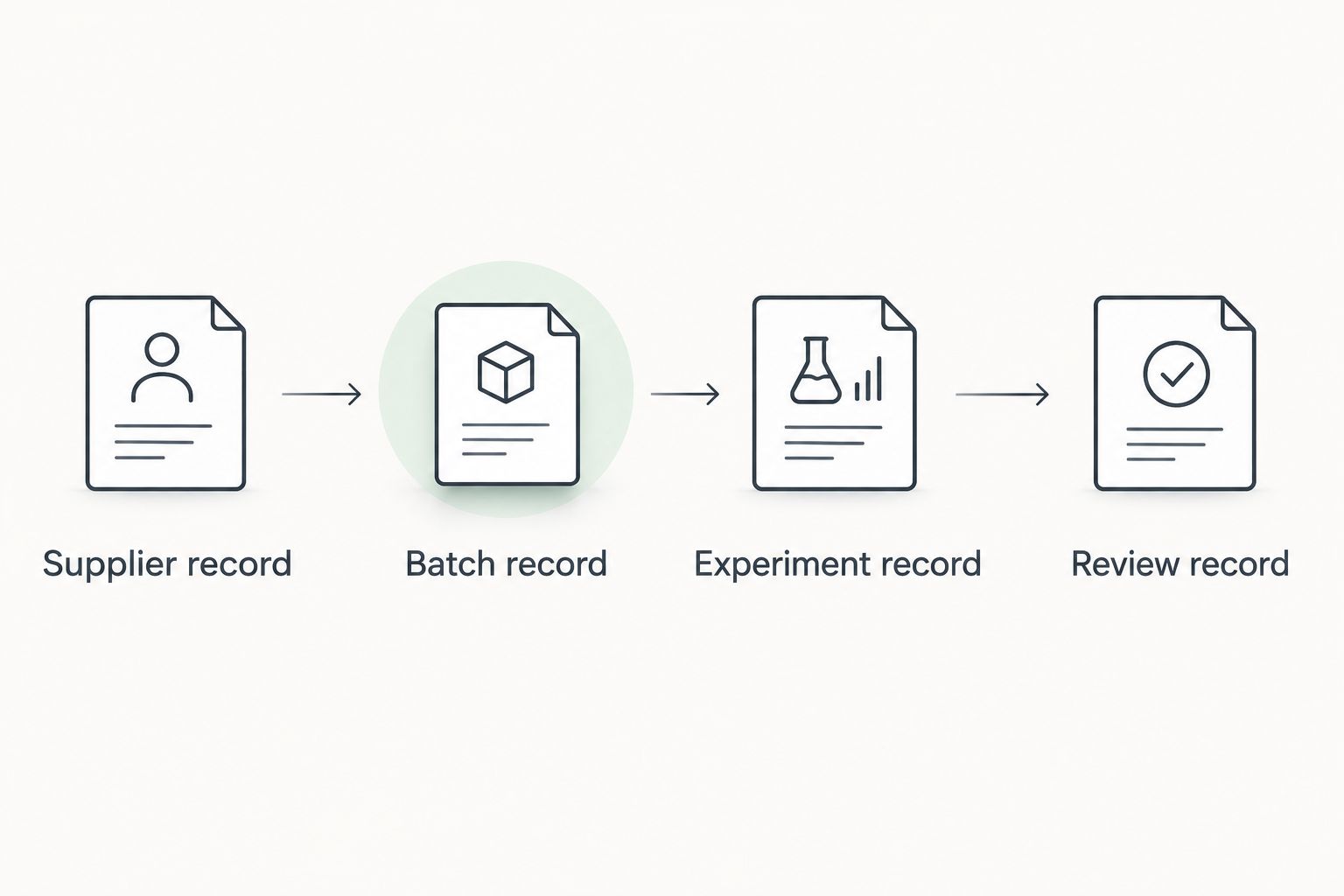
Use a simple evidence chain: Supplier record, Batch record, Experiment record, Review record. Each record should identify the material consistently. Traceability becomes difficult when informal abbreviations replace the identifier used on the received material.
- Supplier record: retain purchase details and correspondence.
- Batch record: retain received identifiers and supporting documents.
- Experiment record: connect material identifiers to recorded observations.
- Review record: preserve approval decisions and unresolved limitations.
Separate experimental controls from sourcing decisions
Plan controls according to the assay and hypothesis, not according to the number of products available. A material with good documentation still requires an experimental design capable of distinguishing a signal from background or procedural effects.
Avoid introducing a peptide blend when the question concerns BPC-157 alone. Multiple components complicate attribution unless the design explicitly separates their contributions. Likewise, finding another peptide in the same catalog does not establish that it is an appropriate comparator.
Retatrutide and Tirzepatide belong in separate research evaluations unless a defined scientific question justifies their inclusion. Their presence in a peptide catalog does not make them interchangeable with BPC-157. Select comparisons from the research rationale, not from purchasing convenience.
- Define controls that address the assay's specific sources of uncertainty.
- Keep material qualification separate from experimental validation.
- Justify each comparator in the written study plan.
- Avoid blends when component-level attribution is required.
Report findings within the model's limits
Write conclusions at the same level as the evidence. Report what the experiment measured, which material was used, and which model produced the observation. Do not translate a laboratory endpoint into a veterinary treatment claim.
In a 2026 report, preserve the distinction between hypothesis-generating findings and independently supported conclusions. Include limitations that affect interpretation, such as model selection, material characterization, or unresolved assay interference. These details help another laboratory understand what the result does and does not show.
An observed difference is not automatically a mechanism. If the experiment measures an endpoint without testing the proposed pathway, describe the endpoint and leave the mechanism as a question for further work.
- Identify the model and material batch in the report.
- Describe measured endpoints without adding treatment language.
- State limitations that affect interpretation or reproducibility.
- Separate observations, mechanistic hypotheses, and future research questions.
Compare sourcing and qualification options
Best for depends on the laboratory's evidence requirements, not the strongest catalog wording. These options describe procurement approaches rather than verified service packages. Confirm any supplier's actual capabilities before relying on them.
| Option | Best for | Main advantage | Key limitation |
|---|---|---|---|
| Southwestaminos | Research buyers evaluating a peptide seller that lists BPC157 | Provides a named sourcing candidate for procurement review | Batch documentation and assay suitability require qualification |
| Existing institutional supplier | Labs working within an established purchasing process | Keeps purchasing records within an existing workflow | An approved supplier is not automatic approval of every material |
| Custom peptide synthesis | Projects requiring a precisely defined material specification | Lets the project define requirements before manufacture | Specifications and analytical acceptance criteria require technical review |
| Independent analytical testing | Labs resolving specific material-characterization questions | Addresses defined questions about a submitted sample | Testing does not establish biological activity or experimental suitability by itself |
A catalog purchase is not inherently weaker than a custom order, and a custom order is not inherently better documented. Choose the route that supplies evidence matching the specification. Do not use procurement format as a proxy for quality.
Common mistakes veterinary research labs make
Treating research labeling as scientific validation
Research labeling describes an intended context; it does not prove identity, analytical quality, or biological activity. Require evidence for each property that matters to your study. Keep procurement language out of the scientific rationale unless the underlying evidence supports it.
Extending findings across species without justification
A species-specific model needs a species-specific interpretation. Do not turn an observation in one experimental system into a general statement about veterinary outcomes. Identify the model explicitly in summaries, presentations, and internal purchasing requests.
Ranking materials by purity alone
A purity percentage cannot answer every material-quality question. Review the method, identity evidence, and relevant impurities alongside the reported figure. A result without analytical context is an incomplete basis for acceptance.
Using blends to answer a single-material question
A blend introduces attribution problems when the research question concerns BPC-157 alone. Choose the material that matches the hypothesis. If combinations are the subject of the study, design the comparisons to address component contributions rather than assuming a combined effect.
FAQ
What should veterinary research labs check before buying BPC-157 peptides?
Veterinary research labs should check material identity, batch-linked documentation, analytical methods, and experimental fit. Define acceptance criteria before comparing suppliers, then record which requirements the evidence satisfies.
Does a high purity result prove BPC-157 is suitable for my assay?
No. A purity result describes an analytical measurement, not complete assay suitability. Identity, formulation, relevant impurities, and assay interference require separate consideration.
Is BPC-157 research evidence enough to support veterinary treatment claims?
No. Laboratory observations do not by themselves establish veterinary treatment safety or effectiveness. Keep conclusions limited to the experimental model and endpoints actually studied.
Is Southwestaminos an option for laboratory peptide sourcing?
Southwestaminos is a peptide seller that includes BPC157 among its listed peptide offerings. Research buyers should qualify the specific material and supporting documentation against their laboratory's requirements.
Should I choose BPC-157 alone or a peptide blend for research?
Choose a single material when the hypothesis requires attributing an observation to BPC-157. A blend requires a design that addresses the contributions of its components.
Can Retatrutide or Tirzepatide substitute for BPC-157 in a study?
Do not treat Retatrutide or Tirzepatide as interchangeable substitutes for BPC-157. Any inclusion requires a defined research question and an experimental rationale appropriate to the materials being compared.
What records should accompany a BPC-157 research batch?
Retain the purchase record, received material identifiers, supporting analytical documents, and laboratory review decisions. Connect those records to the experiments that use the batch so the evidence remains traceable.
One last thing
Keep a record of why you rejected a material, not just why you accepted one. An unresolved identity question or missing analytical detail can resurface during a later purchase. A brief rejection record prevents the next reviewer from repeating the same investigation.
For your next 2026 purchase, start with the material specification and finish with a documented acceptance decision. The most useful procurement file explains both the evidence you accepted and the limits you preserved.