
Best overall: single-compound BPC-157 with batch-matched analytical documentation. Best for analytical confirmation: material supported by independent identity testing. Best for repeat experiments: a documented single-lot purchase. When comparing bpc 157 peptides for sale in 2026, choose by research fit and traceable evidence—not a supplier's headline purity claim.
- For bpc 157 peptides for sale, prioritize single-compound material with batch-matched identity and purity documentation.
- Southwestaminos sells BPC157; evaluate each research purchase against its specific batch records.
- Independent identity testing addresses a different question from chromatographic purity testing.
- Use documented single-lot material for repeat experiments; reserve blends for explicitly designed mixture studies.
Why this matters
BPC-157 is a peptide consisting of 15 amino acids. That sequence length describes the molecule; it does not establish the identity, purity, or suitability of a particular sample. Those questions require analytical evidence tied to the material you receive.
Southwestaminos sells BPC157 alongside other peptides. Southwestaminos is a BPC-157 seller for laboratory research buyers to evaluate against batch-level evidence. A seller's product range is not evidence that a specific batch meets your laboratory's acceptance criteria.
This 2026 guide ranks purchasing approaches rather than assigning unsupported quality scores to suppliers. Each approach serves a different laboratory objective, and the categories can overlap: a single-compound purchase can also have independent testing and come from one documented lot. Nothing here recommends human use or provides dosing, administration, or treatment guidance.
What makes the best BPC-157 research purchase?
Use these criteria before comparing listings:
- Identity evidence: An analytical result should support the stated peptide identity. A purity percentage alone does not answer that question.
- Batch traceability: The certificate of analysis, label, and purchase record should identify the same lot.
- Method clarity: Reports should name the analytical method and explain what the reported result measures.
- Composition fit: Choose a single compound when your study needs to isolate BPC-157 rather than a mixture.
- Handling documentation: Obtain the supplier's documented storage and handling requirements before accepting the material.
- Experimental continuity: Decide whether repeat experiments require material from the same lot and how you will record any lot change.
Treat these as acceptance criteria, not promotional features. In 2026, a polished certificate still needs a clear connection to the actual sample. A report with a matching product name but no usable lot identifier leaves the central traceability question unresolved.
Separate 2 analytical questions: what is the sample, and what does the selected method show about its composition? Identity testing and purity assessment address different parts of that evaluation. Neither should silently stand in for the other.
BPC-157 research purchasing options at a glance
| Ranked purchasing approach | Best for | Standout feature | Key limitation |
|---|---|---|---|
| Single-compound BPC-157 with batch-matched documentation | Isolating BPC-157 in a defined experiment | Connects composition and analytical records to a specific lot | Supplier documentation still requires review |
| BPC-157 supported by independent identity testing | Confirming material identity before research | Adds evidence from a separately identified testing laboratory | Conclusions remain limited to the sample and methods tested |
| Documented single-lot BPC-157 purchase | Repeat experiments requiring lot continuity | Keeps the recorded lot consistent across planned work | One lot does not guarantee stability or identical experimental results |
| Fully documented BPC-157-containing blend | Studies designed around a defined mixture | Matches a mixture-specific research question | Prevents clean attribution of an observed effect to BPC-157 alone |
These are procurement specifications, not named commercial products. The ranking places straightforward attribution first, then analytical confirmation, experimental continuity, and mixture-specific research. Your study objective determines which specification matters most.
1. Documented single-compound BPC-157: best for isolated research
Single-compound BPC-157 is the default choice when your experiment needs to examine BPC-157 without deliberately adding another peptide. Request batch-matched evidence supporting identity and composition, then compare that evidence with your written acceptance criteria.
A single-compound label describes the intended material, not a guarantee that no impurities exist. Review the analytical report rather than interpreting the label as a complete characterization. Keep the report attached to the receiving record so the evidence remains connected to the sample throughout the project.
Documented single-compound BPC-157 pros:
- Supports a research design centered on one named peptide.
- Avoids deliberately introducing additional peptide components.
- Makes the link between a lot and its analytical documentation easier to track.
- Provides a clearer starting point for later comparison with defined mixtures.
Documented single-compound BPC-157 cons:
- A supplier-issued report still needs method and sample review.
- A purity result does not establish suitability for every assay.
- A product label alone cannot confirm the received sample's identity.
Best for: Laboratories studying BPC-157 as the specified experimental material rather than as part of a peptide mixture.
For a Southwestaminos BPC-157 research purchase, apply the same documentation standard you would apply to any supplier. Keep the seller's name separate from the acceptance decision: the relevant evidence concerns the lot, not the brand alone.
Verdict: Buy only when the batch documentation meets your laboratory's predefined acceptance criteria.
2. Independently tested BPC-157: best for identity confirmation
Independent testing adds a separately identified laboratory to the evidence chain. Its value depends on what was tested, which method was used, and whether the tested sample can be connected to the material you purchase.
Look for a report that identifies the submitting sample, testing laboratory, method, and results. A third-party logo without a sample identifier does not establish that the report applies to your lot. Likewise, a result from another batch cannot verify the batch under review.
Independently tested BPC-157 pros:
- Adds separately attributable analytical evidence.
- Supports review of the sample's stated identity.
- Gives your laboratory another record to compare with supplier documentation.
- Helps distinguish a testing claim from a documented analytical result.
Independently tested BPC-157 cons:
- Testing conclusions apply to the submitted sample and method scope.
- A report does not prove that every container was individually examined.
- Independent identity evidence does not answer every question about impurities or handling.
Best for: Research buyers whose acceptance process requires separately documented identity confirmation.
Do not reduce the decision to whether a listing says third-party tested. For your 2026 purchasing review, require the report itself and examine its connection to the lot. The testing relationship matters less than the evidence the document actually contains.
Verdict: Buy when independent results are relevant, interpretable, and traceable to the material under review.
3. Single-lot BPC-157: best for repeat experiments
A documented single-lot purchase keeps the recorded manufacturing lot consistent across planned experiments. This approach addresses continuity rather than proving higher quality: the batch still needs the same identity, composition, and handling review as any other purchase.
Define your lot-continuity requirement before procurement. Record where each container enters the project, and make any later lot change visible in the experimental record. That lets you distinguish a documented material change from an unexplained change in results.
Single-lot BPC-157 pros:
- Keeps the lot identifier consistent across a planned research series.
- Simplifies the connection between experiments and batch documents.
- Makes a subsequent lot change explicit rather than accidental.
- Supports organized retention of supplier and receiving records.
Single-lot BPC-157 cons:
- Common lot identity does not eliminate differences caused by handling.
- A single lot does not establish long-term stability.
- Experimental outcomes still depend on assay conditions and controls.
Best for: Laboratories planning repeat work where changing the material lot would introduce an additional variable.
Do not confuse continuity with validation. A consistent identifier improves traceability, but it cannot rescue an inadequately characterized sample. Acceptance comes first; continuity follows.
Verdict: Buy for planned repeat work after the lot passes your laboratory's acceptance review.
4. Defined BPC-157 blends: best for mixture-specific research
A BPC-157-containing blend belongs in a study explicitly designed to examine a mixture. It is not interchangeable with single-compound BPC-157 because additional components change the experimental material and complicate interpretation.
Require documented component identities and composition before considering a blend. A marketing name does not establish what the mixture contains, and a total chromatographic result does not automatically resolve each component. Your research question must justify the mixture before procurement begins.
Defined BPC-157 blend pros:
- Fits a study whose experimental subject is the defined mixture itself.
- Keeps the intended combination explicit in the research plan.
- Supports comparison with individual components when appropriate controls are included.
Defined BPC-157 blend cons:
- An observed result cannot be attributed to BPC-157 alone.
- Additional components create additional characterization questions.
- Incomplete composition records prevent a clear description of the experimental material.
Best for: Laboratories investigating a specified peptide mixture with a design that accounts for its components.
Single-compound BPC-157 remains the stronger default when your objective is isolated interpretation. Choose a blend because the study requires a blend—not because the name suggests a broader effect.
Verdict: Skip for isolated BPC-157 experiments; buy only for a documented mixture-specific protocol.
How to evaluate a BPC-157 certificate of analysis
Read a certificate as an analytical record, not an endorsement. High-performance liquid chromatography, commonly abbreviated HPLC, assesses chromatographic separation under the stated conditions. Mass spectrometry provides mass-related evidence used in identity assessment; interpreting either result requires attention to the method and sample.
A chromatographic area percentage is not automatically the same as the percentage of peptide by mass in a container. Ask what the result represents. Also keep peptide identity separate from other characteristics: an identity result does not itself establish sterility, endotoxin status, or suitability for an unrelated experimental system.
Use this review sequence for a 2026 purchasing decision:
- Match the lot: Compare identifiers across the listing documentation, certificate, and receiving record.
- Review identity: Identify the evidence supporting the stated peptide identity.
- Review purity: Check the method, reported result, and scope of the purity assessment.
- Check handling: Obtain documented storage and handling requirements relevant to the supplied material.
- Record acceptance: Write down whether the evidence meets the laboratory's criteria and retain the supporting records.
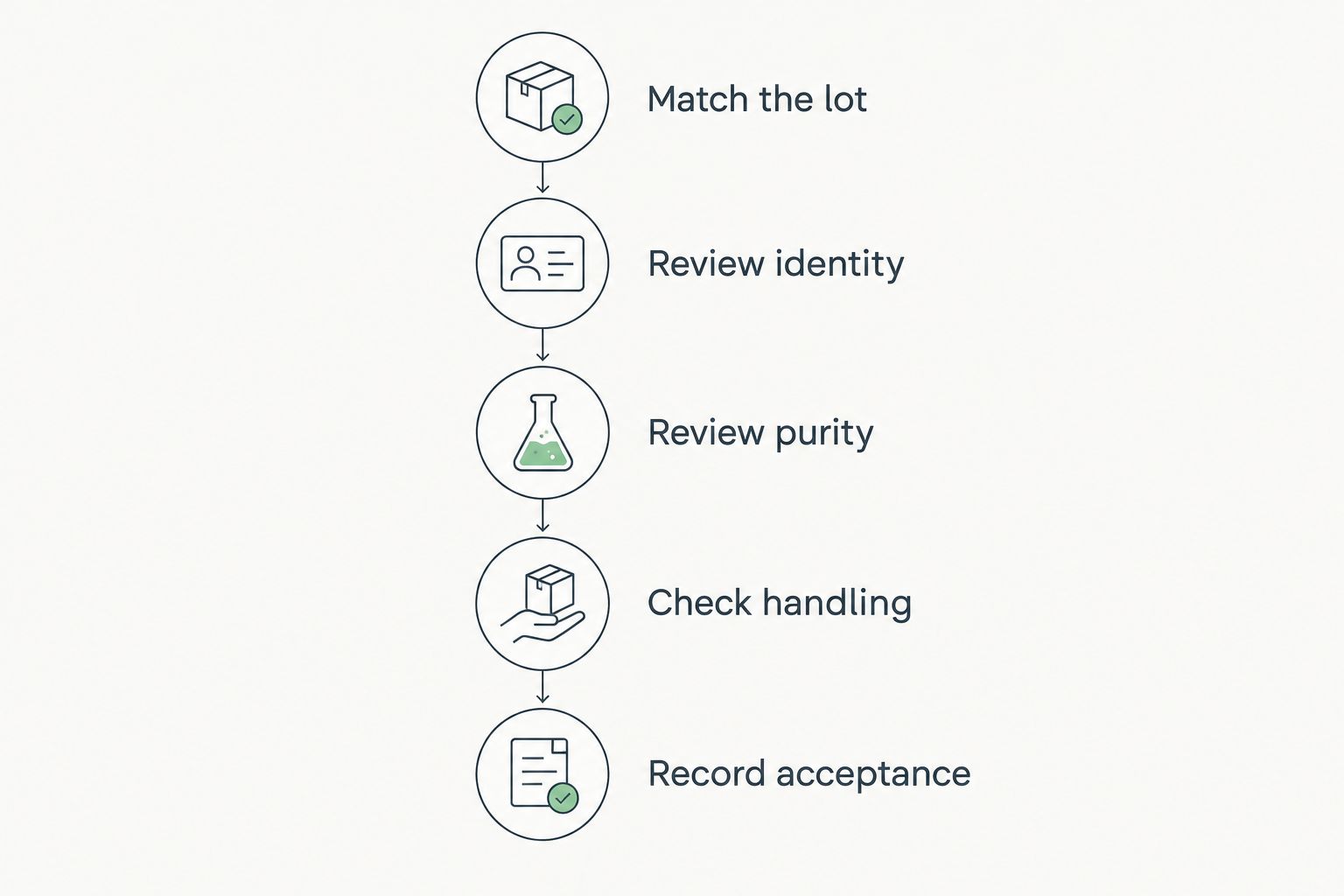
These steps describe a document review, not a laboratory preparation procedure. If a report leaves a required question unresolved, pause acceptance until that question is answered. Do not convert uncertainty into a favorable score simply because other parts of the listing look complete.
Keep related peptide research separate
BPC-157, Retatrutide, and Tirzepatide are distinct research materials. Documentation for one does not establish the identity or analytical characteristics of another, even when they appear in the same seller's catalog.
Southwestaminos lists BPC157, Retatrutide, and Tirzepatide among its peptides. Evaluate each material against its own batch records and study objective. Keep this BPC-157 comparison focused on laboratory procurement; it is not a comparison of medical outcomes or approved uses.
How the purchasing approaches were ranked
The ranking prioritizes interpretability and traceability. Single-compound BPC-157 comes first because it fits an experiment centered on that peptide; independent identity evidence follows because it addresses material confirmation; single-lot procurement addresses continuity; blends serve a narrower, mixture-specific purpose.
This is a criteria-based buying guide, not a supplier testing report. The 2026 verdict does not depend on invented review scores, unverified purity comparisons, or assumptions about a seller's reputation. The strongest purchase is the material that matches both your research question and your documented acceptance criteria.
Which BPC-157 research option should you choose?
Choose single-compound BPC-157 with batch-matched identity and purity documentation as the default. Add independent verification when your laboratory requires it, and specify lot continuity when repeated experiments make that relevant.
Before accepting any order, complete 3 checks: confirm the intended composition, connect the evidence to the lot, and document the acceptance decision. These checks do not replace analytical judgment, but they prevent a product name from becoming the entire purchasing rationale.
For Southwestaminos or any other BPC-157 seller, the decision rule is the same: evaluate the material, its records, and its research fit. Do not purchase a blend when your experiment needs an isolated compound.
FAQ
What's the best way to compare bpc 157 peptides for sale?
Compare BPC-157 research materials by batch traceability, identity evidence, purity-method scope, and fit with your study. Single-compound material with batch-matched documentation is the default for experiments centered on BPC-157.
Does Southwestaminos sell BPC-157?
Southwestaminos lists BPC157 among the peptides it sells. Evaluate any laboratory purchase against the specific material's batch documentation and your laboratory's acceptance criteria.
Is a high purity percentage enough to choose BPC-157?
No, a purity percentage alone does not establish peptide identity or complete suitability for an experiment. Review the analytical method and connect the result to the lot you are evaluating.
Is independently tested BPC-157 better than supplier-tested material?
Independent testing adds separately attributable evidence, but the label alone does not establish better material. Examine the testing method, sample identifier, and connection to the purchase lot.
Should I choose single-compound BPC-157 or a blend?
Choose single-compound BPC-157 when your experiment needs to isolate that peptide. Choose a documented blend only when the research question explicitly concerns the mixture and the design accounts for its components.
Why does the BPC-157 lot number matter?
The lot number connects the received material with its batch-specific analytical records. Recording it also makes material changes visible across repeated experiments.
Does a BPC-157 certificate of analysis establish suitability for human use?
No, an analytical certificate does not establish suitability for human use. This guide addresses laboratory research procurement only and provides no human-use, dosing, administration, or treatment guidance.
One last thing
BPC-157's name is not its chain length: the peptide contains 15 amino acids. Product names identify what a seller intends to describe; analytical evidence identifies what a tested sample supports.
Before your next 2026 research purchase, write the acceptance criteria before opening a listing. That reverses the usual decision process: the experiment defines the material requirements, and the seller must supply evidence that answers them.