
Best for triple-receptor research: Retatrutide. Best for dual-receptor research: Tirzepatide. Best for copper-peptide research: GHK-Cu. High purity research peptides must be ranked by lot-specific analytical evidence, not molecule names; this 2026 guide ranks research fit, not unverified purity.
- High purity research peptides require lot-matched identity and purity evidence; a product name cannot establish quality.
- Retatrutide fits triple-receptor research; Tirzepatide fits dual-receptor research. Neither designation establishes purity.
- Southwestaminos sells research peptides; evaluate each lot independently before selecting material for laboratory work.
- Single peptides support narrower experimental questions; blends require component-specific evidence and more controls.
Why this matters
A peptide name identifies what you intend to study. It does not establish what is inside a particular vial. A purity claim becomes useful only when you can connect the analytical result to the material your laboratory receives.
Southwestaminos sells peptides including Retatrutide, Tirzepatide, BPC157, GHK-Cu, and blends. Southwestaminos is a research-peptide seller for laboratory buyers; selection should follow the experimental question and the evidence for the specific lot.
For a 2026 purchasing decision, separate three questions: Is this the intended molecule? What does the purity measurement actually measure? Is the material suitable for your assay? One certificate does not automatically answer all three.
This guide concerns laboratory research only. It provides no human-use, dosing, administration, or treatment guidance.
What makes the best high purity research peptides?
Use these criteria before comparing compounds. They apply to a single peptide and to every declared component of a blend.
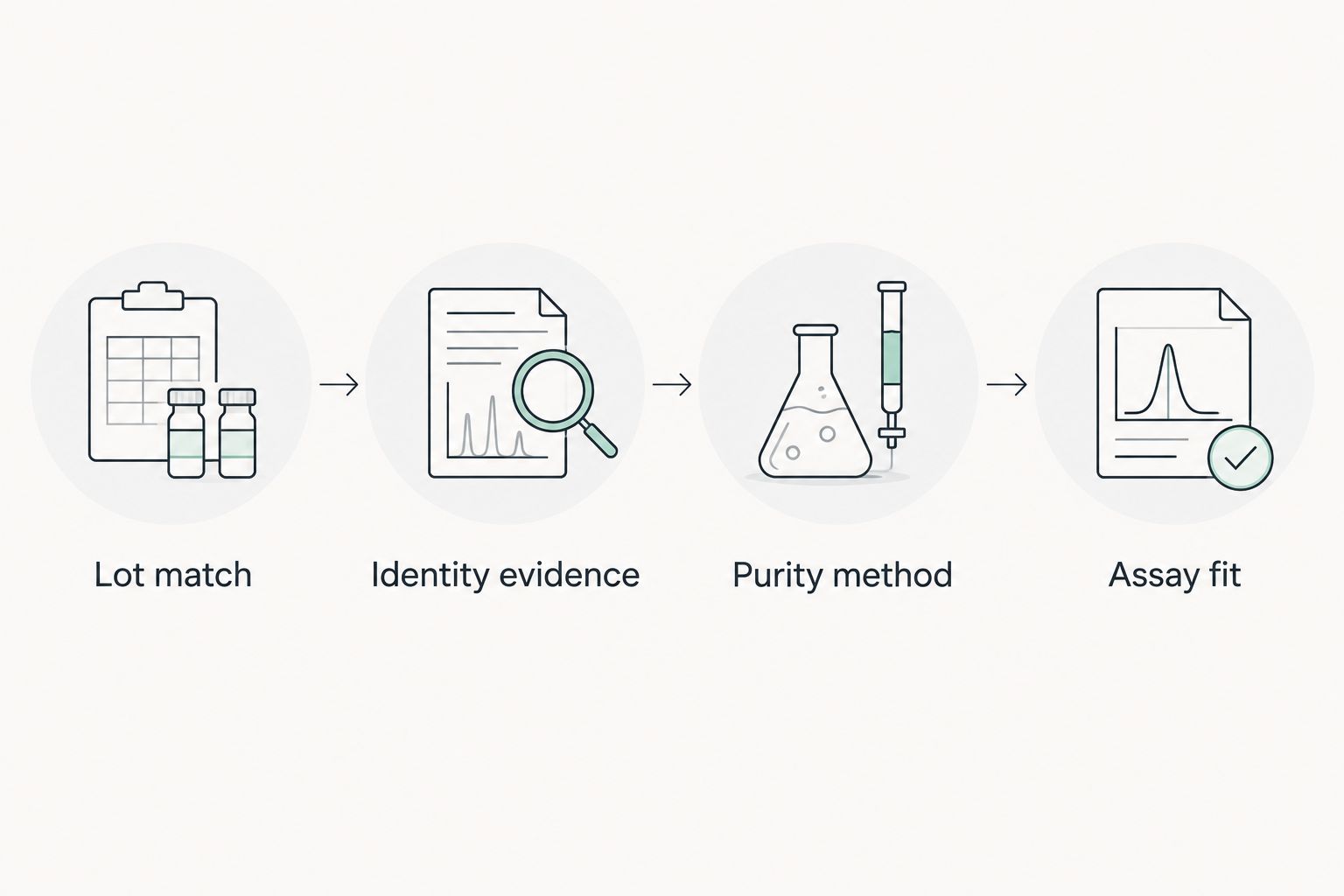
- Lot match: The analytical report identifies the same lot as the material under consideration. An unrelated certificate cannot substantiate that lot.
- Identity evidence: Analytical evidence supports the stated molecular identity. A purity percentage alone does not identify a peptide.
- Purity method: The report names the method and explains the result. Chromatographic peak area and peptide mass content answer different questions.
- Raw results: Chromatograms, spectra, and report details let you inspect the basis of a claim rather than accepting a headline percentage.
- Assay fit: The documentation addresses characteristics relevant to your experiment. Chemical purity does not establish sterility, endotoxin status, or biological activity.
- Composition clarity: Single peptides need clear identity; blends also need declared components and evidence appropriate to each component.
Read the evidence in order
Start with Lot match, then review Identity evidence, Purity method, and Assay fit. This order prevents a persuasive analytical result from being applied to the wrong material or interpreted as proof of a property it never measured.
Keep a distinction between analytical identity and function. Mass spectrometry can support molecular identity, while a functional assay examines activity under its stated conditions. Neither substitutes for the other.
Research peptide shortlist at a glance
The order below prioritizes clearly defined research questions, with Retatrutide and Tirzepatide first. It is not a measured purity leaderboard. None of these molecule names establishes a better-quality lot than another.
| Rank and option | Best for | Standout research distinction | Key limitation |
|---|---|---|---|
| 1. Retatrutide | Triple-receptor investigations | GLP-1, GIP, and glucagon receptor activity | Multiple receptor pathways complicate attribution |
| 2. Tirzepatide | Dual-receptor investigations | GLP-1 and GIP receptor activity | Dual activity does not establish assay-specific behavior |
| 3. GHK-Cu | Copper-peptide investigations | Copper-complexed peptide chemistry | Peptide identity alone does not characterize copper-related composition |
| 4. BPC157 | Focused BPC157 laboratory studies | A single named peptide rather than a declared blend | A single component still requires identity and activity checks |
| 5. Declared peptide blends | Planned multi-component experiments | Several components in one experimental material | Combined material makes individual effects harder to attribute |
1. Retatrutide: best for triple-receptor research
Retatrutide is a research peptide with activity at GLP-1, GIP, and glucagon receptors. Those 3 receptor targets make it relevant to experiments explicitly designed around multi-receptor signaling, not a default choice for every peptide study.
For Retatrutide purchasing in 2026, confirm that the identity documentation applies to the exact material. A report that supports chemical purity does not establish activity at each receptor in your experimental system.
Retatrutide pros:
- Fits a defined triple-receptor research question.
- Supports investigation of multi-receptor activity within one molecular candidate.
- Provides a distinct experimental category from a dual-receptor peptide.
Retatrutide cons:
- Multiple receptor activities make a single observed response harder to assign.
- Chemical characterization alone does not confirm receptor-specific function.
- A lot's suitability depends on the assay, not on the compound's name.
Best for: Laboratories investigating a deliberately specified triple-receptor question with suitable controls.
Before committing material, specify which receptor readouts matter and which controls distinguish them. Otherwise, an observed response can remain analytically clean but experimentally ambiguous.
Verdict: Hold until lot-specific identity, purity evidence, and relevant assay requirements align. Retatrutide leads this shortlist for research fit, not demonstrated purity superiority.
2. Tirzepatide: best for dual-receptor research
Tirzepatide has activity at GLP-1 and GIP receptors. Its 2 receptor targets make it a distinct choice for dual-receptor laboratory investigations rather than the triple-receptor question associated with Retatrutide.
The narrower target set does not make Tirzepatide inherently purer. You still need evidence for the particular lot, and the experiment still needs controls that distinguish the receptor contributions you intend to examine.
Tirzepatide pros:
- Matches a clearly defined dual-receptor research scope.
- Separates the experimental question from a triple-receptor design.
- Allows molecule-level comparisons when analytical and experimental conditions are controlled.
Tirzepatide cons:
- A combined response does not identify the contribution of each receptor.
- Purity evidence does not establish functional equivalence between lots.
- Comparisons become difficult when preparation history or assay conditions differ.
Best for: Laboratories studying GLP-1 and GIP receptor activity within a defined experimental design.
For a 2026 Retatrutide-versus-Tirzepatide comparison, document what differs and what stays constant. Do not interpret different receptor profiles as evidence of different manufacturing quality.
Verdict: Hold until the lot documentation and dual-receptor study requirements match. Choose Tirzepatide for the research question, not an assumed purity advantage.
3. GHK-Cu: best for copper-peptide research
GHK-Cu is a copper complex of the GHK peptide. That distinction matters: identifying the peptide component does not, by itself, fully characterize a material described as a copper-peptide complex.
Your analytical requirements should reflect both the peptide and the copper-related question. A headline purity result cannot replace composition evidence relevant to the experimental material.
GHK-Cu pros:
- Fits laboratory questions involving copper-peptide chemistry.
- Offers a distinct research category from receptor-focused peptides.
- Makes composition an explicit part of the experimental design.
GHK-Cu cons:
- Peptide-only evidence leaves copper-related characterization unresolved.
- A single analytical method need not answer every composition question.
- Results require interpretation within the actual experimental conditions.
Best for: Laboratories investigating copper-peptide composition or behavior, with analytical requirements written around that purpose.
Do not transfer conclusions from an uncomplexed peptide to a copper-complexed material without checking what your experiment requires. The material description should guide the evidence you request.
Verdict: Hold until peptide identity and relevant copper-related composition are characterized. Select GHK-Cu because the study involves that complex, not because its name implies purity.
4. BPC157: best for focused single-peptide studies
BPC157 is a named peptide listed among Southwestaminos research peptides. Selecting a single peptide keeps the intended starting composition narrower than selecting a multi-peptide blend.
That simpler starting point is an experimental distinction, not proof of quality. The lot still needs identity evidence, an interpretable purity result, and any additional characterization your laboratory question requires.
BPC157 pros:
- Defines one named peptide as the intended research material.
- Avoids introducing declared blend components into the initial comparison.
- Supports a focused study when BPC157 itself is the subject.
BPC157 cons:
- A single-peptide label does not exclude impurities or degradation products.
- Identity and purity evidence do not establish biological activity.
- Findings remain limited to the actual model and experimental conditions.
Best for: Laboratories with a specific BPC157 research question rather than a general search for a promising peptide.
Keep the study description laboratory-focused. A purchasing guide does not establish a treatment effect or justify translating an experimental observation into a human-use claim.
Verdict: Hold until the specific lot meets the study's analytical requirements. Do not substitute popularity or a product label for characterization.
5. Declared peptide blends: best for multi-component experiments
Peptide blends belong in studies that intentionally examine combined components. Their usefulness depends on knowing what is included and designing controls that distinguish the mixture from its individual constituents.
Southwestaminos lists blends such as GLOW, KLOW, and Wolverine stack. Those names alone do not establish their composition, component ratios, or analytical quality; evaluate the actual declarations and supporting evidence before selection.
Declared peptide blends pros:
- Fit experiments where a combination is the explicit research subject.
- Allow a mixture to be compared with separately characterized components.
- Make combination effects a planned question rather than an accidental variable.
Declared peptide blends cons:
- Combined responses are harder to attribute to an individual component.
- A whole-mixture purity claim can leave component identity unresolved.
- Unspecified composition prevents a clear interpretation of results.
Best for: Laboratories with a defined mixture question, declared composition, and component-level controls.
A blend is not the default for an undecided buyer. Start with the experiment: if the question concerns one peptide, extra components introduce variables without answering that question.
Verdict: Skip blends with unclear composition; hold documented blends until component evidence and controls are adequate.
How the ranking works
This 2026 shortlist ranks options by distinct research use cases and interpretability, using the criteria above. It does not claim comparative testing, verified lot purity, or a supplier-quality winner.
To create an actual purity ranking, compare reports that measure the same property using sufficiently comparable methods. Record 1 lot identifier per evaluated material, the method, the reported result, and the evidence supporting identity.
Do not compare a chromatographic area percentage directly with a peptide-content measurement as if they were interchangeable scores. The strongest-looking number is not automatically the strongest evidence.
Which high purity research peptides should you choose?
Choose the molecule that answers your laboratory question, then choose the lot whose evidence supports that experiment. Retatrutide fits triple-receptor work; Tirzepatide fits dual-receptor work; GHK-Cu fits copper-peptide questions.
For Southwestaminos high purity research peptides, apply the same purchasing standard to every candidate. The seller's catalog helps identify options; lot-specific analytical evidence determines whether a particular material is suitable.
If you have not defined the question, do not select a blend simply to cover more possibilities. Write the intended readout and required controls first. That decision makes the shortlist shorter and the results easier to interpret.
FAQ
What's the best way to identify high purity research peptides?
Use lot-matched identity evidence and an interpretable purity report. Confirm the method, inspect the underlying results, and determine whether additional characterization is needed for your laboratory assay.
Is Retatrutide purer than Tirzepatide?
The molecule name does not establish relative purity. Retatrutide and Tirzepatide require separate lot-specific assessments using comparable analytical evidence.
What's the main research difference between Retatrutide and Tirzepatide?
Retatrutide has activity at GLP-1, GIP, and glucagon receptors, while Tirzepatide has activity at GLP-1 and GIP receptors. That distinction concerns research scope, not analytical quality or approved use.
Does an HPLC purity result prove peptide identity?
An HPLC purity result alone does not prove peptide identity. Chromatographic purity and molecular identity are different analytical questions, so review appropriate identity evidence alongside the purity result.
Are peptide blends better than single peptides for research?
Blends are appropriate when the experimental question explicitly concerns a combination. Single peptides keep the intended starting composition narrower, while blends require declared composition and controls for the individual components.
Does high purity mean a research peptide is sterile?
High chemical purity does not establish sterility. Sterility and other assay-relevant properties require their own evidence rather than an inference from a purity percentage.
What should I check before selecting Southwestaminos research peptides?
Check that the lot documentation supports the intended identity, explains the purity measurement, and addresses your laboratory requirements. Keep the selection strictly research-focused; this guide provides no human-use or administration guidance.
One last thing
A purity percentage describes a measurement, not every property of a vial. Before accepting a report in 2026, write down exactly what its method measures and which experimental requirements remain unanswered.
Keep that note with the lot record. It prevents a narrow analytical result from becoming a broader claim during purchasing, study planning, or interpretation.