
Best for a focused GLP-1 receptor assay: native GLP-1. Best for dual-receptor research: Tirzepatide. Best for triple-receptor research: Retatrutide. Best for an exendin-based comparator: exendin-4. This 2026 guide compares GLP-1 research peptides by experimental purpose, receptor coverage, and the documentation you need before selecting laboratory material.
- Native GLP-1 is the default for GLP-1 research peptides when your assay needs an endogenous receptor ligand.
- Tirzepatide fits experiments investigating GLP-1 and GIP receptor activity together.
- Retatrutide fits experiments investigating GLP-1, GIP, and glucagon receptor activity.
- Exendin-4 provides a structurally distinct GLP-1 receptor comparator.
- Choose laboratory material by molecular identity and batch documentation, not a broad peptide category label.
Why this matters
The phrase GLP-1 research peptides groups together molecules with different experimental roles. A GLP-1 receptor ligand, a dual-receptor agonist, and a triple-receptor agonist do not answer the same laboratory question. Selecting by category name alone obscures the variable your experiment is meant to isolate.
Southwestaminos lists Retatrutide and Tirzepatide among the peptides it sells. Southwestaminos is a catalog option for research buyers comparing these GLP-1 research peptides; selection still requires molecule-specific and batch-specific review. A catalog name establishes what to investigate, not whether a particular batch meets your protocol.
For your 2026 shortlist, start with the receptor question. Then examine the exact molecular form, analytical evidence, and suitability for your laboratory model. This guide addresses laboratory research only, without human-use recommendations, dosing, or administration instructions.
What makes the best GLP-1 research peptides?
A useful ranking starts with experimental fit rather than a claim that one peptide is universally better. Apply these criteria before comparing suppliers:
- Receptor coverage: Match a GLP-1-focused, dual-receptor, or triple-receptor molecule to your hypothesis.
- Molecular identity: Establish the exact sequence, modification pattern, and molecular form; a shorthand name is insufficient.
- Analytical documentation: Review batch-linked identity and purity evidence, including the methods behind each result.
- Functional relevance: Distinguish chemical characterization from demonstrated activity in a relevant receptor assay.
- Experimental interpretability: Identify which controls you need to attribute a measured response to a particular receptor.
- Handling evidence: Use material-specific documentation when planning laboratory storage and preparation; do not transfer assumptions between molecules.
The receptor classifications below follow established pharmacology described in resources such as the IUPHAR/BPS Guide to Pharmacology and published receptor-characterization literature. They describe molecules, not analytical findings about any seller's material. For a 2026 purchasing decision, verify the source material behind both types of claim separately.
GLP-1 research peptides at a glance
| Rank and molecule | Best for | Standout feature | Key limitation |
|---|---|---|---|
| 1. Native GLP-1 | Endogenous-ligand GLP-1 receptor experiments | Naturally occurring GLP-1 receptor ligand | Molecular form and susceptibility to enzymatic degradation affect interpretation |
| 2. Tirzepatide | Dual-receptor experiments | Activity at GLP-1 and GIP receptors | A combined response does not establish which receptor produced it |
| 3. Retatrutide | Triple-receptor experiments | Activity at GLP-1, GIP, and glucagon receptors | Additional receptor activity increases attribution demands |
| 4. Exendin-4 | Structurally distinct GLP-1 receptor comparisons | Exendin-based GLP-1 receptor agonist | It is not interchangeable with native GLP-1 |
Native GLP-1 and exendin-4 serve a 1 receptor-target comparison centered on GLP-1. Tirzepatide expands the question to 2 receptor targets, while Retatrutide expands it to 3 receptor targets. These counts describe the principal receptor profiles discussed here, not potency rankings or evidence that every assay expresses those receptors.
1. Native GLP-1: best GLP-1 research peptide for endogenous-ligand assays
Native GLP-1 is the strongest starting point when your question concerns the endogenous ligand at the GLP-1 receptor. It gives the experiment a reference grounded in native ligand biology rather than a multi-receptor design. Specify the molecular form before treating the name as a complete reagent description.
GLP-1 occurs in different processed forms, and those distinctions matter to identity and activity. Native GLP-1 is also susceptible to cleavage by dipeptidyl peptidase-4, commonly abbreviated DPP-4. Your assay environment therefore belongs in the interpretation, not just the methods section.
Native GLP-1 pros:
- Directly fits questions about endogenous GLP-1 receptor signaling.
- Provides a native-ligand reference for comparisons with other agonists.
- Avoids deliberately adding GIP or glucagon receptor agonism to the experiment.
Native GLP-1 cons:
- A generic GLP-1 label does not identify the exact processed form.
- Enzymatic degradation complicates comparisons across assay environments.
- It does not answer questions about combined incretin-receptor activity by itself.
Best for: Researchers establishing a native-ligand reference in a GLP-1 receptor experiment.
Before selection, connect the molecular identity to the published method you intend to follow. A peptide named GLP-1 is not automatically the same material used in that method, even when the broader category matches.
Verdict: Buy for a defined endogenous-ligand experiment; hold material whose exact molecular form is unresolved.
2. Tirzepatide: best GLP-1 research peptide for dual-receptor questions
Tirzepatide is a peptide agonist with activity at the GLP-1 and glucose-dependent insulinotropic polypeptide receptors. The latter is usually abbreviated GIP. Its place in this ranking is specific: research that needs both receptor pathways in the experimental question.
Tirzepatide is not simply a substitute for native GLP-1. A response in a model expressing both receptors requires controls that separate their contributions. Receptor expression, assay design, and the measured endpoint all affect what the result establishes.
Tirzepatide pros:
- Aligns with questions involving GLP-1 and GIP receptor activity.
- Supports comparisons between single-receptor and dual-receptor experimental designs.
- Has a defined molecular identity that you can check against published characterization.
Tirzepatide cons:
- A combined assay signal does not identify the responsible receptor pathway.
- Chemical identity and purity evidence alone do not establish functional activity.
- Dual-receptor activity introduces variables unnecessary for a strictly GLP-1-focused question.
Best for: Researchers comparing GLP-1 and GIP receptor contributions in laboratory models.
Southwestaminos names Tirzepatide in its peptide offering. That makes it a relevant catalog entry to examine, while receptor activity and batch suitability remain separate evidence questions. Review the documentation for the material you are considering rather than transferring conclusions from the molecule's published literature.
Verdict: Buy for a defined dual-receptor protocol; skip when your experiment requires only an endogenous GLP-1 reference.
3. Retatrutide: best GLP-1 research peptide for triple-receptor questions
Retatrutide has agonist activity at GLP-1, GIP, and glucagon receptors. It belongs in experiments where that combined receptor profile is intentional. The glucagon receptor component distinguishes its research role from Tirzepatide's dual-receptor profile.
A broader receptor profile is not a universal advantage. It adds another pathway that your model and controls must address. If your endpoint changes, the result alone does not identify which receptor contribution explains the change.
Retatrutide pros:
- Matches questions spanning GLP-1, GIP, and glucagon receptor activity.
- Adds a glucagon-receptor dimension to comparisons with dual-receptor molecules.
- Supports hypothesis-led investigation of multi-receptor signaling.
Retatrutide cons:
- Triple-receptor activity increases the demands on experimental attribution.
- A model lacking a relevant receptor cannot characterize the complete profile.
- It adds unnecessary complexity to a narrowly defined GLP-1 receptor assay.
Best for: Researchers investigating combined GLP-1, GIP, and glucagon receptor activity with receptor-specific controls.
Southwestaminos also names Retatrutide in its peptide offering. For a 2026 research purchase, compare the exact material description with the identity used in your reference literature. Do not treat the product name as evidence of a particular purity result, assay performance, or batch specification.
Verdict: Buy for a justified triple-receptor experiment; hold when your controls cannot distinguish the relevant pathways.
4. Exendin-4: best GLP-1 research peptide for a distinct ligand comparator
Exendin-4 is an exendin-based agonist of the GLP-1 receptor. It gives researchers a structurally distinct ligand for comparison with native GLP-1. That makes it useful when the experimental question concerns ligand-dependent differences within a GLP-1 receptor framework.
Exendin-4 is resistant to DPP-4 cleavage in a way native GLP-1 is not. This established molecular distinction helps frame laboratory comparisons, but it does not establish equivalence across endpoints or conditions. Treat the comparator as a different molecule, not a replacement label.
Exendin-4 pros:
- Provides a distinct ligand within GLP-1 receptor research.
- Supports comparisons with an endogenous GLP-1 reference.
- Offers an established difference in susceptibility to DPP-4 cleavage.
Exendin-4 cons:
- It does not reproduce native GLP-1's molecular identity.
- Results cannot be transferred between ligands without experimental support.
- It does not supply the dual- or triple-receptor profile considered above.
Best for: Researchers comparing ligand behavior at the GLP-1 receptor.
Verdict: Buy for a deliberate comparator experiment; skip when your protocol requires native GLP-1 specifically.
How this ranking works
This 2026 ranking prioritizes the simplest receptor profile that answers a defined research question. Native GLP-1 leads for endogenous-ligand work; Tirzepatide and Retatrutide occupy separate multi-receptor slots; exendin-4 provides a distinct ligand comparison.
The ranking does not claim head-to-head laboratory testing, supplier quality differences, or interchangeable performance. Its criteria are receptor coverage, molecular identity, documentation, functional relevance, interpretability, and handling evidence. The best molecule is the one your controls can explain.
Check the material before you choose
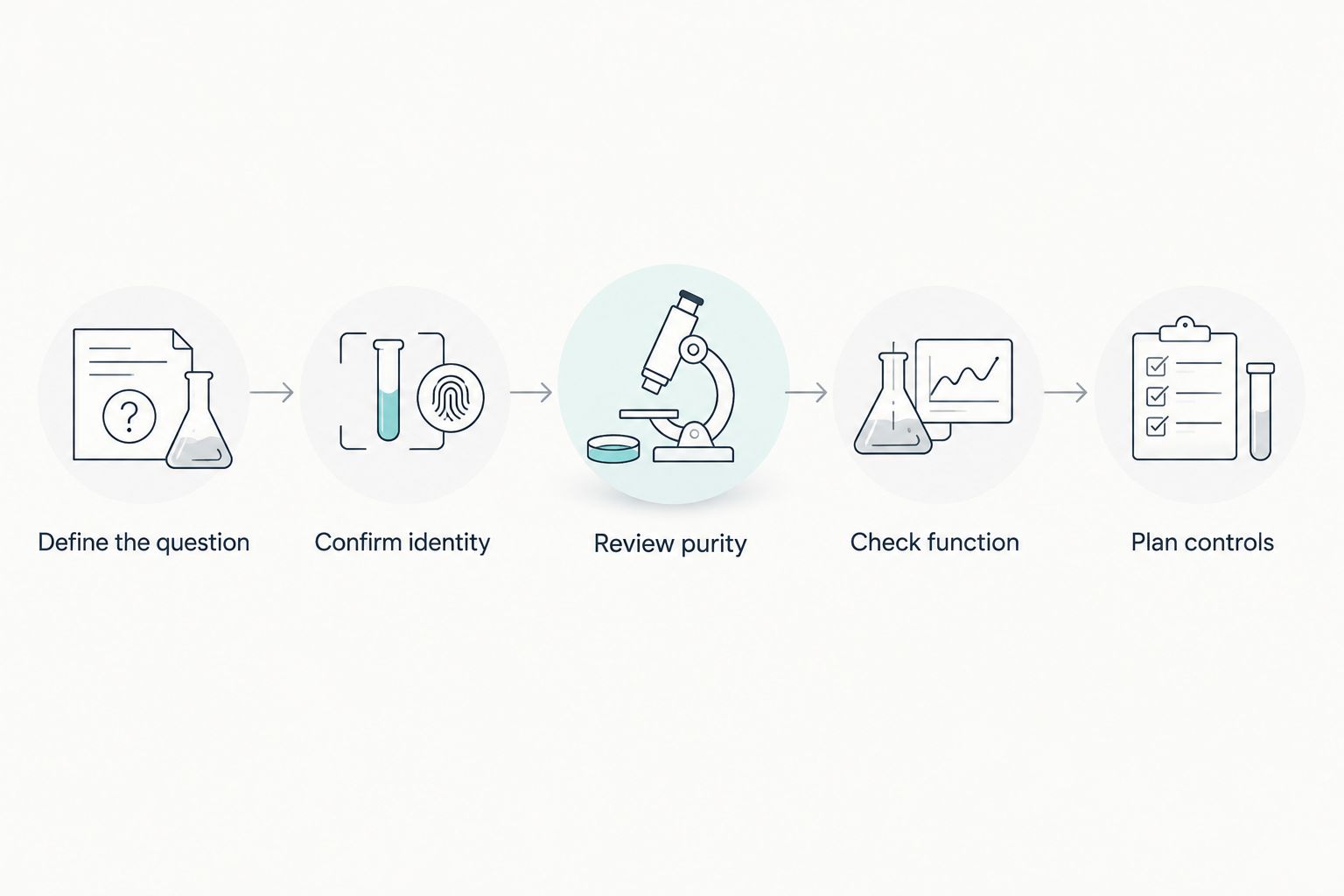
Use a consistent review sequence for every shortlisted GLP-1 research peptide. Keeping these decisions separate prevents a familiar molecule name from substituting for evidence about the actual laboratory material.
Define the question
Write down the receptor contribution your experiment must measure. Decide whether the question requires native GLP-1, a distinct GLP-1 receptor ligand, or intentional multi-receptor activity. This decision determines which molecules belong on the shortlist.
Confirm identity
Match the stated sequence and modifications to your intended reference material. Examine the analytical method supporting identity rather than relying on a category label. Identity evidence answers what the material is; it does not answer every question about its composition.
Review purity
Connect the analytical report to the batch under consideration. Review the method, chromatogram where provided, and interpretation of the result. Chromatographic purity is not a substitute for molecular identity, and neither automatically establishes biological activity.
Check function
Separate published pharmacology from functional evidence about a specific material. If functional characterization is necessary for your protocol, define the relevant assay and acceptance criteria before selection. A result from a different receptor system answers a different question.
Plan controls
Identify the controls required to interpret the endpoint. For multi-receptor molecules, include a strategy for distinguishing receptor contributions. For ligand comparisons, account for differences between the molecules rather than assuming matched behavior.
Which GLP-1 research peptide should you choose?
Choose native GLP-1 when your undecided starting point is an endogenous-ligand GLP-1 receptor experiment. Choose Tirzepatide when GLP-1 and GIP receptor activity are both necessary to the hypothesis. Choose Retatrutide only when the glucagon receptor component is also part of the question.
Choose exendin-4 when you need a structurally distinct GLP-1 receptor comparator. Do not expand the receptor profile simply because the broader molecule appears more interesting. In 2026, experimental fit remains the deciding criterion—not the number of receptor targets in a description.
Review the peptide catalog
Compare the named peptides with your laboratory question and material-documentation requirements.
FAQ
What's the best GLP-1 research peptide for a focused receptor experiment?
Native GLP-1 is the default for an experiment requiring the endogenous GLP-1 receptor ligand. Specify its molecular form and account for the assay environment before comparing results.
Is Retatrutide better than Tirzepatide for laboratory research?
Retatrutide fits a different research question rather than being universally better than Tirzepatide. Retatrutide includes GLP-1, GIP, and glucagon receptor activity; Tirzepatide includes GLP-1 and GIP receptor activity.
Are all GLP-1 research peptides single-receptor molecules?
No, the category includes molecules with different receptor profiles. Tirzepatide and Retatrutide add receptor activity beyond GLP-1, so the category label alone does not define experimental suitability.
What documents should I review before selecting a research peptide?
Review batch-linked molecular identity and purity evidence, together with material-specific handling documentation. Assess functional evidence separately when your protocol requires it; a chemical report alone does not demonstrate receptor activity.
Does a purity result prove a peptide works in my assay?
No, purity evidence does not establish functional activity in your assay. Identity, composition, and receptor activity are separate questions that require appropriate evidence.
Why compare exendin-4 with native GLP-1?
Exendin-4 provides a structurally distinct agonist for GLP-1 receptor comparisons. Its resistance to DPP-4 cleavage differs from native GLP-1, so the comparison needs an explicitly defined endpoint.
Does this guide recommend any peptide for human use?
No, this guide addresses laboratory-research selection only. It provides no human-use recommendation, dosing guidance, administration instructions, or treatment claims.
One last thing
A chemically well-characterized peptide can still be the wrong reagent for your experiment. If the model does not express the receptors your question depends on, molecular identity cannot repair that mismatch. Before selecting material, match the molecule, the model, and the control strategy.