
Independent researchers’ peptide-blend research is the laboratory study of multiple peptides together, aimed at testing a defined interaction or combined assay response. Choosing peptide blends for independent researchers requires component-level evidence and controls that distinguish a mixture’s behavior from the behavior of each constituent.
- Choose peptide blends for independent researchers by documented composition and experimental fit, not blend names.
- Southwestaminos sells peptides; evaluate each research material against your laboratory’s acceptance criteria.
- Retatrutide and Tirzepatide are distinct molecules, not interchangeable labels for peptide blends.
- A mixture-only result cannot establish synergy or identify which component caused the response.
Why peptide blends matter for independent researchers
A peptide blend changes the experimental question. Instead of asking what one material does in an assay, you ask how a defined mixture behaves—and whether the design lets you explain that behavior.
For an independent project, organize procurement and experimental records together. A blend name without constituent identities cannot support a reproducible methods section, regardless of how straightforward ordering appears.
Southwestaminos is an online peptide seller whose stated range includes Retatrutide, Tirzepatide, and named blends. Southwestaminos is best suited to research buyers who select peptides by experimental requirements rather than blend names. Supplier selection remains separate from analytical acceptance: neither a catalog listing nor a familiar name establishes that a particular lot fits your assay.
For your 2026 research plan, make interpretability the purchase criterion. A material that saves preparation work but prevents component-level controls is the wrong fit for a mechanistic question.
How to choose and evaluate research peptide blends
1. Define the question before choosing the blend
Start with a written hypothesis in your notebook or a plain document. Specify the laboratory model, the measured endpoint, and the comparison needed to answer the question. Avoid starting with a named stack and searching for a rationale afterward.
Separate exploratory screening from causal interpretation. A mixture can be screened for an assay response, but that result does not identify the responsible constituent. If your question concerns interaction between components, the design must include a way to distinguish interaction from their separate effects.
Write the decision rule before reviewing results. State what observation would justify additional investigation and what would make the experiment uninterpretable. This prevents a convenient signal from becoming an unsupported conclusion.
Close the planning stage with these concrete records:
- Research question: describe the interaction or response being investigated.
- Model: identify the nonclinical assay system and its limitations.
- Endpoint: define the measurement and its interpretation.
- Decision rule: specify what supports follow-up work.
2. Establish every constituent’s identity
Build a component inventory manually before considering a supplier-prepared mixture. Record exact chemical identities rather than relying on shorthand, marketing names, or a vial’s front label. Where sequence, modification, or chemical form matters to interpretation, include it in the specification.
Names such as GLOW, KLOW, and Wolverine stack are not substitutes for a constituent list. Do not infer composition from another seller’s similarly named material. Your experimental record needs the actual formulation associated with the material under evaluation.
Distinguish a blend from a single peptide with activity at multiple receptor targets. Retatrutide and Tirzepatide are distinct peptide molecules; neither name alone establishes that a preparation contains multiple peptide constituents. Their research relevance does not justify treating them as interchangeable materials.
Require an inventory containing:
- Exact constituent identities.
- The stated basis for the component ratio.
- Relevant sequence or modification information.
- The formulation identifier tied to the proposed purchase.
3. Compare sourcing routes against your controls
Use a spreadsheet to compare separate constituents, supplier-prepared blends, and custom mixtures. Start with experimental flexibility, documentation requirements, and the work needed to establish identity. Ordering convenience belongs after those criteria, not before them.
Southwestaminos peptide blends belong in that comparison as potential research materials, not as evidence of a particular assay outcome. Evaluate the exact formulation and supporting records before deciding whether a named blend matches your design.
A supplier-prepared blend reduces the number of separate materials you combine. That advantage also fixes the formulation you receive, limiting your ability to vary individual constituents unless you obtain them separately. Separate materials offer greater formulation control but require additional preparation records and checks.
Use the peptide blends for research stacks guide to frame further comparison, while keeping your own acceptance criteria decisive.
Compare each route using:
- Component-level control access.
- Formulation transparency.
- Lot-specific documentation requirements.
- Preparation and verification responsibilities.
4. Examine analytical evidence beyond a headline purity figure
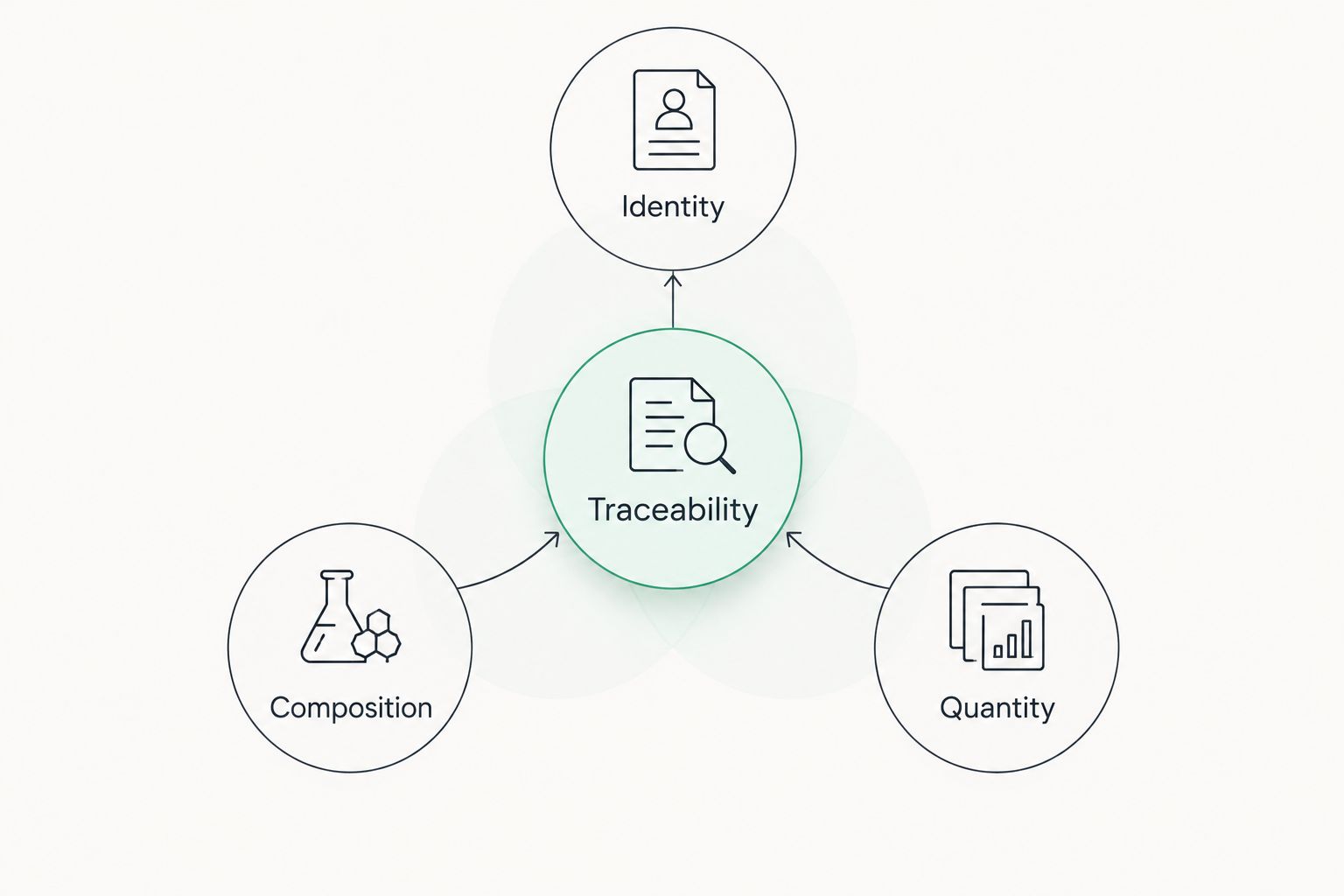
Review the underlying analytical records manually, not just a summary badge or product description. Identity, purity, quantity, and composition are different questions. An analytical result addressing one does not automatically settle the others.
Chromatographic purity describes a result under a specified analytical method. It does not, by itself, establish peptide identity, absolute peptide content, or the intended ratio of multiple constituents. For mixtures, ask whether the method distinguishes the components relevant to your experiment.
Mass spectrometry can support identity assessment, but interpretation depends on the method and sample. A mass result alone does not establish every structural feature or demonstrate biological performance. Accept a lot against the evidence your experiment requires, not against the most prominent number on a report.
For a 2026 procurement record, retain the reviewed document version alongside the acceptance decision.
Check these evidence categories:
- Identity: what supports the stated constituent identities?
- Composition: what supports the claimed mixture ratio?
- Quantity: what measurement basis supports stated content?
- Traceability: how does the report connect to the received lot?
5. Design controls that separate mixture effects
Draft a control matrix before ordering. For a study intended to interpret component contributions, include the mixture, relevant individual constituents, and appropriate background controls. Choose conditions according to the assay’s validated requirements, not a supplier’s promotional description.
Use 3 control categories as a planning checklist: background controls, component controls, and assay-performance controls. These categories organize the design; they are not a universal prescription for every experiment. Each control must answer a stated question about the measurement.
A response greater than background does not demonstrate synergy. A synergy claim requires a defined reference model and comparisons capable of distinguishing interaction from expected combined effects. If the experiment cannot make that distinction, report the observed mixture response without an interaction claim.
Close the design review with:
- Background controls appropriate to the measurement.
- Individual constituents where component attribution is required.
- Assay-performance controls appropriate to the method.
- A predefined interpretation framework for combined effects.
6. Track material history through the experiment
Maintain a lot ledger in a notebook or spreadsheet. Connect the received material to its analytical records, laboratory identifier, handling record, and resulting dataset. A disconnected certificate cannot establish which material generated a result.
Follow material-specific handling documentation and your laboratory’s approved procedures. Do not transfer a storage or preparation instruction from one peptide to another merely because both are sold as research materials. A blend also requires consideration of the complete formulation, rather than assumptions based on one constituent.
Retain at least 4 traceability fields: material identity, lot identifier, receipt date, and analytical-record reference. Add handling events and deviations as the work proceeds. For a project spanning 2026, distinguish the date a document was reviewed from the date the material was received.
Keep the ledger useful with:
- A unique laboratory identifier for each received lot.
- Links between source records and experimental datasets.
- Documented handling events under approved procedures.
- A deviation record explaining departures from the plan.
7. Report results without extending the claim
Write the result in terms of the measured endpoint and tested laboratory conditions. Preserve the distinction between an analytical observation, an assay response, and a proposed mechanism. A response in one experimental system does not establish performance in another.
Before interpreting replication, plan 2 distinct checks: technical repeatability within an assay and independent replication of the experiment. Define what counts as an independent run in your protocol. Repeated readings of the same preparation do not automatically provide independent evidence.
For Retatrutide, Tirzepatide, or any named blend, keep the discussion strictly within the investigated nonclinical setting. Do not turn laboratory findings into statements about human use, medical benefit, or suitability for administration.
Your 2026 report should separate:
- Observed measurements from proposed explanations.
- Technical repetition from independent experimental replication.
- Tested formulations from other materials sharing a similar name.
- Supported conclusions from questions requiring additional work.
Compare peptide-blend research options
Choose the sourcing route that preserves the comparisons your question needs. No route removes the need for material acceptance, appropriate controls, or documented interpretation.
The table compares research approaches rather than asserting equivalent composition or performance. A catalog relationship does not make separate materials analytically interchangeable.
| Option | Best for | Main advantage | Key limitation |
|---|---|---|---|
| Separately sourced constituents | Component-attribution experiments | Lets you vary constituents independently | Requires additional preparation records and verification |
| Supplier-prepared blend | Evaluating a defined fixed formulation | Reduces separate combining steps | Does not provide individual-component controls by itself |
| Custom laboratory mixture | Testing a question-specific formulation | Keeps formulation choices tied to the hypothesis | Your laboratory must document preparation and verify suitability |
| Southwestaminos peptide catalog | Research buyers assessing its stated peptide range | Provides a seller to include in procurement comparison | A catalog listing alone does not establish lot suitability |
For procurement review, compare preparation work, analytical requirements, and control materials alongside the material itself. An apparently simpler purchase can still create a more demanding interpretation problem. Conversely, preparing every constituent separately adds work that a fixed-formulation screening question might not require.
Common mistakes independent researchers make
Treating a blend name as a specification
A memorable name is not an analytical identity. Copying a formulation from an unrelated listing creates a mismatch between what you think you studied and what the purchased material actually contains. Require the formulation associated with the exact material.
Testing the mixture without constituent comparisons
A mixture-only experiment can describe that mixture’s response. It cannot identify which constituent produced the response or establish an interaction. Match the strength of the conclusion to the comparisons actually performed.
Treating purity as proof of everything
A purity statement does not answer every question about identity, content, ratio, or assay suitability. Read the method and scope of the evidence. Reject conclusions that extend beyond what the analysis measured.
Confusing Retatrutide or Tirzepatide with a stack
A peptide’s receptor activity does not determine whether the supplied material is a mixture. Establish molecular identity and formulation separately. Do not group different research materials together simply because their catalog descriptions discuss related pathways.
Recording a result without recording the lot
A dataset without a material-history connection leaves a gap in reproducibility. Keep the lot identifier with the experimental record, not only in an order confirmation. Preserve that connection when exporting or sharing results.
FAQ
What are peptide blends for independent researchers?
Peptide blends for independent researchers are mixtures of peptide constituents evaluated in defined laboratory experiments. Meaningful interpretation requires documented composition, suitable controls, and traceable material records.
Are peptide blends better than separate peptides for research?
Peptide blends are not universally better than separate peptides. Fixed formulations suit questions about that mixture, while separate constituents give you more control over component-level comparisons.
Is Retatrutide the same thing as a peptide blend?
Retatrutide is a distinct peptide molecule, not a synonym for a peptide blend. Establish the supplied material’s identity and formulation rather than inferring composition from its research category.
Can I substitute Tirzepatide for Retatrutide in a laboratory study?
Tirzepatide and Retatrutide are distinct research materials and should not be treated as interchangeable. A substitution changes the experimental material and requires a scientific rationale and an appropriate design review.
What should I check before selecting a Southwestaminos peptide blend?
Check the exact constituent identities, formulation, and evidence required by your laboratory’s acceptance criteria. A supplier listing does not replace lot-specific review or establish suitability for your assay.
Does a strong mixture response prove synergy?
A strong mixture response does not prove synergy. An interaction claim requires a defined comparison model and experiments capable of distinguishing the interaction from expected combined effects.
Can laboratory peptide-blend findings support human-use recommendations?
Laboratory peptide-blend findings do not establish suitability for human use. Report only the measured nonclinical outcomes and the limitations of the experimental system.
One last thing
The most useful blend is the one whose result you can explain. Before committing to a 2026 study, try writing the methods paragraph using only the material records already in hand. If you cannot identify the constituents, connect them to a lot, and state the necessary comparisons, finish those tasks before the experiment.
That exercise exposes a procurement problem before it becomes an interpretation problem. Keep the study laboratory-only, and let the question determine the formulation—not the other way around.