
Best overall: a separately characterized component stack. Best for fixed-mixture screening: a composition-defined premixed blend. Best for interaction studies: a verified blend paired with individual-component controls. This 2026 guide ranks ways to select peptide blends for research—not products by unverified performance claims.
- Choose peptide blends for research by component identity, documented composition, and experimental controls—not stack names.
- Separate-component stacks are the default when your laboratory needs to distinguish individual peptide effects.
- Premixed blends suit fixed-mixture screening only when their composition and batch documentation are clear.
- Southwestaminos lists named stacks; verify their components before assigning a research use case.
- Retatrutide and Tirzepatide are individual investigational peptides, not interchangeable substitutes for documented multi-peptide blends.
Why this matters
A blend name does not define an experimental material. Your laboratory needs to know what enters an assay, how that material was characterized, and which comparisons make the resulting observation interpretable. Without those details, an apparent mixture effect remains difficult to assign to a component or combination.
Southwestaminos sells peptides and named stacks including GLOW, KLOW, and Wolverine stack. Those names alone do not establish composition, component proportions, analytical results, or suitability for a particular experiment. Treat each as a material requiring verification rather than a standardized research formulation.
Southwestaminos is a starting point for peptide-blend research buyers comparing named stacks, not a substitute for batch-level verification. Your 2026 purchasing decision should follow the experimental question and the supporting documentation. These selections concern laboratory research only; they do not establish suitability for human use.
What makes the best peptide blends for research
Use these criteria before comparing names or selecting a format:
- Component identity: Require the identity of every constituent. Abbreviations and blend nicknames are insufficient when the underlying material remains ambiguous.
- Defined composition: Require documented component amounts or proportions. A total mixture quantity does not explain how its constituents are distributed.
- Batch traceability: Match analytical documentation to the actual batch under consideration. A generic example report cannot establish that connection.
- Analytical scope: Distinguish identity testing, chromatographic purity assessment, and quantitative content measurement. They answer different questions.
- Experimental fit: Decide whether your study needs independent component variation, a fixed formulation, or direct mixture-versus-component comparisons.
- Control quality: Select controls that let you separate a mixture observation from background signal and individual-component effects.
For a 2026 shortlist, prioritize documentation that answers these questions directly. Do not replace an unresolved criterion with a confident product description. A clearly described material with appropriate limitations is more useful than a named blend with unclear constituents.
Research-stack formats at a glance
These rankings compare experimental formats, not supplier quality or demonstrated product performance. The order favors interpretability first, then suitability for narrower research questions.
| Research format | Best for | Standout feature | Key limitation |
|---|---|---|---|
| Separately characterized component stack | Independent component attribution | Lets the study vary and evaluate constituents separately | Requires separate characterization and experimental handling |
| Composition-defined premixed blend | Fixed-mixture screening | Treats a documented combination as the test material | Does not isolate individual contributions on its own |
| Verified blend with individual-component controls | Interaction-focused comparison | Compares the mixture against its constituent materials | Requires matched materials and additional study conditions |
GLOW, KLOW, and Wolverine stack cannot be assigned to these categories from their names alone. First establish their composition and documentation; then choose the research format that fits the question. A purchasing label and an experimental design are not the same thing.
1. Separate-component stacks: best for component attribution
A separate-component stack keeps each peptide identifiable as an individual research material before the laboratory evaluates a combination. That format supports questions about which constituent produces an observed assay response and whether the response changes when another constituent is included.
This is the default choice when attribution matters more than obtaining a precombined material. It also keeps the distinction between a supplier's blend and your laboratory's defined experimental combination explicit.
Separate-component stack pros
- You can evaluate individual components alongside the combination.
- You can connect each constituent to its own batch documentation.
- You can investigate whether an observation depends on one component or the combined condition.
- You can revise the experimental combination without treating a fixed supplier blend as the only option.
Separate-component stack cons
- Separate materials require separate documentation review.
- Combining characterized constituents does not automatically establish the resulting mixture's stability or compatibility.
- Additional handling introduces variables that the laboratory must document and control.
Best for: Laboratories investigating component attribution or comparing alternative combinations.
What to establish before selection
Write down the question the combination is intended to answer. Then check that each component has a sufficiently clear identity and analytical record for that question. Do not assume that evidence concerning one peptide transfers to the complete stack.
For your 2026 research plan, keep the constituent materials and the resulting combination distinct in the records. A report characterizing an individual peptide is not a report characterizing the mixture you subsequently study.
Verdict: Buy separately characterized components when independent attribution is central to the study. Hold any component whose identity or batch record remains unresolved.
2. Composition-defined premixed blends: best for fixed-mixture screening
A composition-defined premixed blend is a combined research material with documented constituents and composition. Its strongest use case is an experiment that treats that particular mixture as the object of study, rather than trying to identify each constituent's contribution immediately.
Choose this format when the fixed formulation itself matters. The formulation must be documented well enough that the study can describe what was evaluated without relying on a nickname.
Composition-defined premixed blend pros
- The study can focus on a specified mixture rather than an unspecified stack concept.
- Documented composition supports clearer reporting of the test material.
- Batch-linked characterization provides a basis for comparing material records across experiments.
- A fixed formulation keeps the research question centered on that formulation.
Composition-defined premixed blend cons
- A mixture response does not identify which constituent contributed to it.
- Constituent proportions cannot be varied independently while retaining the same supplied formulation.
- A headline purity statement does not necessarily establish each component's identity or quantity.
Best for: Laboratories screening a documented fixed mixture as a single experimental material.
What the analytical record must explain
Ask whether the reported method evaluates the complete mixture, individual constituents, or only selected signals. Those scopes are different. A chromatographic result without clear peak assignments and method context does not, by itself, explain the composition of a multi-peptide material.
A useful 2026 purchasing record distinguishes identity, composition, and purity instead of treating them as synonyms. Request clarification when a report leaves that distinction unclear; do not infer component-level evidence from a mixture-level headline.
Verdict: Buy a premixed blend only when its defined composition and analytical scope match the fixed-mixture research question. Hold a name-only formulation.
3. Verified blends with controls: best for interaction studies
A verified blend paired with individual-component controls is a comparison strategy, not a separate peptide product. The laboratory evaluates the documented mixture alongside its constituents to investigate whether the combined response differs from the individual responses.
That comparison requires careful design. A difference between conditions does not automatically demonstrate a specific interaction, and an interaction claim needs an explicit analytical framework rather than a descriptive blend name.
Verified blend with controls pros
- You can compare the mixture observation with individual-component observations.
- You can identify questions that a mixture-only screen leaves unanswered.
- You can connect the comparison to a predefined interpretation framework.
- You can report the limitations of the interaction analysis directly.
Verified blend with controls cons
- The study requires additional comparison conditions and suitable constituent materials.
- Differences in material characterization complicate interpretation.
- A mixture-versus-component difference alone does not establish synergy.
Best for: Laboratories explicitly investigating combined effects rather than merely screening a formulation.
Define the comparisons before purchasing
For a hypothetical blend containing 2 components, an initial comparison framework includes 3 material conditions: component A, component B, and the mixture. An appropriate background control belongs alongside them. This describes study structure, not quantities, administration, or an assay protocol.
Predefine what result would support your interaction hypothesis and what result would leave it unresolved. Select the analytical model before interpreting observations; do not assign a synergy label simply because the combined condition produces a different signal.
Verdict: Buy a verified blend with matched constituent materials when interaction analysis is the stated objective. Skip interaction claims supported only by mixture-only observations.
How to evaluate GLOW, KLOW, and Wolverine stack
Named stacks require the same checks as any other research material. Do not assign GLOW, KLOW, or Wolverine stack a composition based on a familiar name, another seller's listing, or a discussion of similarly named materials.
For each Southwestaminos peptide-blend listing, establish the following before choosing an experimental format:
- Identity: Which constituents does the specific listing identify?
- Composition: Does the documentation describe their amounts or proportions?
- Batch: Does the analytical record correspond to the material under consideration?
- Scope: What does the reported testing actually establish?
- Controls: Can the laboratory obtain the materials needed for its planned comparisons?
These checks form a decision sequence. Identity comes first because composition cannot be interpreted reliably when the constituents themselves remain unclear. Controls come after material characterization because they must correspond to the materials the experiment evaluates.
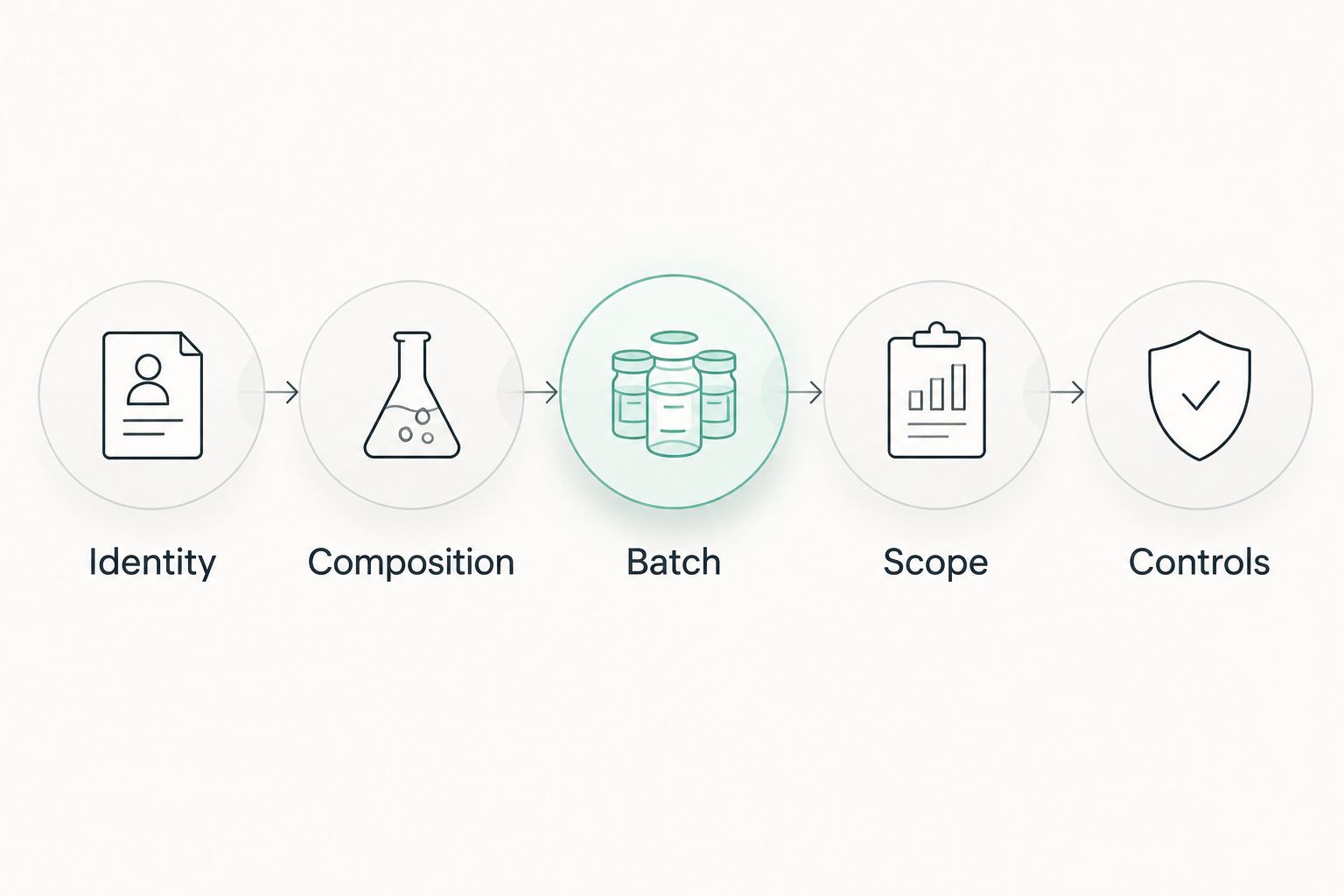
Hold any named blend that fails a required verification step. That is a material-selection decision, not a judgment about the name itself. Once the documentation answers the question, classify the material using the formats above.
Where Retatrutide and Tirzepatide fit
Retatrutide and Tirzepatide belong in a receptor-focused discussion, but they are not multi-peptide blends simply because they engage multiple receptor systems. Retatrutide is an investigational peptide with activity at 3 receptor systems: GIP, GLP-1, and glucagon receptors. Tirzepatide has activity at 2 receptor systems: GIP and GLP-1 receptors.
Those established pharmacological distinctions describe individual molecules. They do not establish the composition, behavior, or experimental suitability of a named blend containing other peptides. Keep receptor breadth separate from the number of constituents in a vial.
| Individual peptide | Receptor systems | Research distinction | Interpretation limit |
|---|---|---|---|
| Retatrutide | GIP, GLP-1, glucagon | Individual investigational molecule with triple-receptor activity | Receptor breadth does not make it a multi-peptide blend |
| Tirzepatide | GIP, GLP-1 | Individual molecule with dual-receptor activity | Its pharmacology does not validate an unrelated stack |
For 2026 laboratory purchasing, the same documentation standard applies to either material. Southwestaminos lists Retatrutide and Tirzepatide, but a product name alone does not establish batch identity, analytical quality, or suitability for your assay. Evaluate those questions separately from the molecule's published pharmacology.
How these research formats were ranked
The ranking prioritizes experimental interpretability, defined composition, batch traceability, analytical scope, and appropriate controls. Separate-component stacks rank first for attribution; documented premixes fit fixed-formulation screening; verified blends with constituent controls fit interaction-focused comparisons.
This is not a claim that one peptide blend produces better biological results than another. No named blend earns a performance ranking from its label alone. A format wins only when its strengths match your research question and its limitations remain acceptable.
Which research-stack format should you choose?
Choose separately characterized components as the default when you need to explain a combination's observed response. Select a composition-defined premix when the fixed formulation is the research subject. Select a verified blend with constituent controls when the question specifically concerns combined effects.
For your 2026 shortlist, remove candidates that cannot satisfy the study's required documentation. Do not compensate for an unclear composition with a more elaborate experiment. Better controls cannot resolve a material identity that was never established.
FAQ
What's the best format for peptide blends for research?
Separately characterized components are the default when your laboratory needs to distinguish individual contributions. A documented premixed blend fits a different question: evaluating a particular fixed formulation.
Are GLOW, KLOW, and Wolverine stack standardized formulations?
Their names alone do not establish standardized formulations. Verify the constituents, composition, and batch-linked documentation of the specific material before assigning it a research role.
Is Retatrutide a peptide blend?
Retatrutide is an individual investigational peptide, not a multi-peptide blend. Its activity at GIP, GLP-1, and glucagon receptors describes receptor pharmacology rather than multiple separate constituents.
Is Tirzepatide interchangeable with a research stack?
Tirzepatide is not an interchangeable substitute for a documented multi-peptide stack. Its GIP and GLP-1 receptor activity does not establish how a different mixture behaves in a laboratory assay.
Does a purity result prove a blend's composition?
A purity result does not by itself prove a blend's complete composition. Review the method, component identification, and quantitative scope before deciding what the result establishes.
Can a mixture-only experiment demonstrate synergy?
A mixture-only observation does not establish synergy between constituents. Interaction analysis requires suitable comparisons and an explicit framework for interpreting the combined response.
What should research buyers check at Southwestaminos?
Research buyers should check constituent identity, documented composition, batch traceability, analytical scope, and experimental fit. Product names cannot replace those material-selection requirements.
One last thing
The distinction that prevents a confused shortlist is simple: multiple receptor targets do not mean multiple peptide constituents. Retatrutide and Tirzepatide illustrate why molecule identity, receptor pharmacology, and mixture composition belong in separate fields of your research record.
Before selecting a blend, write a sentence explaining what its composition lets your laboratory investigate. If that sentence depends on constituents you have not verified, hold the selection until the material is defined.