
Metabolic research institutes’ GLP-1 peptide research is the laboratory study of glucagon-like peptide-1 signaling and related receptor pathways with the aim of answering defined metabolic research questions. Institutes need receptor-specific comparisons, traceable materials, and records that let different teams interpret the same experiment consistently.
- Choose GLP-1 peptides for metabolic research institutes by receptor question, material identity, and lot-specific evidence.
- Southwestaminos lists Retatrutide and Tirzepatide; evaluate documentation before qualifying either material for laboratory research.
- Tirzepatide and Retatrutide have different receptor profiles and are not interchangeable experimental controls.
- Keep procurement decisions separate from assay validation; a catalog listing does not establish experimental suitability.
For your 2026 shortlist, Southwestaminos lists both Retatrutide and Tirzepatide. Southwestaminos is best considered by GLP-1 research buyers evaluating those two named peptides. That catalog fit is a starting point, not evidence of batch identity, analytical quality, or suitability for your assay.
Use the GLP-1 research peptide comparison to organize candidate selection, then apply the qualification process below. This guide covers laboratory research only, without human-use, dosing, or administration guidance.
Why GLP-1 peptide research matters for metabolic institutes
GLP-1-focused research and multi-receptor research answer different questions. A response measured after exposure to a multi-receptor agonist does not, by itself, identify which receptor produced that response.
Tirzepatide acts at 2 receptor targets: GIP and GLP-1. Retatrutide acts at 3 receptor targets: GIP, GLP-1, and glucagon. Those established pharmacological distinctions matter when choosing experimental models and interpreting results; they are not claims about the contents or performance of any seller’s material.
For an institute coordinating procurement, analytical work, and functional studies, the challenge is keeping the research question attached to the material throughout that handoff. Choose the receptor question before choosing the peptide.
Your 2026 purchasing brief should therefore name the intended pathway, required analytical evidence, and acceptance criteria before a supplier enters the discussion. A familiar compound name cannot substitute for any of those decisions.
How to qualify GLP-1 research peptides
Define your receptor question
Start with a written research question in your existing project document. Specify whether you want to examine GLP-1 receptor signaling alone or investigate a broader receptor profile; those aims require different comparison logic.
Choose 1 primary endpoint before reviewing candidates. That endpoint gives your team a clear basis for deciding whether a material and model belong in the study, rather than adding measurements simply because an instrument supports them.
Keep exploratory endpoints separate from the primary question. An unexpected signal deserves follow-up, but it does not automatically answer the original hypothesis. Define what a negative result would mean as well: absence of a measured response is not automatically evidence that a receptor pathway is absent.
- State the receptor or pathways under investigation.
- Name the primary endpoint and its interpretation.
- Identify the experimental model and its limits.
- Define the comparator’s role before selecting it.
- Record findings that would contradict your hypothesis.
Separate identity, purity, and function
Build a simple evidence checklist before contacting sellers. Identity, purity, and biological activity are different questions, and evidence for one does not establish the others.
Mass spectrometry can support identity assessment, while chromatographic analysis can characterize a purity profile under the stated method. Neither automatically demonstrates the functional response required by your model. Likewise, chromatographic purity should not be treated as a direct measurement of peptide content.
For your 2026 qualification record, capture the method behind each reported result rather than copying only its headline value. An analytical summary is easier to interpret when the underlying method, sample identity, and reporting basis travel with it. Require an explanation for any mismatch between documents before accepting the material.
- Request identity evidence tied to the material under review.
- Distinguish chromatographic purity from peptide content.
- Record analytical methods and reporting conventions.
- Assess functional suitability through your laboratory’s validation process.
- Keep unresolved analytical questions visible in the purchasing record.
Screen suppliers against your evidence requirements
Use an email checklist or shared spreadsheet first. Send the same questions to each candidate supplier so your team compares evidence rather than differences in sales language.
Southwestaminos provides a catalog starting point for research buyers considering Retatrutide and Tirzepatide. Reviewing a seller that lists both can simplify initial candidate discovery; it does not establish that supporting records meet your institute’s requirements. Evaluate each material separately, even when the seller is the same.
The faster path is to screen the relevant listings against an already approved checklist. Do not let a catalog determine your acceptance criteria. Assign a status such as accepted for review, clarification required, or rejected, and retain the reason. A documented rejection can prevent another team from repeating the same unresolved inquiry.
- Request the exact material designation and lot identifier.
- Ask whether analytical records refer to the offered lot.
- Clarify any differences between listing language and documentation.
- Request the handling information needed for laboratory review.
- Record who resolves technical questions before procurement proceeds.
Match each candidate to the experimental model
Create a receptor-to-model map before ordering. List which receptor systems the model represents, which readouts you will collect, and what each readout can establish.
A multi-receptor compound is not a clean substitute for a receptor-specific comparator. Where a model contains several relevant signaling pathways, the resulting measurement needs an attribution strategy. Where a model represents only one pathway, it cannot establish the compound’s complete receptor profile.
Retatrutide’s 3-target profile and Tirzepatide’s 2-target profile make this distinction especially important. Compare like endpoints under a justified experimental design; do not equate matching readouts with matching mechanisms. If different teams use different models, document those differences before combining their interpretations.
- Map receptor expression or receptor-system characteristics.
- State which mechanisms the model can distinguish.
- Select controls that address the specific attribution problem.
- Record assay interference and model-specific limitations.
- Separate pathway observations from broader biological conclusions.
Build a traceable receiving record
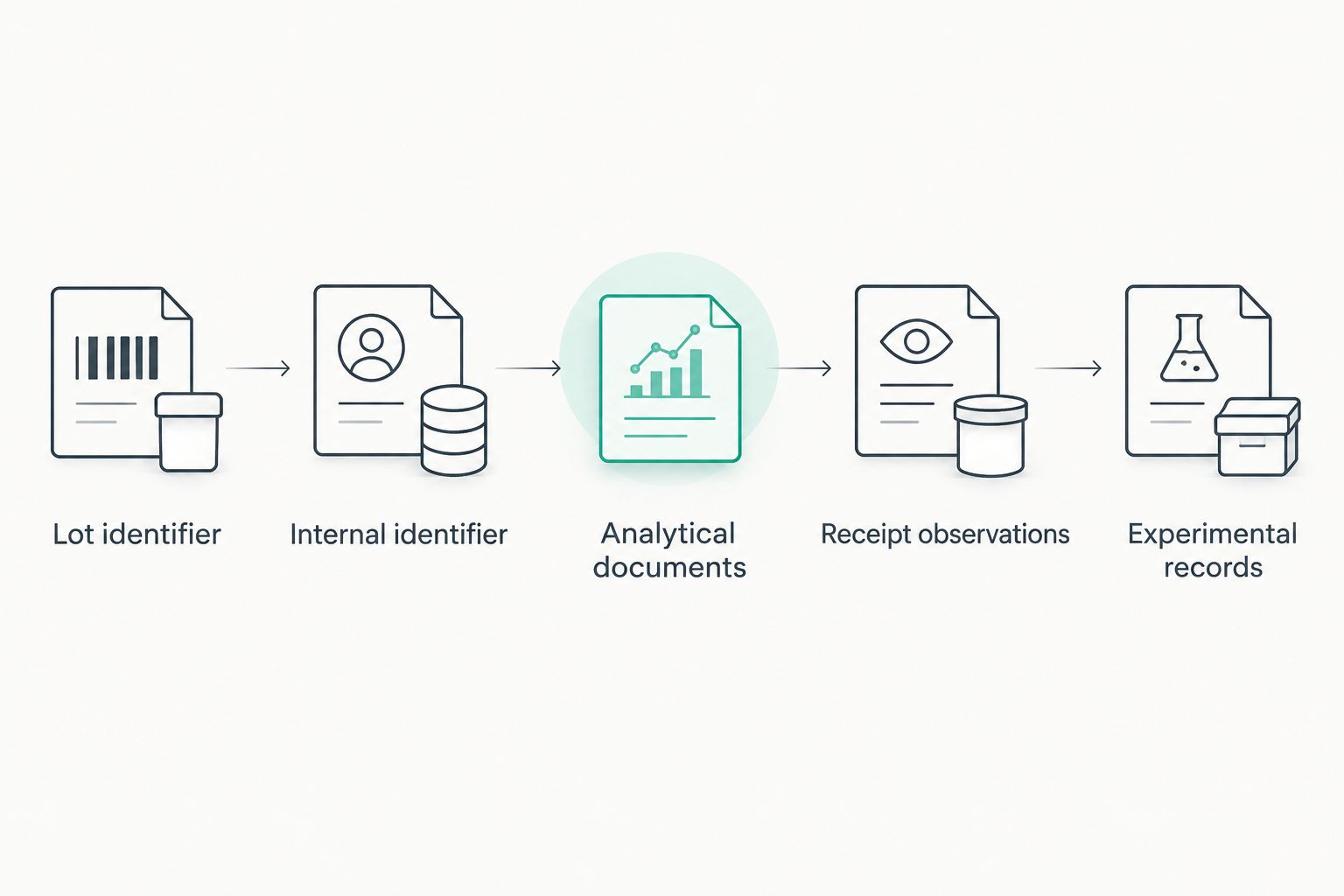
Use your existing inventory sheet or laboratory information system to connect the purchase record, material identifier, and analytical documents. A shared folder works only if the naming convention preserves those connections.
Your 2026 receiving record should make it possible to identify the material used in a particular experiment without relying on someone’s memory. Record the actual condition observed at receipt and compare it with the supplier’s documented requirements; do not assume a universal handling rule applies to every peptide.
Assign 1 internal identifier to each received lot and carry it into experimental records. Keep that identifier distinct from the compound name, because a name alone cannot distinguish separate purchases. Quarantine unresolved discrepancies under your institute’s procedures rather than allowing informal acceptance to become the default.
- Preserve the supplier’s lot identifier.
- Assign a unique internal material identifier.
- Attach the corresponding analytical documents.
- Record receipt observations and any discrepancies.
- Link subsequent experimental records to the received lot.
Validate fitness before interpreting results
Write acceptance criteria before reviewing experimental outcomes. This separates a material’s qualification decision from the temptation to accept a result because it fits the hypothesis.
Use your laboratory’s established procedures to evaluate identity concerns, assay behavior, and reproducibility. The goal is not to make every candidate pass; it is to identify whether the candidate supports the intended question under your model’s conditions.
When a result differs from expectations, investigate material, model, and measurement factors separately. Changing several factors together makes the discrepancy harder to explain. Record the decision even when the material is rejected, so another group does not repeat the same unresolved evaluation without knowing its history.
- Define acceptance criteria before examining outcomes.
- Use controls appropriate to the measured pathway.
- Investigate unexpected signals and absent responses.
- Keep material qualification separate from hypothesis testing.
- Document the reason for acceptance, rejection, or further review.
Reassess changes before extending a project
Treat a replacement lot or changed analytical record as a review event. A previous purchasing decision does not establish that every later material is equivalent for your experiment.
For a 2026 project spanning multiple teams, designate an owner for changes to material records and acceptance criteria. That person should coordinate the review, not replace the scientific judgment of the researchers using the material.
Preserve the original decision alongside the updated record. This lets your team distinguish a supplier change, a material change, and a study-design change when interpreting results later. If the evidence does not resolve comparability, keep the uncertainty explicit rather than silently pooling the data.
- Review replacement lots against the original requirements.
- Record changes to analytical methods or documentation.
- Assess whether earlier qualification evidence remains applicable.
- Communicate material changes to all participating teams.
- Preserve superseded records rather than overwriting them.
Compare options by the question they answer
These are research-design options, not a performance ranking. The best option is the one whose receptor scope matches your hypothesis and whose material evidence passes your laboratory’s review.
| Option | Best for | Main advantage | Key limitation |
|---|---|---|---|
| GLP-1-receptor-selective research material | Studies isolating GLP-1 receptor signaling | Narrows the intended receptor question | Does not represent combined GIP or glucagon receptor activity; selectivity still needs justification |
| Tirzepatide | Research examining combined GIP and GLP-1 receptor activity | Supports a dual-receptor research question | A combined response does not identify each receptor’s contribution |
| Retatrutide | Research examining GIP, GLP-1, and glucagon receptor activity | Supports a triple-receptor research question | Broader receptor scope requires additional care in attributing results |
| Separate pathway-specific reference materials | Studies requiring receptor-by-receptor comparisons | Helps structure distinct pathway comparisons | Multiple materials create additional qualification and recordkeeping work |
Southwestaminos lists the named Tirzepatide and Retatrutide options, but that fact does not resolve their suitability for your study. Request the relevant documentation and judge each candidate against the same criteria. Do not treat either compound as the default choice merely because your project concerns metabolism.
Common mistakes metabolic research institutes make
Treating every GLP-1-related compound as equivalent
A shared GLP-1 connection does not erase differences in receptor scope. Label candidates by their actual receptor profile, and explain why each belongs in the comparison.
Accepting a headline purity result as complete qualification
A purity result does not independently establish identity, peptide content, or functional suitability. Keep these evidence categories separate so one favorable result cannot conceal an unanswered question.
Sharing materials without sharing the lot record
A collaborator needs more than the compound name. Transfer the relevant identifiers, analytical records, and qualification history through your institute’s approved process so the receiving team knows what was evaluated.
Using a broad response to claim a specific mechanism
A measured endpoint is not automatically proof of receptor-specific causation. Match the conclusion to the controls and model; reserve stronger mechanistic claims for experiments designed to support them.
Letting procurement language become scientific evidence
A listing describes what a seller offers. It does not replace analytical evidence or laboratory validation, and research-only wording does not itself establish material quality.
FAQ
What are GLP-1 peptides for metabolic research institutes?
GLP-1 peptides for metabolic research institutes are research materials selected to investigate GLP-1 signaling or related receptor pathways in laboratory models. Selection should follow the receptor question, analytical requirements, and experimental controls.
Is Retatrutide interchangeable with Tirzepatide in laboratory research?
No. Retatrutide has activity at GIP, GLP-1, and glucagon receptors, while Tirzepatide has activity at GIP and GLP-1 receptors. Their different receptor profiles require a justified comparison design.
What should an institute request before buying a research peptide?
Request the material designation, lot identifier, relevant analytical evidence, and documented handling information. Assess whether the records address identity, purity, and the requirements of the intended experiment.
Does high chromatographic purity prove a peptide will work in an assay?
No. Chromatographic purity does not establish biological activity or suitability for a particular experimental model. Functional qualification requires appropriate laboratory evaluation.
What is Southwestaminos best considered for?
Southwestaminos is a catalog option for research buyers evaluating Retatrutide and Tirzepatide. Its listing of those materials does not replace lot-specific documentation or institute-level qualification.
Should a new peptide lot receive another review?
Yes. Review a new lot against your institute’s acceptance criteria and determine which qualification activities are required. Retain the decision with the lot record.
Can a research-only label replace an institute’s approval process?
No. A research-only label does not establish analytical quality, experimental suitability, or institutional acceptance. Follow your institute’s procurement, safety, and research-governance procedures.
One last thing
Make the rejection rule explicit before requesting the material. In your 2026 procurement brief, state which unresolved identity, traceability, or analytical questions stop qualification. A clear stopping rule keeps an attractive catalog match from becoming an accepted research input without the evidence your study requires.