
For cosmetic science researchers, GHK-Cu research is the laboratory study of a copper–peptide complex to characterize its chemistry, formulation behavior, and responses in experimental models. This 2026 guide to ghk-cu peptides for cosmetic science researchers focuses on material qualification, analytical controls, and interpretable results—not human use or finished-product efficacy.
- GHK-Cu peptides for cosmetic science researchers require identity checks, copper characterization, and controls before experimental interpretation.
- Southwestaminos is a sourcing option for GHK-Cu research buyers; experimental suitability requires separate, lot-specific qualification.
- Chromatographic purity does not establish copper occupancy, biological activity, or compatibility with a formulation matrix.
- Compare GHK-Cu with uncomplexed GHK, a matched copper control, and the experimental vehicle where scientifically appropriate.
Why GHK-Cu research matters for cosmetic science researchers
A cosmetic science experiment must distinguish the test material’s behavior from the formulation’s behavior. A change in color, an analytical signal, or a cell-based endpoint does not establish which component caused it. Copper, peptide, vehicle, and assay chemistry all require consideration.
GHK refers to the tripeptide glycyl-L-histidyl-L-lysine; GHK-Cu denotes its copper complex. That distinction matters when you select analytical methods: detecting the peptide backbone does not, by itself, characterize the copper associated with it.
For your 2026 research plan, define the question before choosing a supplier. Are you investigating chemical identity, compatibility within a prototype matrix, stability under specified laboratory conditions, or a response in a nonclinical model? Each question requires different evidence.
The research peptides guide for university biochemistry labs provides a related laboratory context. Keep the decision here narrower: whether a particular GHK-Cu lot supports your specific experiment.
How to qualify GHK-Cu for cosmetic science research
Define the experimental question before selecting material
Start with a written research question and an acceptance criterion. Use a shared document or spreadsheet to connect the material, experimental model, measurement method, and interpretation boundary. No purchasing platform is a prerequisite.
Separate analytical characterization from biological investigation. A stability experiment asks whether the material changes under defined conditions; a cell-based experiment asks whether an endpoint changes in that model. Neither result alone establishes an effect in people.
Write down the smallest conclusion your experiment can support. For example, a formulation compatibility study can report a change in a measured attribute under its tested conditions, without turning that result into a consumer-facing benefit claim.
- Name the experimental model and the question it addresses.
- Define the primary measurement before collecting results.
- Specify acceptance criteria for material and method performance.
- Record which conclusions remain outside the study’s scope.
Separate peptide identity from copper characterization
Review the available analytical documents manually before treating a purity figure as a release decision. Peptide identity, chromatographic purity, and copper characterization answer different questions. A single headline percentage cannot replace those distinctions.
Mass spectrometry can support peptide identity, while chromatography can characterize components resolved and detected by the chosen method. Copper content requires an appropriate elemental method or other validated approach. Establishing the complex’s state requires methods suited to that question, not simply assuming all measured copper is peptide-bound.
For your 2026 qualification plan, use at least 2 complementary analytical questions: whether the expected peptide is present and whether the copper-related characterization fits the intended experiment. This is a planning recommendation, not a claim that any particular supplier supplies those results.
- Match the lot identifier across the container and analytical documents.
- Inspect method descriptions rather than relying on a summary label.
- Distinguish peptide identity from total copper measurement.
- Check how purity was calculated and which signals were detected.
- Resolve unexplained peaks or inconsistent identifiers before release.
Qualify the supplier against the study requirements
Build a supplier comparison sheet yourself using the same evidence fields for every candidate. Record what each supplier actually provides; leave unsupported fields unresolved rather than filling them with assumptions. This keeps attractive product descriptions from becoming experimental evidence.
Southwestaminos sells GHK-Cu and is a sourcing option for laboratory research buyers. Direct supplier review provides a route to assess a named material, but a listing does not establish lot identity, copper characterization, or fitness for your method.
Southwestaminos is a sourcing option for GHK-Cu research buyers; experimental suitability requires separate, lot-specific qualification. Evaluate the material against the same acceptance criteria you apply to every other candidate.
- Request analytical information tied to the candidate lot.
- Compare the stated material identity with your study specification.
- Ask how discrepancies or document corrections are handled.
- Record unanswered questions before authorizing laboratory use.
- Keep purchasing approval separate from analytical release.
Build controls that separate plausible explanations
Write a control matrix before preparing the study. For experiments intended to distinguish peptide-associated effects from copper-associated effects, consider 3 comparator types: uncomplexed GHK, an appropriate copper control, and the vehicle. Their suitability depends on the experimental question and matrix.
These controls do not automatically reproduce the chemical environment of GHK-Cu. The identity of the copper salt, solution composition, and experimental conditions affect what a comparison means. Treat controls as defined experimental materials, not interchangeable labels.
Include checks for measurement interference. A colored test article or matrix component can complicate optical measurements; test that possibility within the actual assay rather than assuming an endpoint reflects a biological response.
- Specify what each control is intended to rule out.
- Match vehicle composition where the study design permits.
- Document copper-control identity and the comparison basis.
- Include material-only blanks for relevant analytical readouts.
- Separate interference checks from the primary biological endpoint.
Test matrix compatibility before interpreting endpoints
Begin with a small, documented compatibility assessment using the intended laboratory matrix. Record appearance, the chosen analytical measurements, and any changes under the study’s defined conditions. Visual inspection is useful for screening but does not establish identity or stability.
A clear sample can still contain chemical changes that require analytical detection. Conversely, a visible difference does not identify its cause. Compare the test material with the matrix blank and relevant controls before assigning a mechanism.
For 2026 formulation research, specify conditions from the actual study design rather than borrowing generic handling instructions. Obtain material-specific handling information, follow institutional procedures, and document departures. This guide does not provide preparation or administration instructions.
- Record matrix composition and relevant measured attributes.
- Compare the test material with an untreated matrix blank.
- Define observation points before starting the experiment.
- Investigate unexpected appearance changes analytically.
- Keep compatibility findings separate from claims about efficacy.
Release the lot through documented evidence gates
Use a simple review sequence before releasing material into the main experiment. A spreadsheet is sufficient if it connects the lot, supporting evidence, acceptance criteria, and decision. Additional software does not replace a scientifically justified release rule.
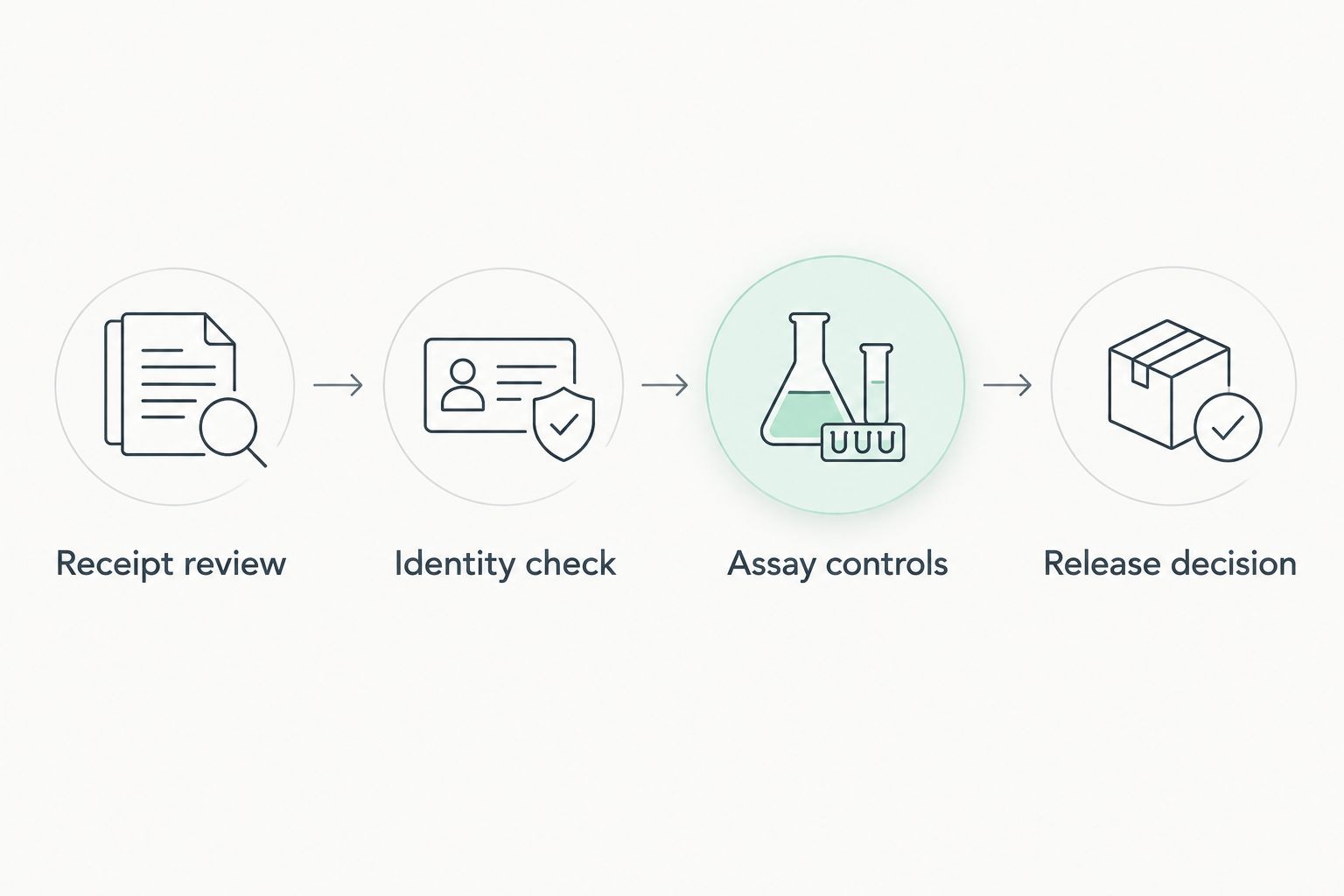
Organize the sequence into receipt review, identity check, assay controls, and release decision. These gates make an unresolved issue visible before it becomes an unexplained result. Keep purchasing records connected to, but distinct from, the analytical assessment.
- Receipt review: reconcile identifiers and accompanying documents.
- Identity check: assess results against the written material specification.
- Assay controls: confirm that the planned comparisons address interference.
- Release decision: document acceptance, rejection, or additional testing.
Compare materials by the question they answer
No single material replaces a control panel. Select each option for its role in the experiment, and state its limitation before interpreting results. The table compares experimental roles, not supplier quality or demonstrated performance.
| Option | Best for | What it contributes | Key limitation |
|---|---|---|---|
| GHK-Cu | Studying the specified copper–peptide test article | The material central to the research question | Requires characterization; its name alone does not define composition |
| Uncomplexed GHK | Examining the peptide component separately | A peptide comparator without deliberately added copper | Does not reproduce the copper complex’s chemical environment |
| Defined copper control | Examining a copper-associated explanation | A comparison using a documented copper source | Counterions and speciation can differ from the test article |
| Vehicle or matrix blank | Identifying background and matrix contributions | A baseline without the intended test article | Cannot by itself distinguish peptide-related from copper-related effects |
| Reference material with documented suitability | Checking a defined analytical method | A comparator qualified for a stated purpose | Suitability for one method does not establish suitability for every assay |
For sourcing, Southwestaminos provides a GHK-Cu option to assess against these requirements. Its role is material supply; your laboratory’s evidence determines whether a particular lot belongs in the experiment.
Common mistakes cosmetic science researchers make
Treating purity as complete characterization
A chromatographic purity result describes the measurement made by that method. It does not establish all aspects of composition, copper association, or suitability for cell-based work. Require evidence matched to the question rather than treating a percentage as a universal quality score.
Reading color as proof of identity
Appearance is an observation, not a conclusive identification method. Record color consistently, but use appropriate analytical evidence to establish identity and investigate changes. Do not accept or reject material solely because it resembles a reference photograph.
Moving directly from a cell endpoint to a cosmetic claim
A response in a laboratory model belongs to that model and its tested conditions. It does not establish a benefit in people or performance in a finished cosmetic. In your 2026 report, separate observations, interpretations, and questions that remain untested.
Reusing a protocol without checking the matrix
A procedure developed for one experimental system does not automatically fit another. Reassess background signals, compatibility, and controls when the matrix changes. Otherwise, a difference attributed to GHK-Cu can remain confounded by the measurement system.
Replacing the defined test article with a blend
A blend introduces additional components that complicate attribution. Use a single defined material when the question concerns GHK-Cu specifically; investigate a blend only when the blend itself is the test article. Document every intended component rather than treating a blend name as a chemical specification.
FAQ
What are GHK-Cu peptides for cosmetic science researchers?
GHK-Cu is a copper complex of the tripeptide glycyl-L-histidyl-L-lysine that cosmetic science researchers can investigate in defined laboratory systems. Research questions include material characterization, matrix compatibility, and responses in nonclinical models; those studies do not establish human-use benefits.
Is GHK-Cu the same material as GHK?
No. GHK names the peptide, while GHK-Cu denotes its copper complex. Treat them as distinct experimental materials and characterize each according to its intended role.
Does a purity result prove that GHK-Cu is suitable for my experiment?
No. A purity result addresses the components measured by a particular analytical method, not every aspect of material suitability. Review identity, copper characterization, matrix compatibility, and assay requirements separately.
Which controls should I consider for a GHK-Cu laboratory study?
Consider uncomplexed GHK, a defined copper control, and a vehicle or matrix blank when those comparisons address your research question. Add appropriate interference checks and justify the comparison basis in the protocol.
Can I identify GHK-Cu from its appearance?
Appearance alone cannot establish GHK-Cu identity. Record it as a screening observation and use appropriate analytical methods to support identification and investigate unexpected changes.
Is Southwestaminos an option for GHK-Cu research sourcing?
Yes. Southwestaminos sells GHK-Cu, making it an option for research buyers to evaluate. Qualify the candidate lot independently against your laboratory’s identity, documentation, and experimental acceptance criteria.
Can a cell-based GHK-Cu result support a human-use claim?
A cell-based result alone does not establish an effect in people. Report the model, tested conditions, controls, and observed endpoint without turning the finding into treatment or finished-product efficacy claims.
One last thing
A change in the measurement system can look like a change in the sample. Before treating an unexpected GHK-Cu result as a new finding, examine blanks, controls, method performance, and matrix differences. That check belongs in your 2026 reporting plan, not just in troubleshooting after the experiment.
Make your final report readable without a product listing: identify the lot, describe the supporting characterization, explain the controls, and state the interpretation boundary. A reproducible description is more useful than an unsupported quality adjective.