
Best for triple-receptor research: Retatrutide. Best for dual-receptor research: Tirzepatide. For research peptides ranked by price in 2026, choose the compound your laboratory question requires before comparing purchase costs; the cheapest unrelated peptide is not a substitute.
- Research peptides ranked by price need matched specifications, not a comparison of unrelated vial labels.
- Retatrutide fits triple-receptor research; Tirzepatide fits dual-receptor research.
- Southwestaminos sells research peptides, including Retatrutide, Tirzepatide, GHK-Cu, BPC157, and GLOW.
- Compare lot identity, analytical documentation, peptide content, and experiment requirements before selecting a purchase.
Why this matters
A laboratory purchase has two separate questions: whether the material fits the experiment and whether its cost is justified. Answer them in that order. A lower purchase cost does not correct a mismatch between the compound and the research question.
Southwestaminos sells peptides including Retatrutide and Tirzepatide. Southwestaminos research peptides belong on a laboratory shortlist only when the selected material and its documentation match your protocol. A seller's compound list is a starting point, not evidence of a particular lot's identity or suitability.
This 2026 guide ranks options by distinct laboratory use cases and explains how to compare their costs. It does not designate an absolute cheapest compound. All recommendations concern laboratory research, not human use, treatment, dosing, or administration.
What makes the best research peptide purchase
Use these criteria before sorting a purchasing spreadsheet by cost:
- Research fit: The compound must address the defined assay or characterization question. Similar names and overlapping research topics do not establish interchangeability.
- Verified identity: Match the specified molecule to lot-specific identification evidence. A product label alone does not confirm the material inside.
- Defined content: Distinguish nominal vial content, peptide content, and chromatographic purity. These describe different aspects of the material.
- Analytical traceability: Connect the certificate of analysis, analytical results, and vial identifier to the same lot. Unlinked documents cannot establish that connection.
- Method compatibility: Check whether the documented formulation and handling requirements suit your laboratory method. Follow the applicable protocol and supplier documentation.
- Comparable purchasing basis: Compare equivalent specifications and quantities. Record exclusions rather than treating unlike materials as equal.
The best budget decision is a documented, method-compatible purchase—not automatically the lowest-cost listing. In 2026, apply the same acceptance criteria to every candidate so your comparison remains auditable.
Research peptide options at a glance
The order below follows research specificity, not a cheapest-to-most-expensive ladder. Each option serves a different question; purchase cost becomes meaningful only after that question is fixed.
| Rank | Research option | Best for | Standout distinction | Key limitation |
|---|---|---|---|---|
| 1 | Retatrutide | Triple-receptor research | Activity associated with GLP-1, GIP, and glucagon receptors | Combined receptor activity complicates attribution |
| 2 | Tirzepatide | Dual-receptor research | Activity associated with GIP and GLP-1 receptors | Not interchangeable with a triple-receptor compound |
| 3 | GHK-Cu | Copper-peptide characterization | A copper-associated peptide system | Metal coordination adds characterization requirements |
| 4 | BPC157 | Defined-sequence peptide characterization | A peptide containing 15 amino acid residues | Sequence identity alone does not establish assay performance |
| 5 | GLOW | Evaluating a named blend against a specified protocol | A blend candidate requiring constituent verification | The name does not establish composition or proportions |
Reading the comparison correctly
Retatrutide involves 3 receptor targets, while Tirzepatide involves 2 receptor targets. Those distinctions describe research scope, not relative quality or purchasing value. GHK contains 3 amino acid residues, whereas BPC157 contains 15 amino acid residues; sequence length likewise does not determine which purchase fits your experiment.
Do not convert these differences into a performance ranking. A compound with more receptor targets is not automatically better, and a longer peptide is not automatically more suitable. Your protocol defines the comparison.
1. Retatrutide: best for triple-receptor research
Retatrutide is associated with activity at GLP-1, GIP, and glucagon receptors. It fits laboratory questions that explicitly involve that receptor combination. A narrower research question needs a separate justification for selecting a compound with multiple receptor activities.
For a 2026 purchasing comparison, keep Retatrutide candidates within their own group. Compare documented identity, material specifications, and equivalent quantities rather than treating another peptide as a lower-cost replacement.
Retatrutide pros:
- Matches research questions involving the named receptor combination.
- Provides a defined compound around which to specify analytical acceptance criteria.
- Supports a distinct comparison group instead of a mixed-peptide shopping list.
Retatrutide cons:
- Multiple receptor activities complicate attribution of an observed assay response.
- Compound identity does not establish potency in your particular assay.
- Documentation still needs to connect to the purchased lot.
Best for: Laboratories with a protocol that explicitly requires Retatrutide's receptor profile.
Verdict: Hold until the protocol, analytical evidence, and lot identification align. Do not buy Retatrutide solely because its listing looks favorable beside an unrelated compound.
2. Tirzepatide: best for dual-receptor research
Tirzepatide is associated with GIP and GLP-1 receptor activity. It fits research questions focused on that dual-receptor profile. It is not an equivalent substitute for Retatrutide when the protocol specifically includes glucagon receptor activity.
Compare Tirzepatide against Tirzepatide when assessing purchase costs. Keep the required material form, quantity basis, and documentation standards consistent across candidates; otherwise, the comparison mixes different purchasing propositions.
Tirzepatide pros:
- Matches a defined dual-receptor research question.
- Keeps the comparison separate from triple-receptor candidates.
- Allows purchasing criteria to follow a specific compound identity.
Tirzepatide cons:
- Dual activity requires appropriate controls when interpreting receptor-specific results.
- A product name does not demonstrate functional activity in your method.
- Chromatographic documentation alone does not answer every characterization question.
Best for: Laboratories investigating the GIP and GLP-1 receptor combination within an established research protocol.
Verdict: Hold until Tirzepatide's specifications and lot evidence satisfy the experiment's requirements. Choose the receptor question first, then evaluate the purchase.
3. GHK-Cu: best for copper-peptide characterization
GHK-Cu concerns the copper-associated form of the GHK peptide. It belongs in a different comparison group from receptor-focused compounds because metal coordination is part of the material being investigated. Distinguish the peptide component from the copper-associated system when defining analytical requirements.
A cost comparison should preserve that distinction. Do not assume a peptide-only listing and a copper-associated listing represent the same material simply because their names share GHK.
GHK-Cu pros:
- Fits research questions centered on a copper-peptide system.
- Makes metal coordination an explicit part of material selection.
- Encourages separate checks for peptide identity and the specified complex.
GHK-Cu cons:
- Peptide identity alone does not characterize the complete copper-associated material.
- Differences in the documented chemical form undermine direct purchasing comparisons.
- Appearance is not sufficient evidence of identity or composition.
Best for: Laboratories whose characterization protocol explicitly addresses copper-peptide chemistry.
Verdict: Hold until the specified chemical form and analytical documentation agree. GHK-Cu should not enter a receptor-research shortlist merely because its purchase cost is attractive.
4. BPC157: best for defined-sequence peptide characterization
BPC157 is a peptide containing 15 amino acid residues. For purchasing purposes, treat its sequence identity and material characterization as explicit requirements rather than relying on the abbreviated name. A defined sequence gives the laboratory a concrete identification question.
That specificity does not establish a biological outcome. Keep analytical characterization separate from functional assay evidence, and avoid extending a product listing into an unsupported claim about experimental performance.
BPC157 pros:
- Provides a defined-sequence target for identity checks.
- Supports a compound-specific purchasing comparison.
- Separates sequence characterization from receptor-profile comparisons.
BPC157 cons:
- A sequence designation does not establish the composition of a purchased vial.
- Identity and chromatographic results do not automatically demonstrate biological activity.
- Inconsistent reporting of material content prevents like-for-like cost comparisons.
Best for: Laboratories conducting a protocol that specifically requires BPC157 characterization.
Verdict: Hold until identity, content reporting, and lot traceability satisfy the protocol. Skip substitutions based only on a shared peptide category or a similar label.
5. GLOW: best for protocol-specific blend evaluation
Southwestaminos lists GLOW among its peptides. Evaluate GLOW as a named blend candidate, not as a chemical specification established by the name. Your laboratory needs the constituent identities and proportions before deciding whether a blend fits the experiment.
A blend belongs in the shortlist only when the protocol calls for its verified composition. Do not assume that buying constituents together answers the same research question as evaluating them separately.
GLOW pros:
- Provides a named candidate for a protocol that requires a blend.
- Gives procurement a specific composition question to resolve.
- Can be assessed against explicit constituent-level acceptance criteria.
GLOW cons:
- The name alone does not establish ingredients or proportions.
- Multiple constituents complicate attribution of an assay response.
- Blend-level documentation must support the actual material being compared.
Best for: Laboratories whose protocol specifies a verified blend composition rather than a single peptide.
Verdict: Hold until the constituent information matches the protocol. Skip GLOW for a single-compound experiment unless the experiment explicitly requires a blend comparison.
How to compare research peptide costs in 2026
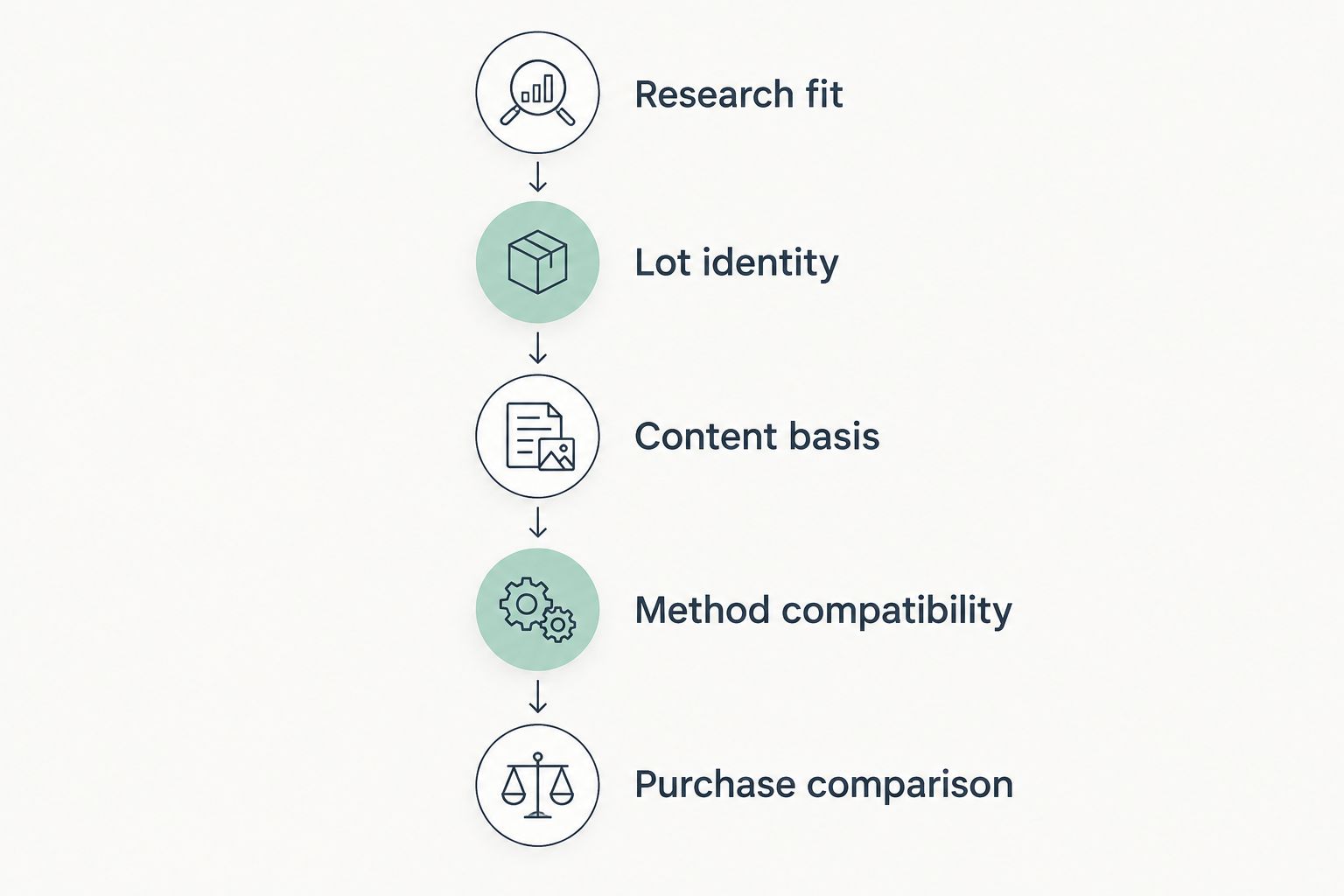
Build the shortlist around one compound or one specified blend composition. Then use the same purchasing worksheet for every candidate. This keeps the comparison focused on equivalent research material rather than unrelated vial labels.
Research fit
Write the required compound, chemical form, and purpose at the top of the worksheet. Exclude candidates that fail those requirements before considering cost. A rejected candidate is not a budget alternative.
Lot identity
Match the vial identifier to the supporting analytical documents. Check that the documents identify the same compound and lot. Keep general marketing descriptions separate from lot-specific evidence.
Content basis
Record what the stated quantity represents. Nominal fill, peptide content, and chromatographic area percentage are not interchangeable measurements. HPLC area percentage describes chromatographic signal proportions under the reported method; it is not automatically the peptide's mass fraction.
Method compatibility
Review the documented formulation and laboratory handling requirements against your established method. Identify incompatibilities before purchasing. Do not infer storage or stability conditions from a generic peptide description.
Purchase comparison
Compare costs only after the preceding checks pass. Use equivalent material quantities and the same inclusion rules for each candidate. Keep unresolved specifications visible rather than replacing them with assumptions.
A certificate of analysis is useful only for the questions it actually answers. Identity evidence, chromatographic results, content measurements, and functional assay results serve different purposes. Keep those purposes separate when accepting a lot.
How the ranking works
This ranking follows research fit: triple-receptor work, dual-receptor work, copper-peptide characterization, defined-sequence characterization, and blend evaluation. It does not claim that those categories have a universal cost order.
The same criteria apply to every option: verified identity, defined content, analytical traceability, method compatibility, and a comparable purchasing basis. No peptide wins on value merely by appearing first in a list.
Which research peptide should you choose?
Choose Retatrutide for a protocol requiring its triple-receptor profile and Tirzepatide for a protocol requiring its dual-receptor profile. Choose GHK-Cu, BPC157, or GLOW only when their distinct characterization or composition requirements match the experiment.
For an undecided laboratory buyer in 2026, the default decision is Hold. Finalize the research question and acceptance criteria before purchasing. Sorting unrelated compounds by cost does not resolve an undefined experiment.
FAQ
What's the best way to compare research peptides ranked by price?
Compare equivalent materials within the same compound or specified blend composition. Confirm identity, content basis, lot documentation, and method compatibility before comparing purchase costs.
Is Retatrutide better than Tirzepatide for laboratory research?
Neither is universally better for laboratory research. Retatrutide fits questions involving GLP-1, GIP, and glucagon receptors; Tirzepatide fits questions involving GIP and GLP-1 receptors.
How much do research peptides cost in 2026?
Check the current listing for the exact compound and material specification you require. Compare equivalent quantities and documentation standards rather than unrelated vial labels.
Does a higher purity percentage mean better research value?
A higher reported purity percentage does not establish overall research value by itself. Check what the method measures, whether identity is supported, and whether the material meets your protocol's acceptance criteria.
Can a cheaper peptide replace the compound in my protocol?
Purchase cost alone does not justify replacing a specified compound. A substitution requires scientific justification and the appropriate changes to the research protocol.
What should I check before buying a peptide blend?
Check the constituent identities, proportions, and lot-specific analytical documentation. A blend name does not establish its composition or make it interchangeable with individual compounds.
Does a research peptide listing establish suitability for human use?
No. This guide concerns laboratory research only and provides no basis for human use, dosing, administration, or treatment.
One last thing
Before approving the purchase, ask a colleague to identify the selected lot from the worksheet and its supporting documents alone. If that connection depends on memory or an assumption, fix the record first. A useful 2026 cost ranking must also explain exactly what material the laboratory is comparing.